Coura Fernanda Morcatti, Freitas Moisés Dias, Ribeiro Juliane, de Leme Raquel Arruda, de Souza Cecília, Alfieri Amauri Alcindo, Facury Filho Elias Jorge, de Carvalho Antônio Último, Silva Marcos Xavier, Lage Andrey Pereira, Heinemann Marcos Bryan
Departamento de Medicina Veterinária Preventiva, Escola de Veterinária, Universidade Federal de Minas Gerais, Av. Antônio Carlos, 6627, Belo Horizonte, Minas Gerais, 31270-010, Brazil.
Trop Anim Health Prod. 2015 Jan;47(1):3-11. doi: 10.1007/s11250-014-0675-5. Epub 2014 Oct 14.
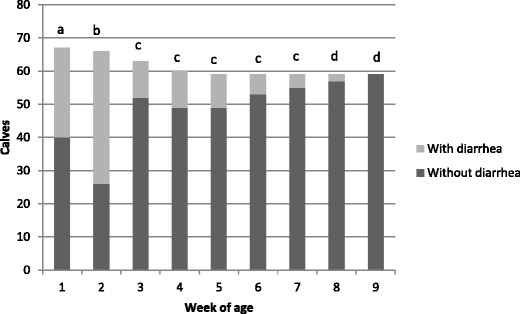
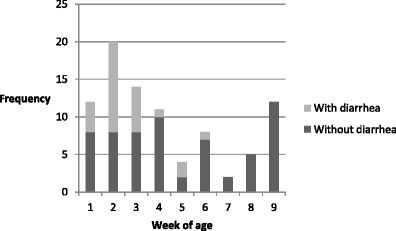
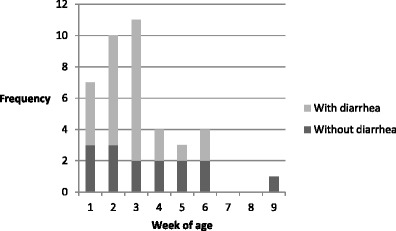
This prospective longitudinal study investigated the epidemiology of enteric disease associated with infections in calves aging up to 70 days. A total of 850 fecal samples were collected from 67 calves. Seventeen isolates of Salmonella spp. were recovered from feces of 11 calves (16.4%), and statistical analysis revealed no association between the presence of Salmonella spp. and clinical signs of diarrhea or age. Virulence factors of Escherichia coli were identified in 103 strains: eae (7), K99/STa (7), Stx1 (7), Stx1/eae (36), Stx1/Stx2/eae (2), Stx2 (43), and Stx2/eae (1). There was statistical association between diarrheic animals carrying E. coli Stx1/eae (+) in their feces at 2 and 4 weeks of age (P = 0.003) and E. coli Stx2 (+) at 5 weeks of age (P = 0.03). Rotavirus was detected in 49 (5.76%) fecal samples collected from 33 calves (49.2%). The presence of rotavirus was correlated with diarrheic feces (P < 0.0001) rather than feces with normal consistency. There was a significant relationship between age group and diarrhea (P = 0.001). Bovine coronavirus (BCoV) was detected in 93 fecal samples collected from 46 calves (68.6%). There was an association (P < 0.0001) between diarrheic animals positive for BCoV and age groups. The results demonstrate the importance of the pathogens studied in the etiology of diarrhea in calves.
这项前瞻性纵向研究调查了70日龄以内犊牛感染相关肠道疾病的流行病学情况。共从67头犊牛采集了850份粪便样本。从11头犊牛(16.4%)的粪便中分离出17株沙门氏菌,统计分析表明沙门氏菌的存在与腹泻临床症状或年龄之间无关联。在103株大肠杆菌中鉴定出毒力因子:eae(7株)、K99/STa(7株)、Stx1(7株)、Stx1/eae(36株)、Stx1/Stx2/eae(2株)、Stx2(43株)和Stx2/eae(1株)。2周龄和4周龄粪便中携带大肠杆菌Stx1/eae(+)的腹泻动物(P = 0.003)以及5周龄携带大肠杆菌Stx2(+)的腹泻动物之间存在统计学关联(P = 0.03)。在从33头犊牛(49.2%)采集的49份(5.76%)粪便样本中检测到轮状病毒。轮状病毒的存在与腹泻粪便相关(P < 0.0001),而非与正常质地的粪便相关。年龄组与腹泻之间存在显著关系(P = 0.001)。在从46头犊牛(68.6%)采集的93份粪便样本中检测到牛冠状病毒(BCoV)。BCoV阳性的腹泻动物与年龄组之间存在关联(P < 0.0001)。结果表明所研究的病原体在犊牛腹泻病因学中的重要性。