Department of EndocrinologyMetabolism and Diabetology, Karolinska University Hospital, 171 76 Stockholm, SwedenDepartment of Molecular Medicine and SurgeryKarolinska Institute, Stockholm, Sweden Department of EndocrinologyMetabolism and Diabetology, Karolinska University Hospital, 171 76 Stockholm, SwedenDepartment of Molecular Medicine and SurgeryKarolinska Institute, Stockholm, Sweden
Department of EndocrinologyMetabolism and Diabetology, Karolinska University Hospital, 171 76 Stockholm, SwedenDepartment of Molecular Medicine and SurgeryKarolinska Institute, Stockholm, Sweden.
Endocr Connect. 2014 Dec;3(4):200-6. doi: 10.1530/EC-14-0098. Epub 2014 Oct 13.
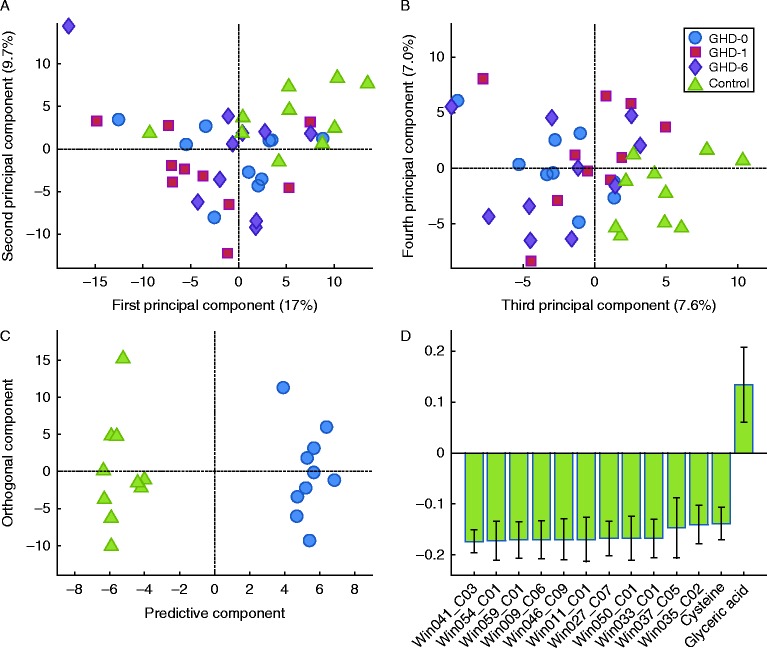
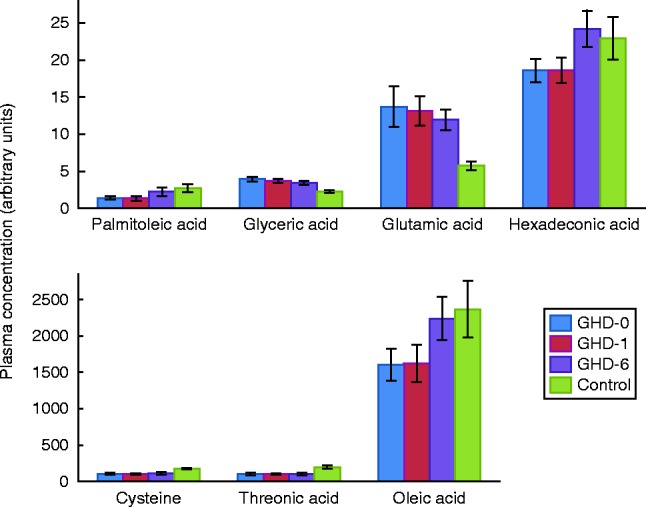
The diagnostic value of insulin-like growth factor 1 (IGF1) for GH deficiency (GHD) in adults is not optimal. Molecular profiling could be used for biomarker discovery. The aim of this pilot study was to compare the serum metabolome between GHD patients and healthy controls, and identification of potential markers for diagnosis and/or for individual GH dosing. A total of ten patients with GHD, median age of 55 years and BMI of 27 kg/m(2), were compared with ten healthy age- and gender-matched controls. The serum metabolic profiles were generated using gas chromatography-coupled mass spectroscopy on fasting samples taken in the morning from the controls and at baseline and during 6 months of GH replacement in the patients with GHD. The difference in low-molecular weight compounds (LMC) distinguished the healthy controls from GHD patients. Among 285 measured metabolites, 13 were identified as being most important in differentiating GHD patients from controls. Of these, 11 could not be structurally annotated but many were classified as lipids. The difference in the LMC pattern persisted despite normalisation of IGF1 following GH replacement. GH replacement increased the levels of specific fatty acid compounds and decreased the levels of certain amino acids. No metabolite changed in response to GH treatment, to the same extent as IGF1. The measurement of 285 metabolites resulted in a unique pattern in GHD, but changes in the metabolite patterns during GH treatment were limited. The utility of metabolomics to find new markers in GHD and GH replacement remains to be further elucidated.
胰岛素样生长因子 1(IGF1)对成人生长激素缺乏症(GHD)的诊断价值并不理想。分子谱分析可用于生物标志物的发现。本研究旨在比较 GHD 患者和健康对照者的血清代谢组,并鉴定潜在的诊断和/或个体化 GH 剂量标志物。共纳入 10 例 GHD 患者(中位年龄 55 岁,BMI 为 27kg/m2)和 10 例年龄和性别匹配的健康对照者。使用气相色谱-质谱联用技术在空腹状态下采集对照组和 GHD 患者基线及 GH 替代治疗 6 个月时的清晨血清样本,以检测血清代谢谱。小分子化合物(LMC)的差异可区分健康对照组和 GHD 患者。在检测到的 285 种代谢物中,有 13 种在区分 GHD 患者和对照组方面最为重要。其中 11 种不能进行结构注释,但很多被归类为脂质。尽管 IGF1 在 GH 替代治疗后得到了正常化,但 LMC 模式的差异仍然存在。GH 替代治疗增加了特定脂肪酸化合物的水平,降低了某些氨基酸的水平。没有代谢物像 IGF1 一样,在 GH 治疗下发生同等程度的变化。尽管对 285 种代谢物进行了测量,但 GHD 仍呈现出独特的代谢谱,而 GH 治疗期间代谢谱的变化有限。代谢组学在发现 GHD 和 GH 替代治疗中的新标志物方面的应用仍有待进一步阐明。