Department of Internal Medicine, University of Iowa, Iowa City, Iowa, USA.
Department of Anatomy and Cell Biology, University of Iowa, Iowa City, Iowa, USA.
Mol Ther Nucleic Acids. 2014 Oct 14;3(10):e202. doi: 10.1038/mtna.2014.50.
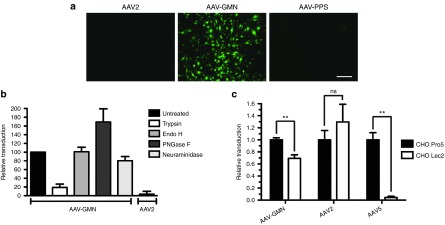
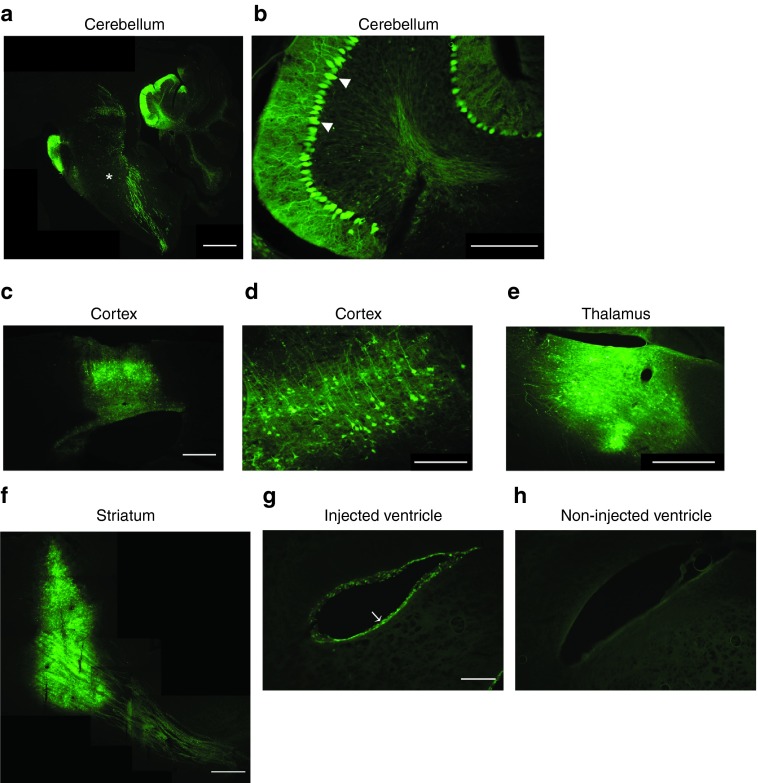
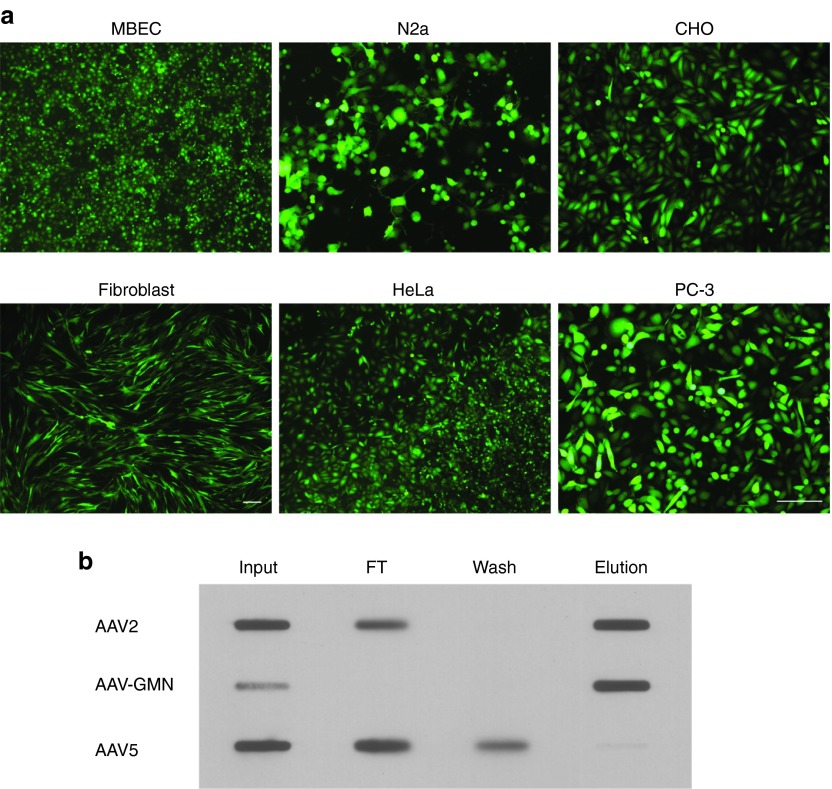
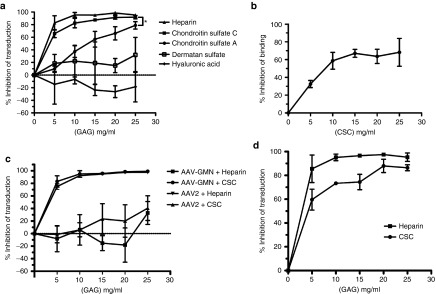
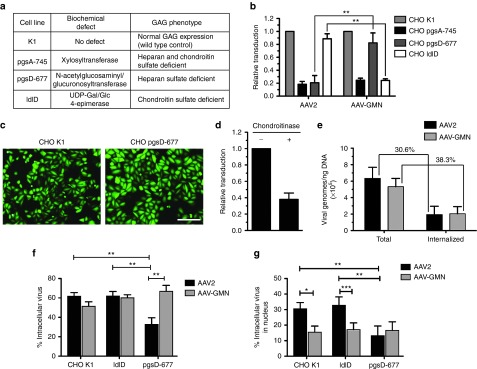
Recently, we described a peptide-modified AAV2 vector (AAV-GMN) containing a capsid-displayed peptide that directs in vivo brain vascular targeting and transduction when delivered intravenously. In this study, we sought to identify the receptor that mediates transduction by AAV-GMN. We found that AAV-GMN, but not AAV2, readily transduces the murine brain endothelial cell line bEnd.3, a result that mirrors previously observed in vivo transduction profiles of brain vasculature. Studies in vitro revealed that the glycosaminoglycan, chondroitin sulfate C, acts as the primary receptor for AAV-GMN. Unlike AAV2, chondroitin sulfate expression is required for cell transduction by AAV-GMN, and soluble chondroitin sulfate C can robustly inhibit AAV-GMN transduction of brain endothelial cells. Interestingly, AAV-GMN retains heparin-binding properties, though in contrast to AAV2, it poorly transduces cells that express heparan sulfate but not chondroitin sulfate, indicating that the peptide insertion negatively impacts heparan-mediated transduction. Lastly, when delivered directly, this modified virus can transduce multiple brain regions, indicating that the potential of AAV-GMN as a therapeutic gene delivery vector for central nervous system disorders is not restricted to brain vascular endothelium.
最近,我们描述了一种经过肽段修饰的 AAV2 载体(AAV-GMN),该载体含有一个在囊壳表面展示的肽段,当经静脉内给药时,可指导体内脑血管靶向和转导。在这项研究中,我们试图确定介导 AAV-GMN 转导的受体。我们发现,AAV-GMN 可轻易转导小鼠脑内皮细胞系 bEnd.3,而 AAV2 则不能,这一结果与先前观察到的体内脑血管转导谱一致。体外研究表明,糖胺聚糖硫酸软骨素 C 是 AAV-GMN 的主要受体。与 AAV2 不同,硫酸软骨素 C 的表达对于 AAV-GMN 对细胞的转导是必需的,并且可溶性硫酸软骨素 C 可以强烈抑制 AAV-GMN 对脑内皮细胞的转导。有趣的是,AAV-GMN 保留了肝素结合特性,尽管与 AAV2 不同,它对表达肝素硫酸但不表达硫酸软骨素的细胞的转导效果很差,表明肽插入会对肝素介导的转导产生负面影响。最后,当直接给药时,这种修饰后的病毒可以转导多个脑区,这表明 AAV-GMN 作为治疗中枢神经系统疾病的基因传递载体的潜力不仅限于脑血管内皮细胞。