BMC Vet Res. 2014 Oct 15;10:253. doi: 10.1186/s12917-014-0253-0.
Opioid-induced immobilization is associated with severe respiratory depression in the white rhinoceros. We evaluated the efficacy of butorphanol and oxygen insufflation in alleviating opioid-induced respiratory depression in eight boma-managed rhinoceros.
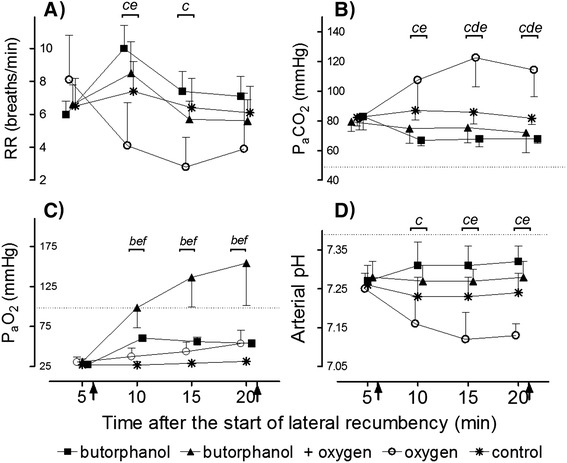
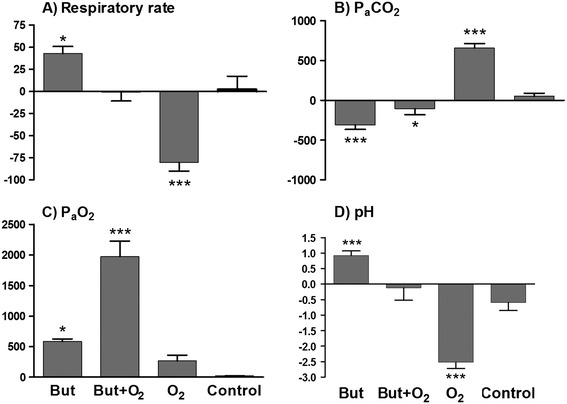
Chemical immobilization with etorphine, azaperone and hyaluronidase, as per standard procedure for the white rhinoceros, caused severe respiratory depression with hypoxaemia (PaO2 = 27 ± 7 mmHg [mean ± SD]), hypercapnia (PaCO2 = 82 ± 6 mmHg) and acidosis (pH =7.26 ± 0.02) in the control trial at 5 min. Compared to pre-intervention values, butorphanol administration (without oxygen) improved the PaO2 (60 ± 3 mmHg, F (3,21) =151.9, p < 0.001), PaCO2 (67 ± 4 mmHg, F (3,21) =22.57, p < 0.001) and pH (7.31 ± 0.06, F (3,21) = 27.60, p < 0.001), while oxygen insufflation alone exacerbated the hypercapnia (123 ± 20 mmHg, F (3,21) = 50.13, p < 0.001) and acidosis (7.12 ± 0.07, F (3,21) = 110.6, p < 0.001). Surprisingly, butorphanol combined with oxygen fully corrected the opioid-induced hypoxaemia (PaO2 = 155 ± 53 mmHg) and reduced the hypercapnia over the whole immobilization period (p <0.05, areas under the curves) compared to the control trial. However, this intervention (butorphanol + oxygen) did not have any effect on the arterial pH.
Oxygen insufflation combined with a single intravenous dose of butorphanol improved the immobilization quality of boma-managed white rhinoceros by correcting the opioid-induced hypoxaemia, but did not completely reverse all components of respiratory depression. The efficacy of this intervention in reducing respiratory depression in field-captured animals remains to be determined.
阿片类药物引起的固定不动与白犀牛严重的呼吸抑制有关。我们评估了丁丙诺啡和氧气吹入缓解 8 头圈养犀牛阿片类药物引起的呼吸抑制的效果。
根据白犀牛的标准程序,用依托啡、氯丙嗪和透明质酸酶进行化学固定导致严重的呼吸抑制,低氧血症(PaO2 = 27 ± 7 mmHg [平均值 ± 标准差]),高碳酸血症(PaCO2 = 82 ± 6 mmHg)和酸中毒(pH = 7.26 ± 0.02)在对照试验中 5 分钟。与干预前相比,丁丙诺啡(无氧气)给药改善了 PaO2(60 ± 3 mmHg,F(3,21)= 151.9,p < 0.001),PaCO2(67 ± 4 mmHg,F(3,21)= 22.57,p < 0.001)和 pH 值(7.31 ± 0.06,F(3,21)= 27.60,p < 0.001),而单独氧气吹入加剧了高碳酸血症(123 ± 20 mmHg,F(3,21)= 50.13,p < 0.001)和酸中毒(7.12 ± 0.07,F(3,21)= 110.6,p < 0.001)。令人惊讶的是,丁丙诺啡联合氧气完全纠正了阿片类药物引起的低氧血症(PaO2 = 155 ± 53 mmHg),并在整个固定期间降低了高碳酸血症(p < 0.05,曲线下面积)与对照试验相比。然而,这种干预(丁丙诺啡+氧气)对动脉 pH 没有任何影响。
氧气吹入联合单次静脉注射丁丙诺啡通过纠正阿片类药物引起的低氧血症改善了圈养白犀牛的固定质量,但没有完全逆转呼吸抑制的所有成分。这种干预在减少野外捕获动物的呼吸抑制方面的效果仍有待确定。