Narsale Aditi A, Carson James A
aIntegrative Muscle Biology Laboratory, Department of Exercise Science bDivision of Applied Physiology, Department of Exercise Science cCenter for Colon Cancer Research, University of South Carolina, Columbia, South Carolina, USA.
Curr Opin Support Palliat Care. 2014 Dec;8(4):321-7. doi: 10.1097/SPC.0000000000000091.
Interleukin-6 (IL-6) has emerged as a cytokine involved in cachexia progression with some cancers. This review will present the recent breakthroughs in animal models and humans related to targeting IL-6 as a cancer cachexia therapy.
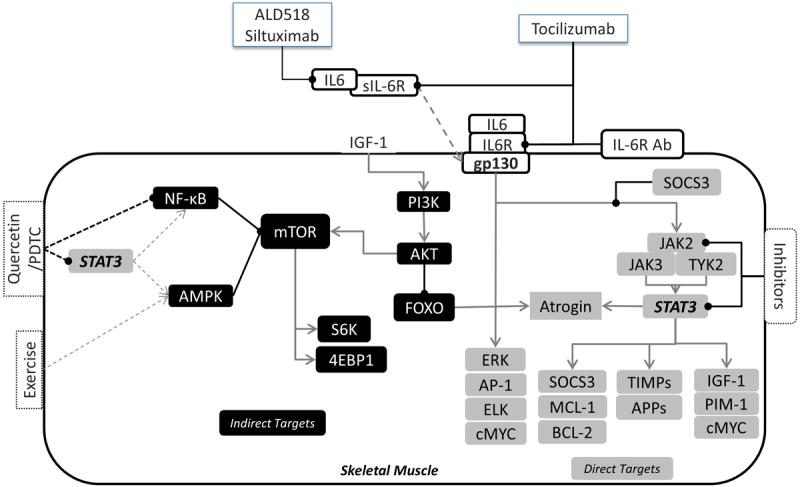
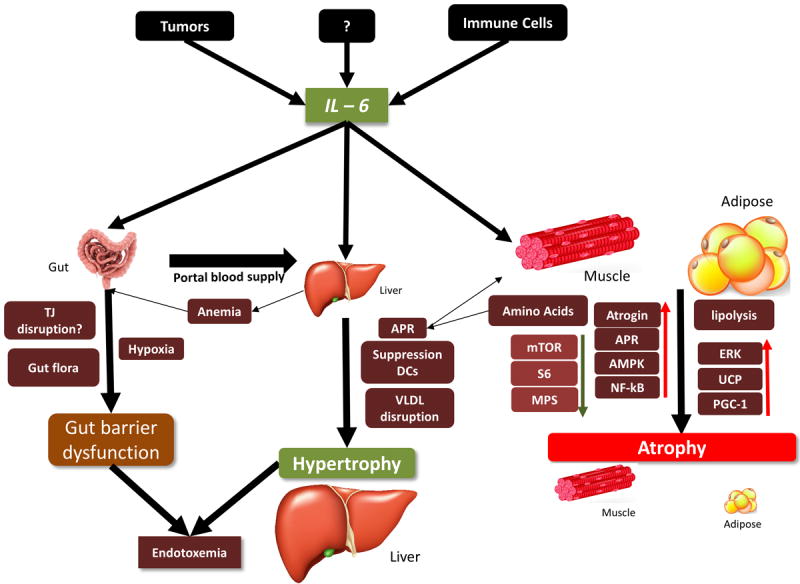
IL-6 can target adipose, skeletal muscle, gut, and liver tissue, which can all affect cachectic patient recovery. IL-6 trans-signaling through the soluble IL-6R has the potential to amplify IL-6 signaling in the cachectic patient. In the skeletal muscle, chronic IL-6 exposure induces proteasome and autophagy protein degradation pathways that lead to wasting. IL-6 is also indirectly associated with AMP-activated kinase (AMPK) and nuclear factor kappa B (NF-κB) activation. Several mouse cancer models have clearly demonstrated that blocking IL-6 and associated signaling can attenuate cachexia progression. Additionally, pharmaceuticals targeting IL-6 and associated signaling can relieve some cachectic symptoms in cancer patients. Research with cachectic mice has demonstrated that exercise and nutraceutical administration can interact with chronic IL-6 signaling during cachexia progression.
IL-6 remains a promising therapeutic strategy for attenuating cachexia progression with many types of cancer. However, improvement of this treatment will require a better understanding of the indirect and direct effects of IL-6 as well as its tissue-specific actions in the cancer patient.
白细胞介素-6(IL-6)已成为一种与某些癌症恶病质进展相关的细胞因子。本综述将介绍在动物模型和人类中有关将靶向IL-6作为癌症恶病质治疗方法的最新突破。
IL-6可作用于脂肪、骨骼肌、肠道和肝脏组织,所有这些都会影响恶病质患者的恢复。通过可溶性IL-6受体进行的IL-6转信号传导有可能放大恶病质患者体内的IL-6信号。在骨骼肌中,长期暴露于IL-6会诱导蛋白酶体和自噬蛋白降解途径,从而导致消瘦。IL-6还与AMP激活的蛋白激酶(AMPK)和核因子κB(NF-κB)的激活间接相关。多个小鼠癌症模型已清楚表明,阻断IL-6及相关信号传导可减轻恶病质进展。此外,靶向IL-6及相关信号传导的药物可缓解癌症患者的一些恶病质症状。对恶病质小鼠的研究表明,运动和营养补充剂给药可在恶病质进展过程中与长期IL-6信号传导相互作用。
IL-6仍然是减轻多种类型癌症恶病质进展的一种有前景的治疗策略。然而,要改进这种治疗方法,需要更好地了解IL-6的间接和直接作用及其在癌症患者中的组织特异性作用。