Raj Pant Sara, Goswami Anjali, Finarelli John A
BMC Evol Biol. 2014 Sep 10;14:184. doi: 10.1186/s12862-014-0184-1.
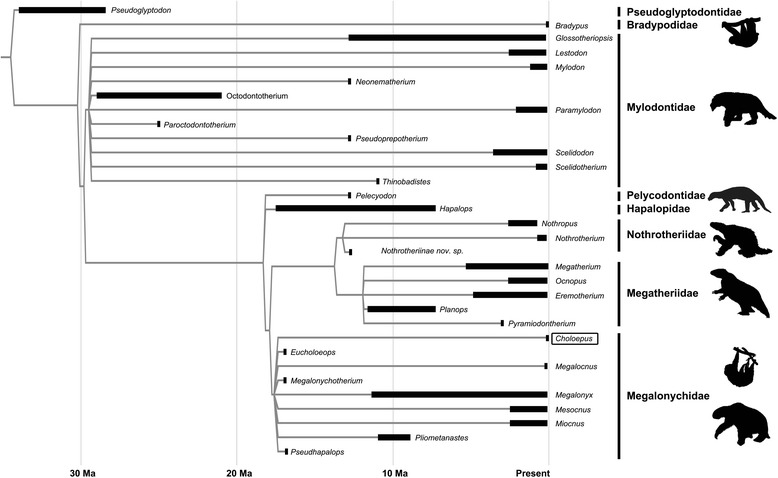
Extant sloths present an evolutionary conundrum in that the two living genera are superficially similar (small-bodied, folivorous, arboreal) but diverged from one another approximately 30 million years ago and are phylogenetically separated by a radiation of medium to massive, mainly ground-dwelling, taxa. Indeed, the species in the two living genera are among the smallest, and perhaps most unusual, of the 50+ known sloth species, and must have independently and convergently evolved small size and arboreality. In order to accurately reconstruct sloth evolution, it is critical to incorporate their extinct diversity in analyses. Here, we used a dataset of 57 species of living and fossil sloths to examine changes in body mass mean and variance through their evolution, employing a general time-variable model that allows for analysis of evolutionary trends in continuous characters within clades lacking fully-resolved phylogenies, such as sloths.
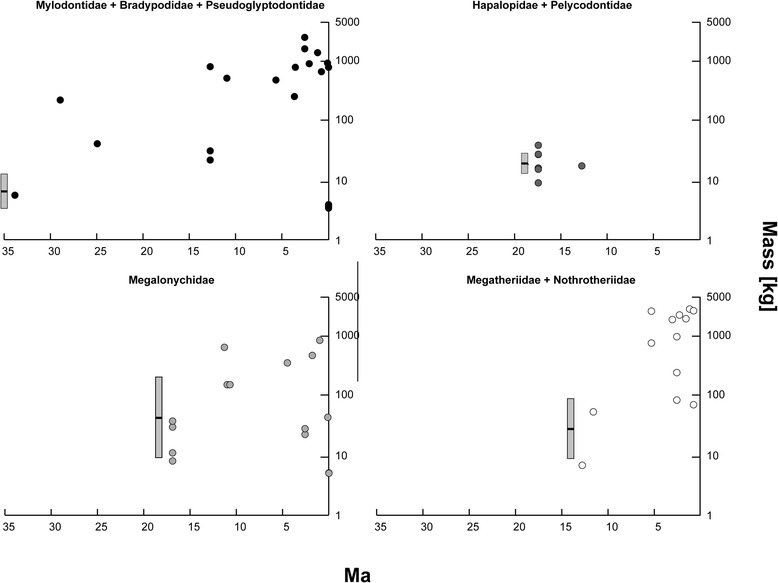
Our analyses supported eight models, all of which partition sloths into multiple subgroups, suggesting distinct modes of body size evolution among the major sloth lineages. Model-averaged parameter values supported trended walks in most clades, with estimated rates of body mass change ranging as high as 126 kg/million years for the giant ground sloth clades Megatheriidae and Nothrotheriidae. Inclusion of living sloth species in the analyses weakened reconstructed rates for their respective groups, with estimated rates for Megalonychidae (large to giant ground sloths and the extant two-toed sloth) were four times higher when the extant genus Choloepus was excluded.
Analyses based on extant taxa alone have the potential to oversimplify or misidentify macroevolutionary patterns. This study demonstrates the impact that integration of data from the fossil record can have on reconstructions of character evolution and establishes that body size evolution in sloths was complex, but dominated by trended walks towards the enormous sizes exhibited in some recently extinct forms.
现存的树懒呈现出一个进化难题,即两个现存属在表面上相似(体型小、食叶、树栖),但大约在3000万年前彼此分化,并且在系统发育上被一系列中型到大型的、主要为地栖的类群分隔开来。事实上,这两个现存属中的物种是已知的50多种树懒物种中体型最小、可能也是最不寻常的,而且一定是独立且趋同地进化出了小体型和树栖性。为了准确重建树懒的进化过程,在分析中纳入它们已灭绝的多样性至关重要。在这里,我们使用了一个包含57种现存和化石树懒的数据集,通过它们的进化过程来研究体重均值和方差的变化,采用了一种通用的时间可变模型,该模型允许在缺乏完全解析的系统发育的类群(如树懒)中分析连续性状的进化趋势。
我们的分析支持了八个模型,所有这些模型都将树懒分成多个亚组,这表明主要树懒谱系中体型进化的模式各不相同。模型平均参数值支持大多数类群中的趋势性变化,巨型地懒类群大地懒科和南方磨齿兽科的体重变化估计速率高达126千克/百万年。在分析中纳入现存树懒物种会削弱其各自类群的重建速率,当排除现存的二趾树懒属时,大懒兽科(大型到巨型地懒和现存的二趾树懒)的估计速率要高出四倍。
仅基于现存类群的分析有可能过度简化或错误识别宏观进化模式。这项研究证明了将化石记录数据纳入分析对性状进化重建的影响,并确定树懒的体型进化是复杂的,但主要由朝着一些最近灭绝的形态所展现出的巨大体型的趋势性变化所主导。