Kuni Benita, Wang Haili, Rickert Markus, Ewerbeck Volker, Schiltenwolf Marcus
Clinic for Orthopedics and Trauma Surgery, Center for Orthopedics, Trauma Surgery and Spinal Cord Injury , Heidelberg University Hospital, Heidelberg , Germany.
Acta Orthop. 2015 Apr;86(2):215-9. doi: 10.3109/17453674.2014.973343. Epub 2014 Oct 17.
Pain sensitization may be one of the reasons for persistent pain after technically successful joint replacement. We analyzed how pain sensitization, as measured by quantitative sensory testing, relates preoperatively to joint function in patients with osteoarthritis (OA) scheduled for joint replacement.
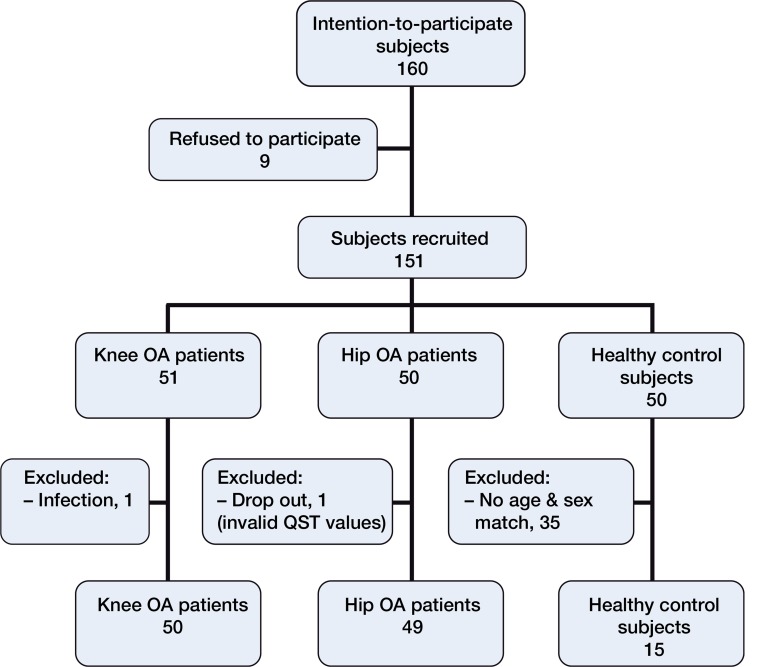
We included 50 patients with knee OA and 49 with hip OA who were scheduled for joint replacement, and 15 control participants. Hip/knee scores, thermal and pressure detection, and pain thresholds were examined.
Median pressure pain thresholds were lower in patients than in control subjects: 4.0 (range: 0-10) vs. 7.8 (4-10) (p = 0.003) for the affected knee; 4.5 (2-10) vs. 6.8 (4-10) (p = 0.03) for the affected hip. Lower pressure pain threshold values were found at the affected joint in 26 of the 50 patients with knee OA and in 17 of the 49 patients with hip OA. The American Knee Society score 1 and 2, the Oxford knee score, and functional questionnaire of Hannover for osteoarthritis score correlated with the pressure pain thresholds in patients with knee OA. Also, Harris hip score and the functional questionnaire of Hannover for osteoarthritis score correlated with the cold detection threshold in patients with hip OA.
Quantitative sensory testing appeared to identify patients with sensory changes indicative of mechanisms of central sensitization. These patients may require additional pain treatment in order to profit fully from surgery. There were correlations between the clinical scores and the level of sensitization.
疼痛敏化可能是关节置换技术成功后持续疼痛的原因之一。我们分析了通过定量感觉测试测量的疼痛敏化在术前与计划进行关节置换的骨关节炎(OA)患者关节功能之间的关系。
我们纳入了50例计划进行膝关节置换的膝骨关节炎患者、49例计划进行髋关节置换的髋骨关节炎患者以及15名对照参与者。检查了髋/膝关节评分、热觉和压力觉检测以及疼痛阈值。
患者的压力疼痛阈值中位数低于对照受试者:患侧膝关节为4.0(范围:0 - 10)对7.8(4 - 10)(p = 0.003);患侧髋关节为4.5(2 - 10)对6.8(4 - 10)(p = 0.03)。在50例膝骨关节炎患者中的26例以及49例髋骨关节炎患者中的17例的患侧关节处发现较低的压力疼痛阈值。美国膝关节协会评分1和2、牛津膝关节评分以及汉诺威骨关节炎功能问卷评分与膝骨关节炎患者的压力疼痛阈值相关。此外,Harris髋关节评分和汉诺威骨关节炎功能问卷评分与髋骨关节炎患者的冷觉检测阈值相关。
定量感觉测试似乎能够识别出具有提示中枢敏化机制的感觉变化的患者。这些患者可能需要额外的疼痛治疗以便从手术中充分获益。临床评分与敏化水平之间存在相关性。