Taguchi Satoru, Fukuhara Hiroshi, Azuma Takeshi, Suzuki Motofumi, Fujimura Tetsuya, Nakagawa Tohru, Ishikawa Akira, Kume Haruki, Igawa Yasuhiko, Homma Yukio
Department of Urology, Graduate School of Medicine, The University of Tokyo, 7-3-1 Hongo, Bunkyo-ku, Tokyo 113-8655, Japan.
BMC Urol. 2014 Oct 16;14:81. doi: 10.1186/1471-2490-14-81.
The optimal timing of salvage androgen deprivation therapy (ADT) for biochemical recurrence after radical prostatectomy is controversial. We compared the outcomes of ultra-early versus early salvage ADT.
Among 855 patients undergoing radical prostatectomy at our institution between 2000 and 2012, we identified 121 with adjuvant-treatment-naïve pT2-4N0M0 prostate cancer who received salvage ADT for biochemical recurrence. These patients were divided into an ultra-early salvage ADT group (n = 51), who started salvage ADT before meeting the standardized definition of biochemical recurrence in Japan (two consecutive prostate-specific antigen [PSA] values ≥0.2 ng/ml), and an early salvage ADT group (n = 70) who started salvage ADT when they met the definition. The ultra-early ADT group consisted of those who started salvage ADT with a single PSA value ≥0.2 ng/ml (n = 30) or with two consecutive PSA values >0.1 ng/ml and rising (n = 21). The primary endpoint was biochemical recurrence after salvage ADT, defined as a single PSA value ≥0.2 ng/ml after PSA nadir following salvage ADT. Secondary endpoints were clinical metastasis and cancer-specific survival. A Cox proportional hazards model was used for multivariate analysis. The median follow-up was 65.5 months.
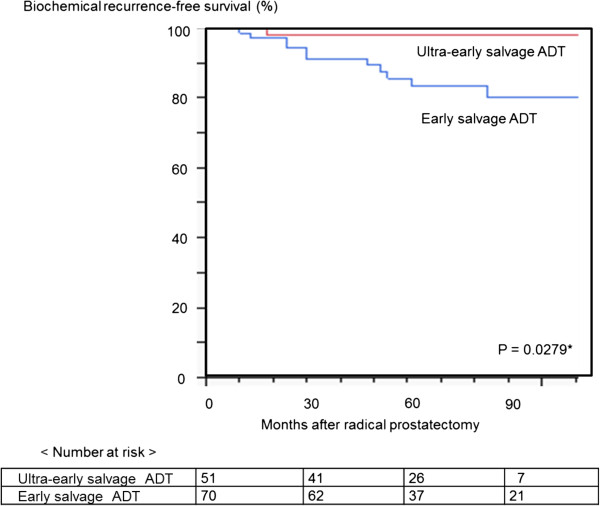
Biochemical recurrence occurred in one patient (2.0%) in the ultra-early group and in 12 (17.1%) in the early salvage ADT group. Multivariate analysis identified ultra-early salvage ADT and preoperative Gleason score ≤7 as independent negative predictors of biochemical recurrence after salvage ADT. Only one patient in the early salvage ADT group developed clinical metastasis to a left supraclavicular lymph node, and no patient died from prostate cancer during follow-up. The major limitations of this study were its retrospective design, selection bias, and the possibility that the ultra-early salvage ADT group may have included patients without biochemical recurrence.
Ultra-early salvage ADT was an independent negative predictor of biochemical recurrence after salvage ADT in post-prostatectomy patients. Further consideration should be given to the use of salvage ADT before meeting the current definition of biochemical recurrence.
根治性前列腺切除术后挽救性雄激素剥夺治疗(ADT)的最佳时机存在争议。我们比较了超早期与早期挽救性ADT的疗效。
在2000年至2012年间于我院接受根治性前列腺切除术的855例患者中,我们确定了121例未接受辅助治疗的pT2-4N0M0前列腺癌患者,他们因生化复发接受了挽救性ADT。这些患者被分为超早期挽救性ADT组(n = 51),即在未达到日本生化复发的标准化定义(连续两次前列腺特异性抗原[PSA]值≥0.2 ng/ml)之前开始挽救性ADT;以及早期挽救性ADT组(n = 70),在达到该定义时开始挽救性ADT。超早期ADT组包括那些在单个PSA值≥0.2 ng/ml时开始挽救性ADT的患者(n = 30)或连续两次PSA值>0.1 ng/ml且呈上升趋势的患者(n = 21)。主要终点是挽救性ADT后的生化复发,定义为挽救性ADT后PSA最低点后单个PSA值≥0.2 ng/ml。次要终点是临床转移和癌症特异性生存。采用Cox比例风险模型进行多变量分析。中位随访时间为65.5个月。
超早期组1例患者(2.0%)发生生化复发,早期挽救性ADT组12例患者(17.1%)发生生化复发。多变量分析确定超早期挽救性ADT和术前Gleason评分≤7是挽救性ADT后生化复发的独立负性预测因素。早期挽救性ADT组只有1例患者发生左侧锁骨上淋巴结临床转移,随访期间无患者死于前列腺癌。本研究的主要局限性在于其回顾性设计、选择偏倚以及超早期挽救性ADT组可能纳入了未发生生化复发患者的可能性。
超早期挽救性ADT是前列腺切除术后患者挽救性ADT后生化复发的独立负性预测因素。在未达到当前生化复发定义之前,应进一步考虑使用挽救性ADT。