• 文献检索
  • 文档翻译
  • 深度研究
  • 学术资讯
  • Suppr Zotero 插件Zotero 插件
  • 邀请有礼
  • 套餐&价格
  • 历史记录
应用&插件
Suppr Zotero 插件Zotero 插件浏览器插件Mac 客户端Windows 客户端微信小程序
定价
高级版会员购买积分包购买API积分包
服务
文献检索文档翻译深度研究API 文档MCP 服务
关于我们
关于 Suppr公司介绍联系我们用户协议隐私条款
关注我们

Suppr 超能文献

核心技术专利:CN118964589B侵权必究
粤ICP备2023148730 号-1Suppr @ 2026

文献检索

告别复杂PubMed语法,用中文像聊天一样搜索,搜遍4000万医学文献。AI智能推荐,让科研检索更轻松。

立即免费搜索

文件翻译

保留排版,准确专业,支持PDF/Word/PPT等文件格式,支持 12+语言互译。

免费翻译文档

深度研究

AI帮你快速写综述,25分钟生成高质量综述,智能提取关键信息,辅助科研写作。

立即免费体验

精神分裂症患者自知力与内化耻辱感之间的相关性

Correlation between insight and internalized stigma in patients with schizophrenia.

作者信息

Lu Ying, Wang Xiaoping

机构信息

Mental Health Institute of the Second Xiangya Hospital, Central South University, Changsha, China ; Forensic Psychiatry Department of Nanjing Brain Hospital, Nanjing Medical University, Nanjing, China.

Mental Health Institute of the Second Xiangya Hospital, Central South University, Changsha, China.

出版信息

Shanghai Arch Psychiatry. 2012 Apr;24(2):91-8. doi: 10.3969/j.issn.1002-0829.2012.02.004.

DOI:10.3969/j.issn.1002-0829.2012.02.004
PMID:25324609
原文链接:https://pmc.ncbi.nlm.nih.gov/articles/PMC4198835/
Abstract

BACKGROUND

The relationship between insight and internalized stigma in patients with schizophrenia is important both for theoretical and practical reasons because of its close association with patients' willingness to seek (or accept) care for their mental illness.

OBJECTIVE

To investigate the relationship between insight and internalized stigma in patients with schizophrenia in mainland China.

METHODS

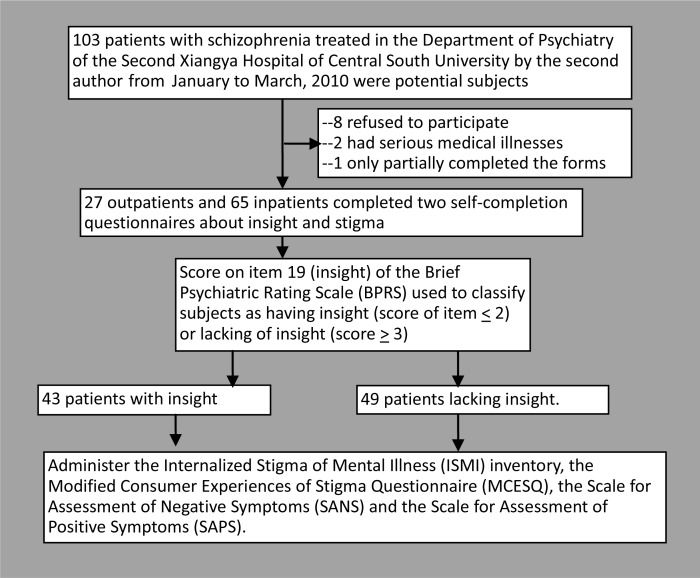
65 inpatients and 27 outpatients with schizophrenia who had a median duration of four years of illness completed Chinese versions of two self-report questionnaires-the Internalized Stigma of Mental Illness (ISMI) scale and the Modified Consumer Experiences of Stigma Questionnaire (MCESQ). The patients were also assessed by senior psychiatrists using the Scale for Assessment of Positive Symptoms (SAPS) and the Scale for Assessment of Negative Symptoms (SANS). Patients were divided into those with and without insight into their illness based on the score of the insight item on the Chinese version of the Brief Psychiatric Rating Scale.

RESULTS

49 patients were classified as having insight and 43 classified as lacking insight. Compared to patients with insight, those without insight had a significantly shorter duration of illness, were more likely to be inpatients, and (at trend level only) had more prominent positive and negative symptoms. The 'alienation' subscale score of the ISMI was significantly higher in patients with insight but none of the remaining six subscales in the two instruments were different between the two groups and only 4 of the 48 separate items in the two scales were significantly different between the groups. Logistic regression analysis found no relationship between lack of insight and the scores of the two self-completion stigma scales or the scores of the two clinician-administered symptom scales.

CONCLUSION

This study among inpatients and outpatients with schizophrenia in China does not support findings of previous studies that report increased experience of stigma among patients who have better insight. The measures of stigma used in the study need further revision and validation for use in China and studies with a wider spectrum of patients that make more detailed assessments of insight and that follow fluctuations in insight and experiences of stigma over time are needed to clarify the complex relationship between these two phenomena in patients with schizophrenia.

摘要

背景

精神分裂症患者的自知力与内化耻辱感之间的关系无论在理论上还是实践中都很重要,因为它与患者寻求(或接受)精神疾病治疗的意愿密切相关。

目的

调查中国大陆精神分裂症患者自知力与内化耻辱感之间的关系。

方法

65例住院精神分裂症患者和27例门诊精神分裂症患者,病程中位数为4年,完成了两个自填式问卷的中文版——精神疾病内化耻辱感(ISMI)量表和修订后的耻辱感消费者体验问卷(MCESQ)。这些患者还由资深精神科医生使用阳性症状评定量表(SAPS)和阴性症状评定量表(SANS)进行评估。根据中文版简明精神病评定量表自知力项目的得分,将患者分为有自知力和无自知力两组。

结果

49例患者被归类为有自知力,43例被归类为无自知力。与有自知力的患者相比,无自知力的患者病程明显较短,更可能是住院患者,并且(仅在趋势水平上)有更明显的阳性和阴性症状。有自知力的患者ISMI的“疏离感”分量表得分显著更高,但两组在这两个工具的其余六个分量表上没有差异,且两个量表中48个单独项目中只有4个在两组之间有显著差异。逻辑回归分析发现,无自知力与两个自填式耻辱感量表的得分或两个由临床医生评定的症状量表的得分之间没有关系。

结论

在中国住院和门诊精神分裂症患者中进行的这项研究不支持先前研究的结果,即报告显示自知力较好的患者耻辱感体验增加。本研究中使用的耻辱感测量方法需要在中国进一步修订和验证,需要开展针对更广泛患者群体的研究,对自知力进行更详细的评估,并跟踪自知力和耻辱感体验随时间的波动情况,以阐明精神分裂症患者这两种现象之间的复杂关系。
https://cdn.ncbi.nlm.nih.gov/pmc/blobs/9080/4198835/33f14be505dd/sap-24-02-091-g001.jpg

相似文献

1
Correlation between insight and internalized stigma in patients with schizophrenia.精神分裂症患者自知力与内化耻辱感之间的相关性
Shanghai Arch Psychiatry. 2012 Apr;24(2):91-8. doi: 10.3969/j.issn.1002-0829.2012.02.004.
2
Experienced stigma and self-stigma in Chinese patients with schizophrenia.中国精神分裂症患者的经验性耻辱和自我耻辱。
Gen Hosp Psychiatry. 2013 Jan-Feb;35(1):83-8. doi: 10.1016/j.genhosppsych.2012.07.007. Epub 2012 Aug 24.
3
The Relationship Between Internalized Stigma with Self-reported Cognitive Dysfunction and Insight in Schizophrenia.精神分裂症中内化耻辱感与自我报告的认知功能障碍及自知力之间的关系
Psychiatry Clin Psychopharmacol. 2024 Jun 1;34(2):119-126. doi: 10.5152/pcp.2024.23787. eCollection 2024 Jun.
4
Self-perception of mental illness, and subjective and objective cognitive functioning in people with schizophrenia.精神分裂症患者对精神疾病的自我认知以及主观和客观认知功能
Neuropsychiatr Dis Treat. 2019 Apr 23;15:967-976. doi: 10.2147/NDT.S193239. eCollection 2019.
5
Association between insight and internalized stigma and other clinical factors among patients with depression: A cross-sectional study.抑郁症患者的自知力与内化耻辱感及其他临床因素之间的关联:一项横断面研究。
Indian J Psychiatry. 2020 Mar-Apr;62(2):186-192. doi: 10.4103/psychiatry.IndianJPsychiatry_612_19. Epub 2020 Mar 17.
6
Stigma and discrimination experienced by people with schizophrenia living in the community in Guangzhou, China.在中国广州,居住在社区中的精神分裂症患者所经历的污名化和歧视。
Psychiatry Res. 2017 Sep;255:225-231. doi: 10.1016/j.psychres.2017.05.040. Epub 2017 May 29.
7
[Exploring the relationship between internalized stigma, insight and depression for inpatients with schizophrenia].[探索精神分裂症住院患者内化耻辱感、自知力与抑郁之间的关系]
Encephale. 2015 Oct;41(5):435-43. doi: 10.1016/j.encep.2014.07.006. Epub 2014 Sep 17.
8
Brief version of the Internalized Stigma of Mental Illness (ISMI) scale: psychometric properties and relationship to depression, self esteem, recovery orientation, empowerment, and perceived devaluation and discrimination.精神疾病内化耻辱感(ISMI)量表简版:心理测量特性及其与抑郁、自尊、康复取向、赋权以及感知到的贬低和歧视的关系
Psychiatr Rehabil J. 2014 Mar;37(1):17-23. doi: 10.1037/prj0000035.
9
The Correlation Between Schizophrenic Patients' Level of Internalized Stigma and Their Level of Hope.精神分裂症患者内化耻辱感水平与其希望水平之间的相关性
Arch Psychiatr Nurs. 2017 Aug;31(4):332-337. doi: 10.1016/j.apnu.2017.03.001. Epub 2017 Mar 24.
10
Mental Illness Related Internalized Stigma: Psychometric Properties of the Brief ISMI Scale in Greece.与精神疾病相关的内化耻辱感:希腊简短ISMI量表的心理测量特性
Mater Sociomed. 2017 Sep;29(3):211-215. doi: 10.5455/msm.2017.29.211-215.

引用本文的文献

1
Mental health literacy and the stigmatisation and discrimination of individuals affected by mental illnesses in China: a scoping review.中国的心理健康素养以及对精神疾病患者的污名化与歧视:一项范围综述
Lancet Reg Health West Pac. 2025 Aug 1;61:101642. doi: 10.1016/j.lanwpc.2025.101642. eCollection 2025 Aug.
2
Self-stigma in schizophrenia: a systematic review and meta-analysis of 37 studies from 25 high- and low-to-middle income countries.精神分裂症中的自我污名化:对来自25个高收入和中低收入国家的37项研究的系统评价和荟萃分析
Mol Psychiatry. 2023 May;28(5):1920-1931. doi: 10.1038/s41380-023-02003-4. Epub 2023 Mar 8.
3

本文引用的文献

1
'Forensic' labelling: an empirical assessment of its effects on self-stigma for people with severe mental illness.“法医”标签:对严重精神疾病患者自我污名化影响的实证评估。
Psychiatry Res. 2011 Jun 30;188(1):115-22. doi: 10.1016/j.psychres.2011.01.018. Epub 2011 Feb 18.
2
Cognitive insight and causal attribution in the development of self-stigma among individuals with schizophrenia.精神分裂症患者自我污名化发展过程中的认知洞察力与因果归因
Psychiatr Serv. 2006 Dec;57(12):1800-2. doi: 10.1176/ps.2006.57.12.1800.
3
Toward understanding the insight paradox: internalized stigma moderates the association between insight and social functioning, hope, and self-esteem among people with schizophrenia spectrum disorders.
Self-stigma in Serious Mental Illness: A Systematic Review of Frequency, Correlates, and Consequences.
严重精神疾病中的自我污名:频率、相关性和后果的系统综述。
Schizophr Bull. 2021 Aug 21;47(5):1261-1287. doi: 10.1093/schbul/sbaa181.
4
Self-perception of mental illness, and subjective and objective cognitive functioning in people with schizophrenia.精神分裂症患者对精神疾病的自我认知以及主观和客观认知功能
Neuropsychiatr Dis Treat. 2019 Apr 23;15:967-976. doi: 10.2147/NDT.S193239. eCollection 2019.
5
A scoping review of health-related stigma outcomes for high-burden diseases in low- and middle-income countries.高负担疾病在中低收入国家的健康相关污名后果的范围综述。
BMC Med. 2019 Feb 15;17(1):17. doi: 10.1186/s12916-019-1250-8.
6
Advances in Alzheimer's imaging are changing the experience of Alzheimer's disease.阿尔茨海默病成像技术的进展正在改变阿尔茨海默病的诊疗体验。
Alzheimers Dement (Amst). 2018 Mar 19;10:285-300. doi: 10.1016/j.dadm.2018.02.006. eCollection 2018.
为了理解领悟悖论:内化的耻辱感调节了精神分裂症谱系障碍患者的领悟与社会功能、希望和自尊之间的关联。
Schizophr Bull. 2007 Jan;33(1):192-9. doi: 10.1093/schbul/sbl016. Epub 2006 Aug 7.
4
Internalized stigma predicts erosion of morale among psychiatric outpatients.内化耻辱感预示着精神科门诊患者士气的低落。
Psychiatry Res. 2004 Dec 30;129(3):257-65. doi: 10.1016/j.psychres.2004.08.003.
5
Internalized stigma of mental illness: psychometric properties of a new measure.精神疾病的内化耻辱感:一种新测量工具的心理测量特性
Psychiatry Res. 2003 Nov 1;121(1):31-49. doi: 10.1016/j.psychres.2003.08.008.
6
Stigma and expressed emotion: a study of people with schizophrenia and their family members in China.污名与情感表达:对中国精神分裂症患者及其家庭成员的一项研究。
Br J Psychiatry. 2002 Dec;181:488-93. doi: 10.1192/bjp.181.6.488.
7
Experiences of stigma among outpatients with schizophrenia.精神分裂症门诊患者的耻辱感经历。
Schizophr Bull. 2002;28(1):143-55. doi: 10.1093/oxfordjournals.schbul.a006917.
8
Mental health consumers' experience of stigma.精神健康消费者的耻辱感体验。
Schizophr Bull. 1999;25(3):467-78. doi: 10.1093/oxfordjournals.schbul.a033394.
9
Public conceptions of mental illness: labels, causes, dangerousness, and social distance.公众对精神疾病的认知:标签、成因、危险性及社会距离。
Am J Public Health. 1999 Sep;89(9):1328-33. doi: 10.2105/ajph.89.9.1328.
10
Reliability and validity of the Chinese versions of the Scales for Assessment of Positive and Negative Symptoms.
Acta Psychiatr Scand. 1991 Oct;84(4):364-70. doi: 10.1111/j.1600-0447.1991.tb03161.x.