Institute for Genomic Biology, University of Illinois at Urbana-Champaign Urbana, IL, USA ; Department of Geology, University of Illinois at Urbana-Champaign Urbana, IL, USA ; Energy Biosciences Institute, University of Illinois at Urbana-Champaign Urbana, IL, USA.
Department of Geology, University of Illinois at Urbana-Champaign Urbana, IL, USA.
Front Microbiol. 2014 Sep 30;5:511. doi: 10.3389/fmicb.2014.00511. eCollection 2014.
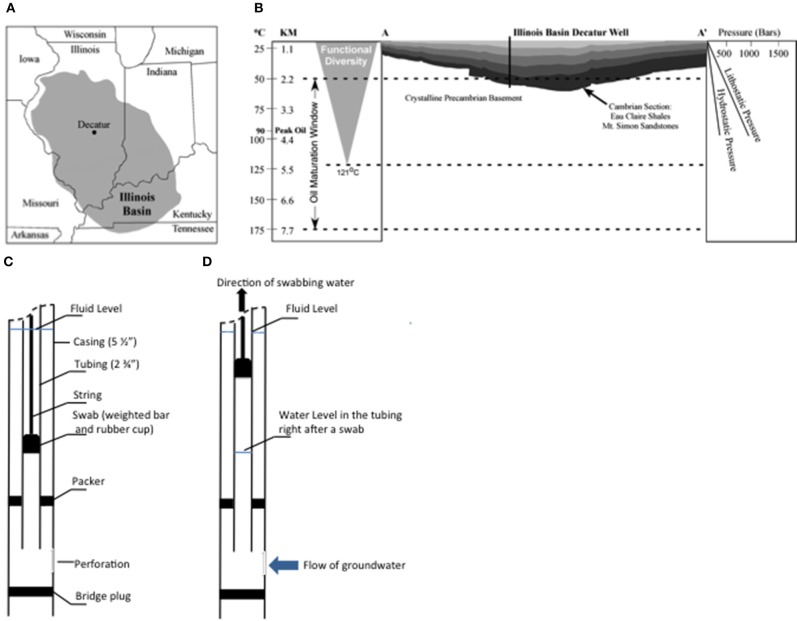
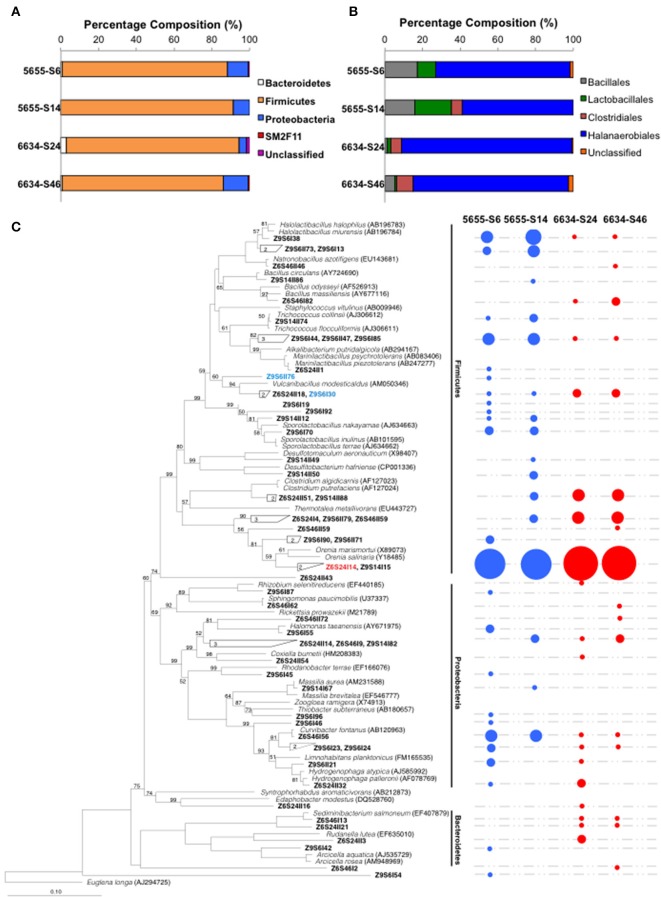
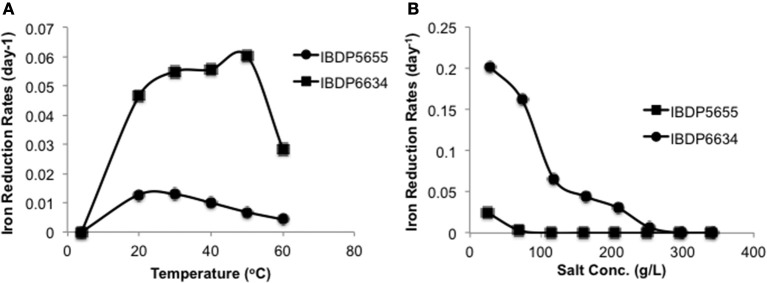
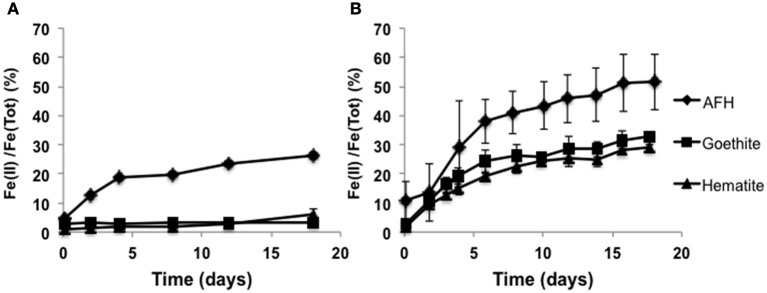
The Cambrian-age Mt. Simon Sandstone, deeply buried within the Illinois Basin of the midcontinent of North America, contains quartz sand grains ubiquitously encrusted with iron-oxide cements and dissolved ferrous iron in pore-water. Although microbial iron reduction has previously been documented in the deep terrestrial subsurface, the potential for diagenetic mineral cementation to drive microbial activity has not been well studied. In this study, two subsurface formation water samples were collected at 1.72 and 2.02 km, respectively, from the Mt. Simon Sandstone in Decatur, Illinois. Low-diversity microbial communities were detected from both horizons and were dominated by Halanaerobiales of Phylum Firmicutes. Iron-reducing enrichment cultures fed with ferric citrate were successfully established using the formation water. Phylogenetic classification identified the enriched species to be related to Vulcanibacillus from the 1.72 km depth sample, while Orenia dominated the communities at 2.02 km of burial depth. Species-specific quantitative analyses of the enriched organisms in the microbial communities suggest that they are indigenous to the Mt. Simon Sandstone. Optimal iron reduction by the 1.72 km enrichment culture occurred at a temperature of 40°C (range 20-60°C) and a salinity of 25 parts per thousand (range 25-75 ppt). This culture also mediated fermentation and nitrate reduction. In contrast, the 2.02 km enrichment culture exclusively utilized hydrogen and pyruvate as the electron donors for iron reduction, tolerated a wider range of salinities (25-200 ppt), and exhibited only minimal nitrate- and sulfate-reduction. In addition, the 2.02 km depth community actively reduces the more crystalline ferric iron minerals goethite and hematite. The results suggest evolutionary adaptation of the autochthonous microbial communities to the Mt. Simon Sandstone and carries potentially important implications for future utilization of this reservoir for CO2 injection.
北美中部大陆伊利诺伊盆地深处的寒武纪西蒙山砂岩普遍含有被铁氧化物胶结物和孔隙水中溶解的亚铁包裹的石英砂颗粒。尽管先前在深层陆地地下环境中已经记录了微生物的铁还原作用,但成岩矿物胶结作用驱动微生物活动的潜力尚未得到很好的研究。在这项研究中,分别从伊利诺伊州迪凯特的西蒙山砂岩中采集了 1.72 和 2.02 公里深处的两个地下地层水样。从两个地层都检测到了低多样性的微生物群落,主要由厚壁菌门的盐厌氧菌目主导。使用地层水成功建立了以柠檬酸铁为铁源的铁还原富集培养物。系统发育分类将富集的物种鉴定为与来自 1.72 公里深度样本的 Vulcanibacillus 有关,而在 2.02 公里埋藏深度处,Orenia 则主导了群落。微生物群落中富集微生物的种特异性定量分析表明,它们是西蒙山砂岩的土著微生物。1.72 公里处的富集培养物在 40°C(20-60°C 范围)的温度和 25 千分比(25-75 ppt 范围)的盐度下最佳地还原铁。该培养物还介导了发酵和硝酸盐还原。相比之下,2.02 公里处的富集培养物仅将氢和丙酮酸盐用作铁还原的电子供体,可耐受更宽的盐度范围(25-200 ppt),且仅表现出最小限度的硝酸盐和硫酸盐还原。此外,2.02 公里深度的群落还积极还原更具结晶度的铁氧化物针铁矿和赤铁矿。研究结果表明,自生微生物群落对西蒙山砂岩的适应性进化,并可能对未来将该储层用于二氧化碳注入具有重要意义。