Jiang Pengbo, Christakos Athena, Fam Mina, Sadeghi-Nejad Hossein
Department of Urology, Rutgers-New Jersey Medical School, Newark, NJ, USA.
Department of Urology, Rutgers-New Jersey Medical School, Newark, NJ, USA. ; Center for Male Reproductive Medicine & Microsurgery, Hackensack University Medical Center, Hackensack, NJ, USA.
Korean J Urol. 2014 Oct;55(10):665-9. doi: 10.4111/kju.2014.55.10.665. Epub 2014 Oct 10.
Although penile duplex Doppler ultrasonography (PDDU) is a common and integral procedure in a Peyronie's disease workup, the intracavernosal injection of vasoactive agents can carry a serious risk of priapism. Risk factors include young age, good baseline erectile function, and no coronary artery disease. In addition, patients with Peyronie's disease undergoing PDDU in an outpatient setting are at increased risk given the inability to predict optimal dosing. The present study was conducted to provide support for a standard protocol of early administration of phenylephrine in patients with a sustained erection after diagnostic intracavernosal injection of vasoactive agents to prevent the deleterious effects of iatrogenic priapism.
This was a retrospective review of Peyronie's disease patients who received phenylephrine reversal after intracavernosal alprostadil (prostaglandin E1) administration to look at the priapism rate. Safety was determined on the basis of adverse events reported by subjects and efficacy was determined on the basis of the rate of priapism following intervention.
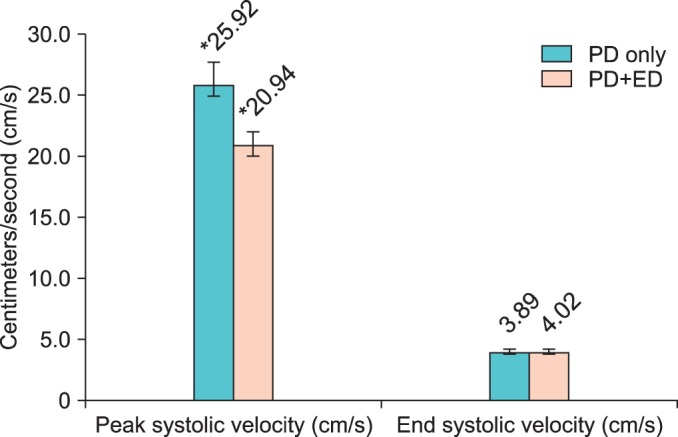
Patients with Peyronie's disease only had better hemodynamic values on PDDU than did patients with Peyronie's disease and erectile dysfunction. All of the patients receiving prophylactic phenylephrine had complete detumescence of erections without adverse events, including no priapism cases.
The reversal of erections with phenylephrine after intracavernosal injections of alprostadil to prevent iatrogenic priapism can be effective without increased adverse effects.
尽管阴茎双功多普勒超声检查(PDDU)是佩罗尼氏病检查中常见且不可或缺的一项操作,但海绵体内注射血管活性药物可能会带来阴茎异常勃起的严重风险。风险因素包括年轻、基线勃起功能良好以及无冠状动脉疾病。此外,在门诊接受PDDU检查的佩罗尼氏病患者因无法预测最佳剂量而面临更高风险。本研究旨在为在诊断性海绵体内注射血管活性药物后出现持续性勃起的患者早期使用去氧肾上腺素的标准方案提供支持,以预防医源性阴茎异常勃起的有害影响。
这是一项对接受海绵体内注射前列地尔(前列腺素E1)后使用去氧肾上腺素进行逆转治疗的佩罗尼氏病患者的回顾性研究,以观察阴茎异常勃起的发生率。根据受试者报告的不良事件确定安全性,根据干预后阴茎异常勃起的发生率确定疗效。
仅患有佩罗尼氏病的患者在PDDU检查中的血流动力学值优于患有佩罗尼氏病和勃起功能障碍的患者。所有接受预防性去氧肾上腺素治疗的患者勃起均完全消退,且无不良事件发生,包括无阴茎异常勃起病例。
海绵体内注射前列地尔后使用去氧肾上腺素逆转勃起以预防医源性阴茎异常勃起可能有效且不会增加不良反应。