Sexual & Reproductive Medicine Program, Urology Service, Memorial Sloan Kettering Cancer Center, New York, NY, USA; Sexual Medicine Group, Division of Urology, Hospital das Clinicas - University of Sao Paulo Medical School, Sao Paulo, Brazil.
Sexual & Reproductive Medicine Program, Urology Service, Memorial Sloan Kettering Cancer Center, New York, NY, USA; Division of Urology, Federal University of Ceara, Ceara, Brazil.
J Sex Med. 2020 Aug;17(8):1416-1422. doi: 10.1016/j.jsxm.2020.05.023. Epub 2020 Jul 3.
Penile duplex Doppler ultrasound (PDDU) is a minimally invasive tool to evaluate erectile hemodynamics in patients with erectile dysfunction (ED). Despite decades of use, there is still a large variability in PDDU protocols, and a high rate of false diagnosis is reported.
Review of PDDU methodology in the published literature addressing protocol heterogeneity, technical and interpretation challenges.
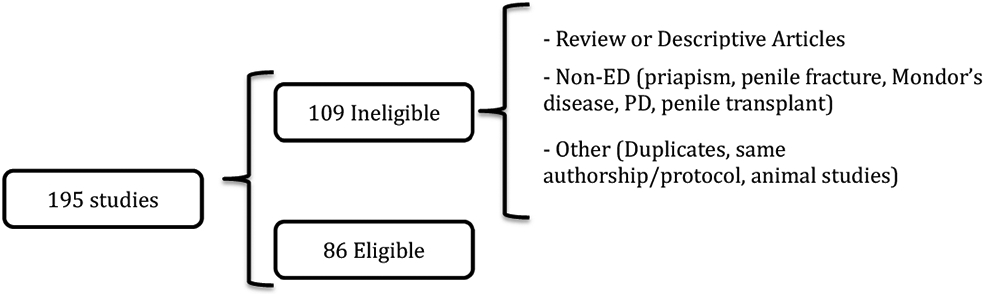
A PubMed literature search was performed using the search terms "penile doppler ultrasound", "penile duplex ultrasound" or "penile ultrasound", and "Erectile dysfunction". Studies were analyzed for the presence of the following elements in reporting of the PDDU protocol: (i) intracavernosal vasoactive agents used, (ii) use of a redosing protocol, (iii) means of rigidity assessment, (iv) report of at-home best-quality erection, (v) normative criteria for peak systolic velocity (PSV) and end-diastolic velocity (EDV), and (vi) use of time-based hemodynamics assessment. Inclusion criteria were studies available in English, from 2005 onwards, and with full text. Exclusion criteria were review, descriptive or short communication articles, animal studies, and studies in populations other than those with ED.
A critical review of the heterogeneity in published literature was performed to guide a structured discussion of methodological challenges and to create a list of recommendations.
Significant heterogeneity was seen in key methodological aspects. Fifty percent of studies reported the use of prostaglandin E1 only, and 12% of studies did not mention the agent used. Redosing as part of the PDDU protocol was mentioned in only 26% of studies. The majority (56%) did not mention any form of rigidity assessment. The most frequently used grading system was the Erection Hardness Score (14%). Overall, most studies (59%) used a timed-base protocol for hemodynamic assessment. No clear consensus was defined for normative criteria for PSV and EDV, 39% defining a normal PSV as ≥30 cm/s, and 57% using EDV values ≤5 cm/sec as normal.
The absence of standardization has led to inadequate reporting of key factors which has rendered data interpretation and comparison between studies challenging.
Our strengths include an extensive review of literature, with a structured analysis of the impact of each methodological pitfall. Our main limitation is the fact that protocol reporting, and not its application, was assessed.
Despite its widespread use, analysis of the literature on PDDU use in the ED population shows marked protocol heterogeneity, rendering data interpretation a problem. Nascimento B, Miranda EP, Terrier JE, et al. A Critical Analysis of Methodology Pitfalls in Duplex Doppler Ultrasound in the Evaluation of Patients With Erectile Dysfunction: Technical and Interpretation Deficiencies. J Sex Med 2020;17:1416-1422.
阴茎双功能多普勒超声(PDDU)是一种评估勃起功能障碍(ED)患者勃起血流动力学的微创工具。尽管已经使用了几十年,但 PDDU 方案仍存在很大的变异性,并且报告的误诊率很高。
回顾发表文献中 PDDU 方法学,以解决方案异质性、技术和解释方面的挑战。
使用“penile doppler ultrasound”、“penile duplex ultrasound”或“penile ultrasound”和“erectile dysfunction”等术语在 PubMed 文献中进行搜索。分析这些研究报告中 PDDU 方案的以下要素:(i)使用的海绵体内血管活性药物,(ii)使用重新给药方案,(iii)硬度评估方法,(iv)报告在家中获得的最佳勃起质量,(v)收缩期峰值速度(PSV)和舒张末期速度(EDV)的正常标准,(vi)使用基于时间的血流动力学评估。纳入标准为可获取英文全文的 2005 年后发表的研究。排除标准为综述、描述性或简短通讯文章、动物研究以及非 ED 患者人群的研究。
对发表文献中的异质性进行了批判性评价,以指导对方法学挑战的结构化讨论,并提出了一系列建议。
尽管 PDDU 广泛应用,但对 ED 人群中 PDDU 使用的文献分析表明,方案存在明显的异质性,导致数据解释和研究之间的比较成为问题。Nascimento B, Miranda EP, Terrier JE, et al. 阴茎双功能多普勒超声在勃起功能障碍评估中的应用:技术与解释缺陷. 性医学杂志 2020;17:1416-1422.
