Department of Clinical and Experimental Medicine, Linköping University, Linköping, Sweden ; Department of Hematology, County Council of Östergötland, Linköping, Sweden.
Department of Medical and Health Sciences, Linköping University, Linköping, Sweden.
Biomark Res. 2014 Oct 8;2:18. doi: 10.1186/2050-7771-2-18. eCollection 2014.
The isocitrate dehydrogenase (IDH1/IDH2) genes are metabolic enzymes, which are frequently mutated in acute myeloid leukemia (AML). The enzymes acquire neomorphic enzymatic activity when they mutated.
We have investigated the frequency and outcome of the acquired IDH1/IDH2 mutations and the IDH1 SNP 105C > T (rs11554137) in 189 unselected de novo AML patients by polymerase chain reaction amplification followed by direct sequencing. The survival are presented in Kaplan Meier curves with log rank test. Multivariable survival analysis was conducted using Cox regression method, taking age, risk group, treatment, IDH1/2 mutations and IDH1 SNP105 genotype into account.
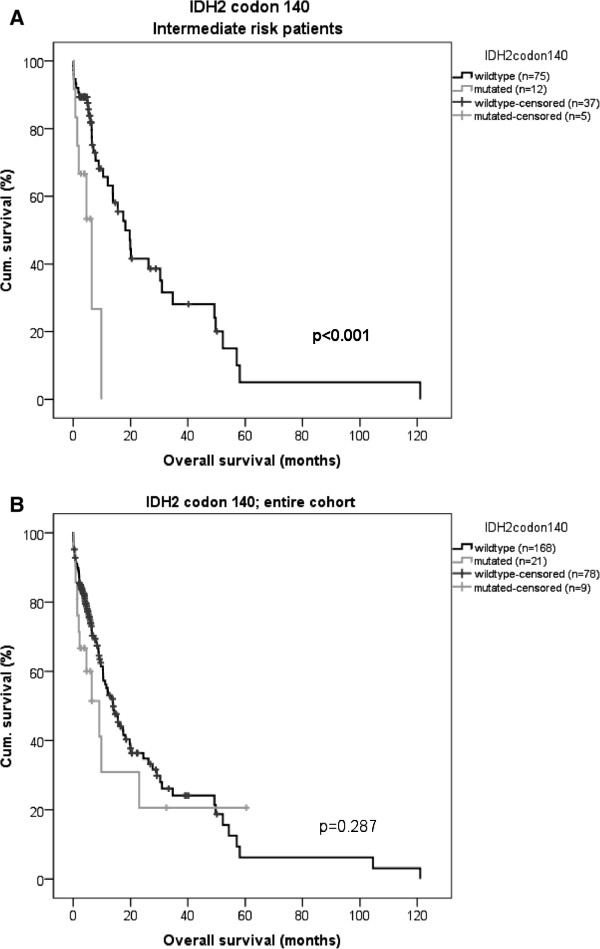
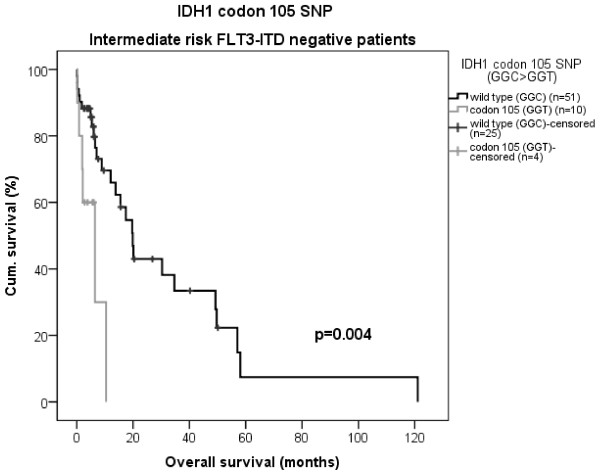
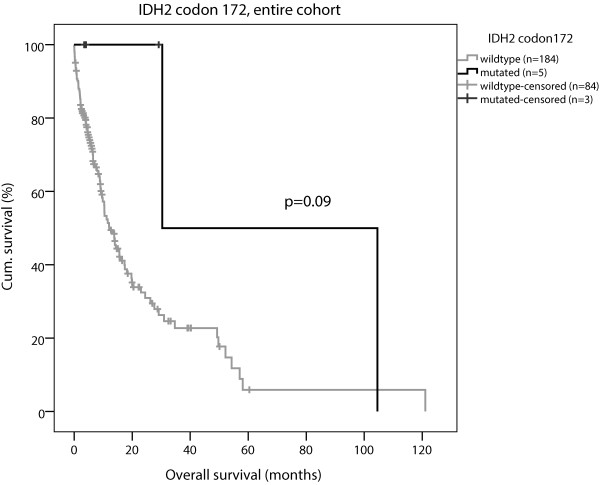
Overall, IDH1/2 mutations were found in 41/187 (21.7%) of the AML patients. IDH1 codon 132 mutations were present in 7.9%, whereas IDH2 mutations were more frequent and mutations were identified in codon 140 and 172 in a frequency of 11.1% and 2.6%, respectively. The SNP 105C > T was present in 10.5% of the patients, similar to the normal population. A significantly reduced overall survival (OS) for patients carrying IDH2 codon 140 mutation compared with patients carrying wild-type IDH2 gene (p < 0.001) was observed in the intermediate risk patient group. Neither in the entire patient group nor subdivided in different risk groups, IDH1 mutations had any significance on OS compared to the wild-type IDH1 patients. A significant difference in OS between the heterozygous SNP variant and the homozygous wild-type was observed in the intermediate risk FLT3 negative AML patients (p = 0.004).
Our results indicate that AML-patients with IDH2 mutations or the IDH1 SNP 105C > T variant can represent a new subgroup for risk stratification and may indicate new treatment options.
异柠檬酸脱氢酶(IDH1/IDH2)基因是代谢酶,在急性髓系白血病(AML)中经常发生突变。当这些酶发生突变时,它们会获得新的酶活性。
我们通过聚合酶链反应扩增后直接测序,研究了 189 例未经选择的新发 AML 患者中获得的 IDH1/IDH2 突变和 IDH1 SNP105C > T(rs11554137)的频率和结局。生存情况用 Kaplan-Meier 曲线表示,对数秩检验进行比较。多变量生存分析采用 Cox 回归方法,考虑年龄、风险组、治疗、IDH1/2 突变和 IDH1 SNP105 基因型。
总的来说,在 187 例 AML 患者中发现 IDH1/2 突变 41 例(21.7%)。IDH1 密码子 132 突变占 7.9%,而 IDH2 突变更为常见,分别在密码子 140 和 172 处发现突变,频率分别为 11.1%和 2.6%。SNP105C > T 存在于 10.5%的患者中,与正常人群相似。在中危患者组中,携带 IDH2 密码子 140 突变的患者与携带野生型 IDH2 基因的患者相比,总生存(OS)显著降低(p < 0.001)。在整个患者组和不同风险组亚组中,与野生型 IDH1 患者相比,IDH1 突变对 OS 没有任何意义。在中危 FLT3 阴性 AML 患者中,杂合 SNP 变异与纯合野生型之间的 OS 存在显著差异(p = 0.004)。
我们的结果表明,AML 患者中 IDH2 突变或 IDH1 SNP105C > T 变异可能代表一个新的风险分层亚组,并可能提示新的治疗选择。