Laine Jessica E, Bailey Kathryn A, Rubio-Andrade Marisela, Olshan Andrew F, Smeester Lisa, Drobná Zuzana, Herring Amy H, Stýblo Miroslav, García-Vargas Gonzalo G, Fry Rebecca C
Department of Epidemiology, and Department of Environmental Sciences and Engineering, University of North Carolina at Chapel Hill, Gillings School of Public Heath, Chapel Hill, North Carolina, USA.
Environ Health Perspect. 2015 Feb;123(2):186-92. doi: 10.1289/ehp.1307476. Epub 2014 Oct 17.
Exposure to inorganic arsenic (iAs) from drinking water is a global public health problem, yet much remains unknown about the extent of exposure in susceptible populations.
We aimed to establish the Biomarkers of Exposure to ARsenic (BEAR) prospective pregnancy cohort in Gómez Palacio, Mexico, to better understand the effects of iAs exposure on pregnant women and their children.
Two hundred pregnant women were recruited for this study. Concentrations of iAs in drinking water (DW-iAs) and maternal urinary concentrations of iAs and its monomethylated and dimethylated metabolites (MMAs and DMAs, respectively) were determined. Birth outcomes were analyzed for their relationship to DW-iAs and to the concentrations and proportions of maternal urinary arsenicals.
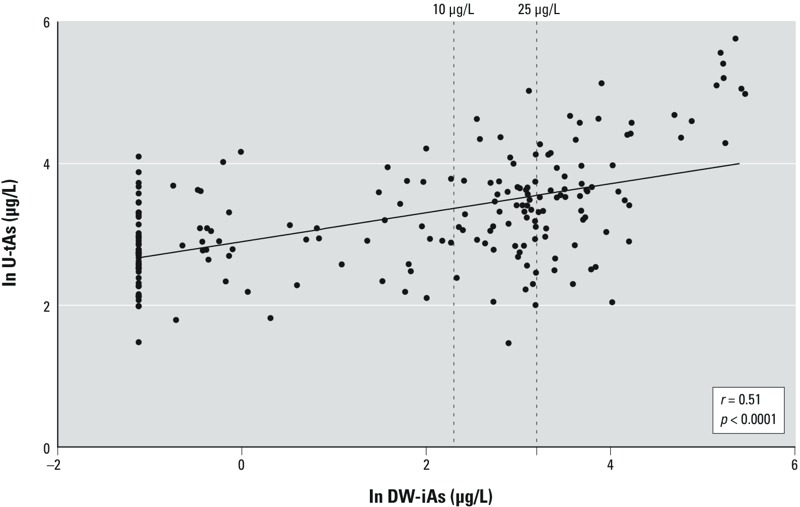
DW-iAs for the study subjects ranged from < 0.5 to 236 μg As/L. More than half of the women (53%) had DW-iAs that exceeded the World Health Organization's recommended guideline of 10 μg As/L. DW-iAs was significantly associated with the sum of the urinary arsenicals (U-tAs). Maternal urinary concentrations of MMAs were negatively associated with newborn birth weight and gestational age. Maternal urinary concentrations of iAs were associated with lower mean gestational age and newborn length.
Biomonitoring results demonstrate that pregnant women in Gómez Palacio are exposed to potentially harmful levels of DW-iAs. The data support a relationship between iAs metabolism in pregnant women and adverse birth outcomes. The results underscore the risks associated with iAs exposure in vulnerable populations.
饮用水中无机砷(iAs)的暴露是一个全球性的公共卫生问题,但对于易感人群的暴露程度仍有许多未知之处。
我们旨在墨西哥戈麦斯·帕拉西奥建立砷暴露生物标志物(BEAR)前瞻性妊娠队列,以更好地了解iAs暴露对孕妇及其子女的影响。
本研究招募了200名孕妇。测定了饮用水中iAs的浓度(DW-iAs)以及母体尿液中iAs及其单甲基化和二甲基化代谢物(分别为MMA和DMA)的浓度。分析了出生结局与DW-iAs以及母体尿液砷化物的浓度和比例之间的关系。
研究对象的DW-iAs范围为<0.5至236μg As/L。超过一半的女性(53%)的DW-iAs超过了世界卫生组织推荐的10μg As/L的指导标准。DW-iAs与尿液砷化物总和(U-tAs)显著相关。母体尿液中MMA的浓度与新生儿出生体重和孕周呈负相关。母体尿液中iAs的浓度与较低的平均孕周和新生儿身长相关。
生物监测结果表明,戈麦斯·帕拉西奥的孕妇暴露于潜在有害水平的DW-iAs。数据支持孕妇体内iAs代谢与不良出生结局之间的关系。结果强调了易感人群中与iAs暴露相关的风险。