Coronary Care Unit, National Institute of Cardiology in Mexico City, Mexico City, Mexico.
Department of Clinical Research, National Institute of Cardiology in Mexico City, Mexico City, Mexico.
Ther Clin Risk Manag. 2014 Oct 6;10:815-23. doi: 10.2147/TCRM.S67945. eCollection 2014.
Among patients with coronary artery disease (CAD), 80%-90% present at least one conventional risk factor. On the other hand, lipid profile modification after a cardiovascular event related to acute coronary syndrome (ACS) has been recognized. The prevalence of conventional risk factors and the lipid profile at the time of admission in patients with ACS and significant CAD (stenosis ≥50%) determined through coronary angiography is not well described.
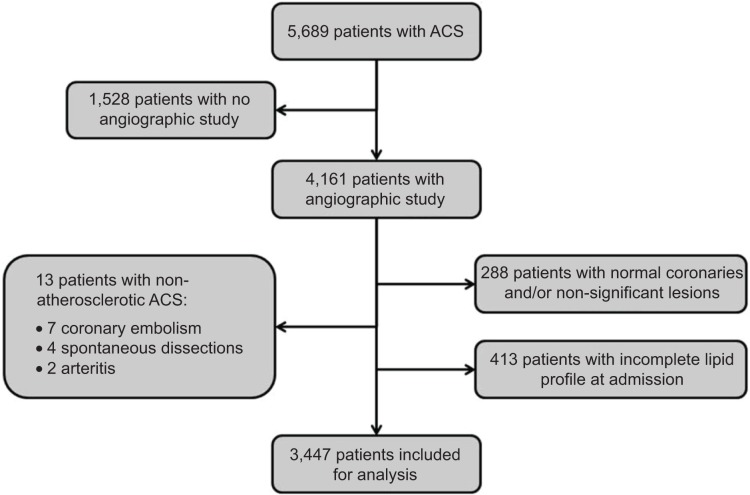
We studied 3,447 patients with a diagnosis of ACS and significant CAD with stenosis ≥50%, as shown o n angiography. We recorded the presence of conventional risk factors, including smoking, hypertension, dyslipidemia, and diabetes. In addition, we analyzed the lipid profiles within the first 24 hours of admission. We analyzed the studied population and compared findings according to sex.
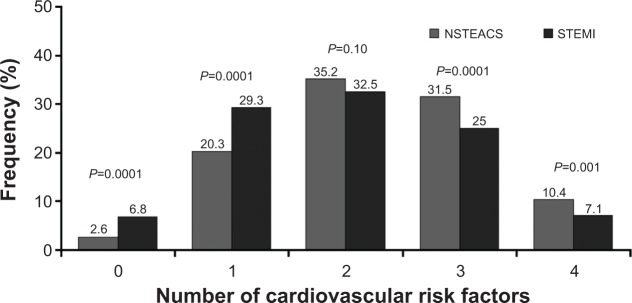
Most patients (81.7%) were male. ST-elevation myocardial infarction was present in 51.3% of patients, and non-ST-elevation acute coronary syndrome was present in 48.7%. The most frequent risk factor was smoking, which was present in 68% of patients, followed by hypertension (57.8%), dyslipidemia (47.5%), and diabetes (37.7%). In women, the most frequent risk factors were hypertension, diabetes, and dyslipidemia, whereas in men, smoking was the most frequent. We identified at least one risk factor in 95.7% of all patients, two or three risk factors in 62%, and four risk factors in 8.6% of patients. The lipid profile analysis revealed that 85.1% of patients had some type of dyslipidemia, and the most frequent was low levels of high-density lipoprotein cholesterol (68.6% of cases).
We found at least one conventional risk factor in 95.7% of patients with ACS and significant CAD. The lipid profile analysis revealed that two thirds of cases had low high-density lipoprotein cholesterol levels.
在患有冠状动脉疾病(CAD)的患者中,80%-90%至少存在一种传统危险因素。另一方面,急性冠状动脉综合征(ACS)相关心血管事件后的血脂谱改变已得到认可。ACS 合并严重 CAD(狭窄≥50%)患者的传统危险因素患病率和入院时的血脂谱尚未得到充分描述。
我们研究了 3447 例经冠状动脉造影诊断为 ACS 合并严重 CAD(狭窄≥50%)的患者。我们记录了传统危险因素的存在情况,包括吸烟、高血压、血脂异常和糖尿病。此外,我们还分析了入院后 24 小时内的血脂谱。我们分析了研究人群,并按性别进行了比较。
大多数患者(81.7%)为男性。51.3%的患者为 ST 段抬高型心肌梗死,48.7%为非 ST 段抬高型急性冠状动脉综合征。最常见的危险因素是吸烟,占 68%,其次是高血压(57.8%)、血脂异常(47.5%)和糖尿病(37.7%)。女性最常见的危险因素是高血压、糖尿病和血脂异常,而男性最常见的危险因素是吸烟。我们发现所有患者中有 95.7%至少存在一种危险因素,62%有两种或三种危险因素,8.6%有四种危险因素。血脂谱分析显示,85.1%的患者存在某种类型的血脂异常,最常见的是高密度脂蛋白胆固醇水平降低(68.6%的病例)。
我们发现 ACS 合并严重 CAD 的患者中有 95.7%至少存在一种传统危险因素。血脂谱分析显示,三分之二的病例存在低水平高密度脂蛋白胆固醇。