Ibrahim Luka Mangveep, Hadjia Idris Suleiman, Nguku Patrick, Waziri Ndadilnasiya Endie, Akhimien Moses Obiemen, Patrobas Phillip, Nsubuga Peter
Nigeria Field Epidemiology and Laboratory Training Programme, Nigeria.
Department of Community Medicine, Ahmadu Bello University, Zaria, Nigeria.
Pan Afr Med J. 2014 Jul 21;18 Suppl 1(Suppl 1):8. doi: 10.11694/pamj.supp.2014.18.1.3408. eCollection 2014.
Tuberculosis (TB) is a public health problem in Nigeria. Adherence to the total duration of treatment is critical to cure the patients. We explored the knowledge of the health care workers on management of TB patients including their perceived reasons for patient non adherence to treatment to develop strategies to improve the quality of the TB control service in the state.
We conducted a cross sectional study. We used self administered questionnaire to extract information from the health workers on their trainings for TB control, knowledge of the control services, patients' education including prevention of defaulting from treatment. We conducted focus group discussion with the health care workers. We performed descriptive analysis using epiInfo software.
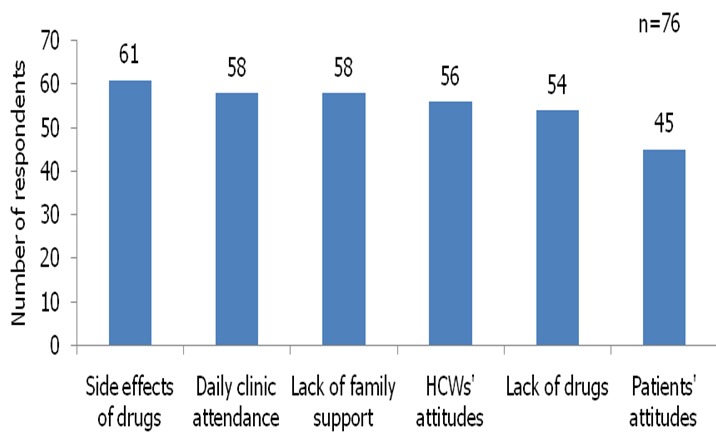
Of the 76 respondents 41 (53.9%) were female, 39.9% were community health extension workers, 26.3% were nurses/midwifes 30.3% lacked training on management of TB patient. Only 43.4% knew when to take action on patients who miss their drugs in the intensive phase, 30.3% and 35.5% knew defaults among category 1 and category 2 in the continuation phases of treatment respectively. They identified side effects of drugs (80%), daily clinic attendance (76.3%), health workers attitude (73.4%) and lack of knowledge on duration of treatment (71.1%) including their unfriendly attitudes towards the patients as the major barriers to patients' adherence to treatment.
Lack of knowledge of the health care workers on management of TB patients and poor interpersonal relation and communication with patients have negative effect on patients' adherence to the long duration of TB treatment.
结核病是尼日利亚的一个公共卫生问题。坚持整个治疗疗程对于治愈患者至关重要。我们探讨了医护人员对结核病患者管理的知识,包括他们认为患者不坚持治疗的原因,以制定提高该州结核病控制服务质量的策略。
我们进行了一项横断面研究。我们使用自填式问卷从医护人员那里获取有关他们结核病控制培训、控制服务知识、患者教育(包括预防治疗中断)的信息。我们与医护人员进行了焦点小组讨论。我们使用EpiInfo软件进行描述性分析。
在76名受访者中,41名(53.9%)为女性,39.9%是社区卫生推广工作者,26.3%是护士/助产士,30.3%缺乏结核病患者管理培训。只有43.4%的人知道在强化期对错过服药的患者何时采取行动,在治疗延续期,分别只有30.3%和35.5%的人知道1类和2类患者的治疗中断情况。他们认为药物副作用(80%)、每日到诊所就诊(76.3%)、医护人员态度(73.4%)以及对治疗疗程缺乏了解(71.1%),包括他们对患者不友好的态度,是患者坚持治疗的主要障碍。
医护人员对结核病患者管理知识的缺乏以及与患者不良的人际关系和沟通对患者坚持长时间的结核病治疗产生负面影响。