Qiu Qian, Li Yan, Duan Xiao-wan, Yang Li-kun, Chen Yu, Li Hui, Wang Li, Duan Zhong-ping
Dept of Epidemiology and Biostatistics, Institute of Basic Medical Sciences Chinese Academy of Medical Sciences, School of Basic Medicine Peking Union Medical College, Beijing, China.
Liver center, Beijing You'an Hospital of Capital Medical University, Beijing, China.
PLoS One. 2014 Oct 16;9(10):e109652. doi: 10.1371/journal.pone.0109652. eCollection 2014.
Hepatitis B virus (HBV) infection is a significant clinical and financial burden for chronic hepatitis B (CHB) patients. In Beijing, China, partial reimbursement on antiviral agents was first implemented for the treatment of CHB patients in July 1, 2011.
In this study, we describe the medical cost and utilization rates of antiviral therapy for CHB patients to explore the impact of the new partial reimbursement policy on the medical care cost, the composition, and antivirals utilization.
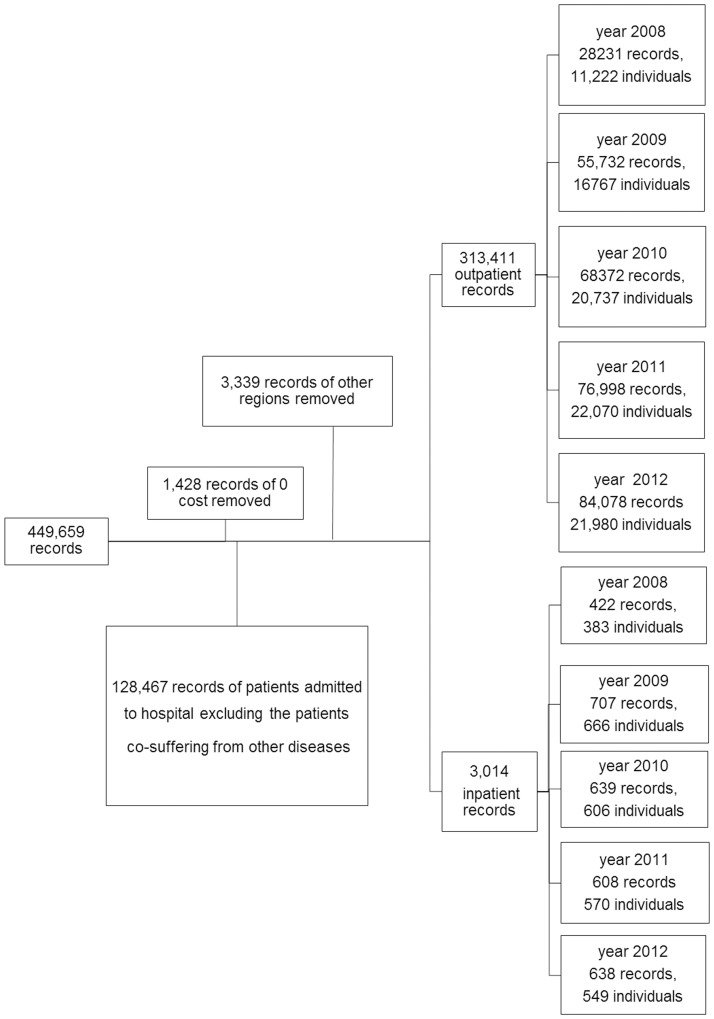
Clinical and claims data of a retrospective cohort of 92,776 outpatients and 2,774 inpatients with non-cirrhotic CHB were retrieved and analyzed from You'an Hospital, Beijing between February 14, 2008 and December 31, 2012. The propensity score matching was used to adjust factors associated with the annual total cost, including age, gender, medical insurance type and treatment indicator.
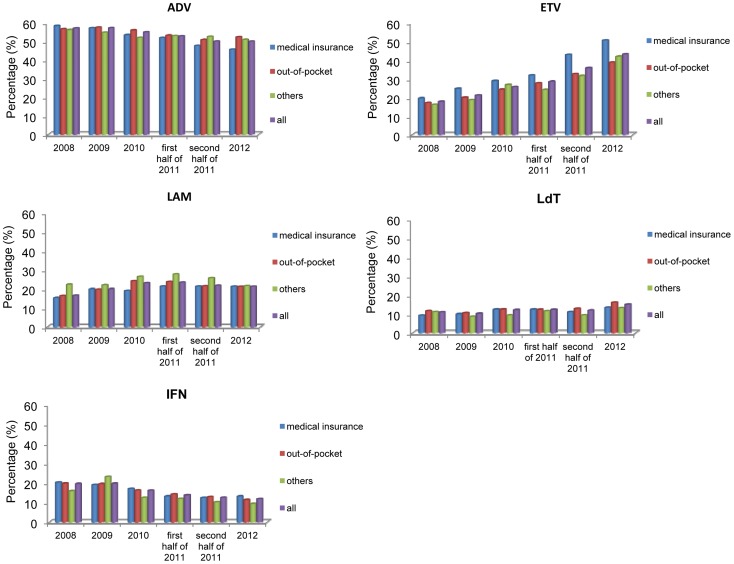
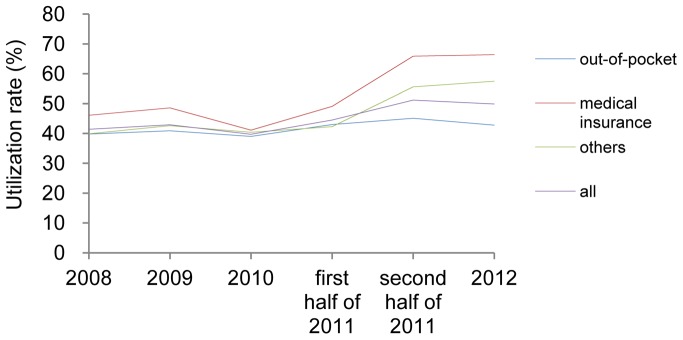
Compared to patients who paid out-of-pocket, medical cost, especially antiviral costs increased greater among patients with medical insurance after July 1, 2011, the start date of reimbursement policy. Outpatients with medical insurance had 16% more antiviral utilization; usage increased 3% among those who paid out-of-pocket after the new partial reimbursement policy was implemented.
Direct medical costs and antiviral utilization rates of CHB patients with medical insurance were higher than those from paid out-of-pocket payments, even after adjusting for inflation and other factors. Thus, a new partial reimbursement program may positively optimize the cost and standardization of antiviral treatment.
乙型肝炎病毒(HBV)感染给慢性乙型肝炎(CHB)患者带来了重大的临床和经济负担。在中国北京,自2011年7月1日起首次对CHB患者的抗病毒药物实施部分报销政策。
在本研究中,我们描述了CHB患者抗病毒治疗的医疗费用和使用率,以探讨新的部分报销政策对医疗费用、构成以及抗病毒药物使用的影响。
检索并分析了2008年2月14日至2012年12月31日期间北京佑安医院92776例门诊和2774例非肝硬化CHB住院患者的回顾性队列的临床和理赔数据。采用倾向得分匹配法来调整与年度总成本相关的因素,包括年龄、性别、医疗保险类型和治疗指标。
与自费患者相比,在2011年7月1日报销政策开始实施后,医疗保险患者的医疗费用尤其是抗病毒药物费用增长幅度更大。有医疗保险的门诊患者抗病毒药物使用率提高了16%;在新的部分报销政策实施后,自费患者的使用率提高了3%。
即使在调整了通货膨胀和其他因素后,有医疗保险的CHB患者的直接医疗费用和抗病毒药物使用率仍高于自费患者。因此,新的部分报销计划可能会积极优化抗病毒治疗的成本和标准化。