Perkins Arden, Phillips Jessica L, Kerkvliet Nancy I, Tanguay Robert L, Perdew Gary H, Kolluri Siva K, Bisson William H
Department of Biochemistry and Biophysics, Oregon State University, Corvallis, OR 97331, USA.
Cancer Research Laboratory, Corvallis, OR 97331, USA.
Biology (Basel). 2014 Oct 17;3(4):645-69. doi: 10.3390/biology3040645.
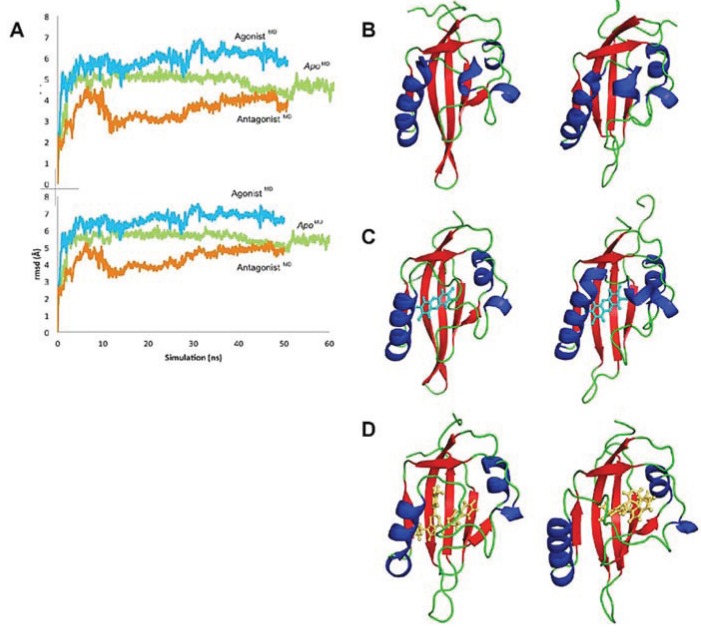
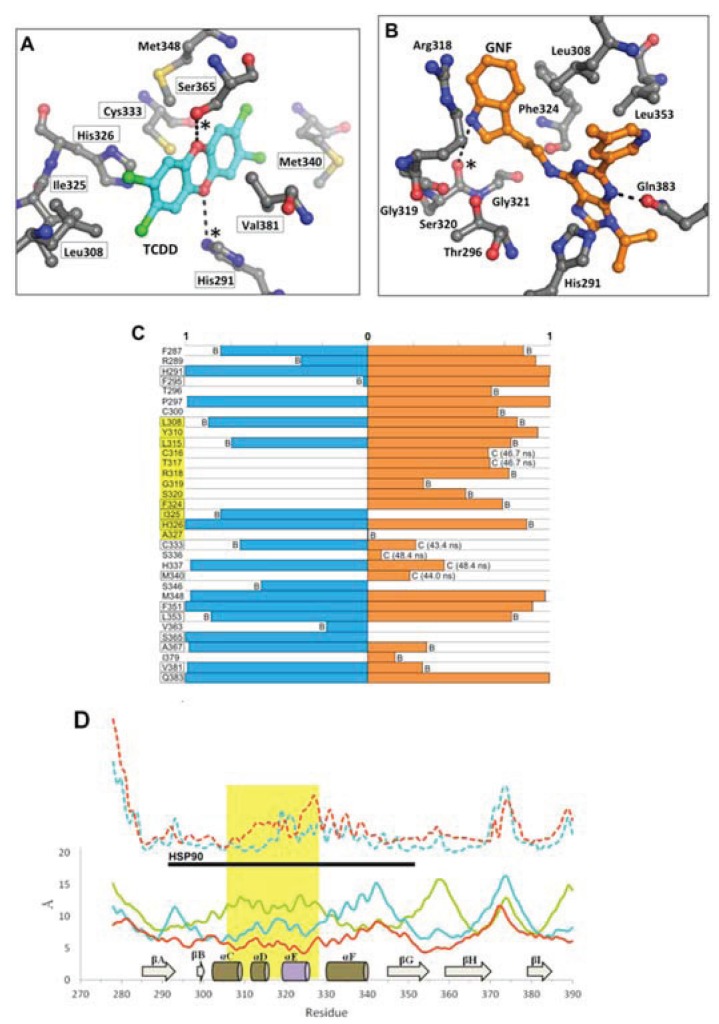
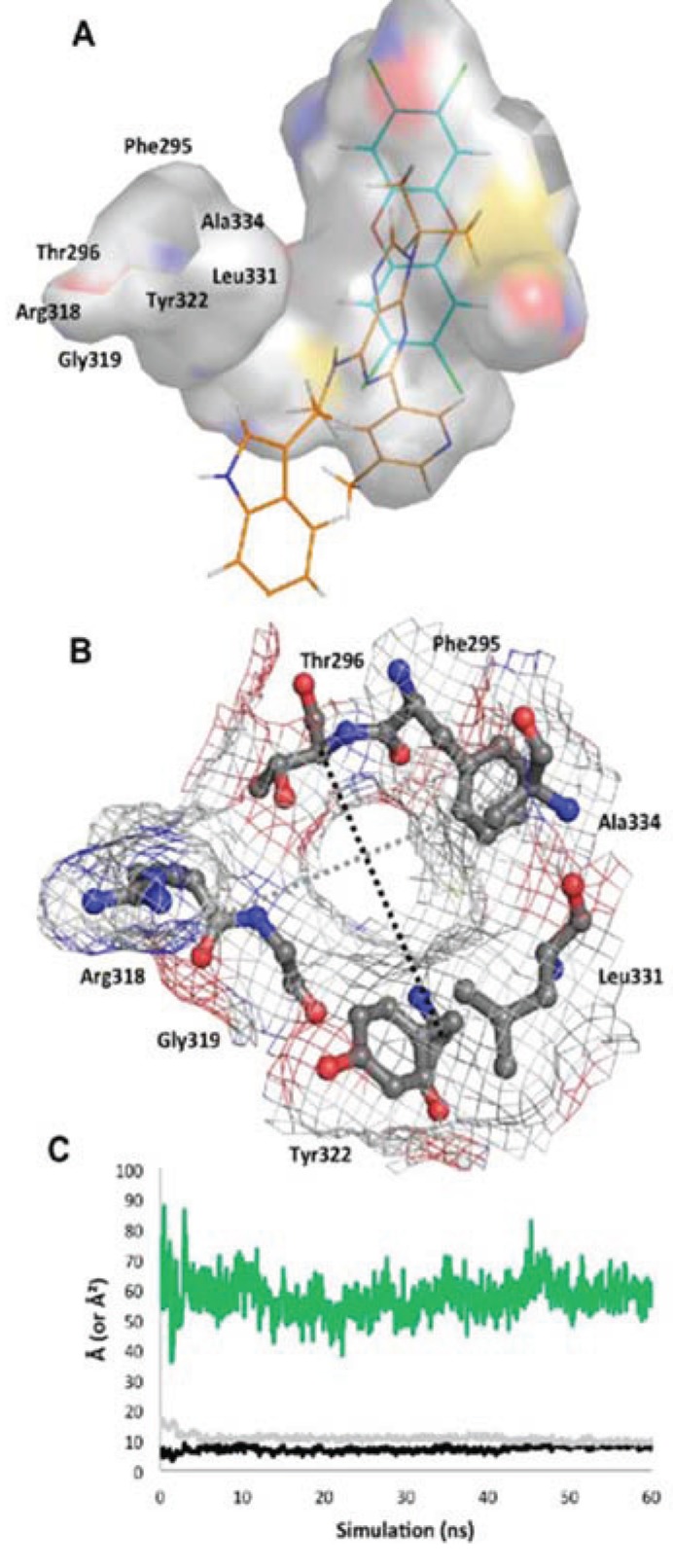
The aryl hydrocarbon receptor (AHR) is a ligand-activated transcription factor that regulates the expression of a diverse group of genes. Exogenous AHR ligands include the environmental contaminant 2,3,7,8-tetrachlorodibenzo-p-dioxin (TCDD), which is a potent agonist, and the synthetic AHR antagonist N-2-(1H-indol-3yl)ethyl)-9-isopropyl-2- (5-methylpyridin-3-yl)-9H-purin-6-amine (GNF351). As no experimentally determined structure of the ligand binding domain exists, homology models have been utilized for virtual ligand screening (VLS) to search for novel ligands. Here, we have developed an "agonist-optimized" homology model of the human AHR ligand binding domain, and this model aided in the discovery of two human AHR agonists by VLS. In addition, we performed molecular dynamics simulations of an agonist TCDD-bound and antagonist GNF351-bound version of this model in order to gain insights into the mechanics of the AHR ligand-binding pocket. These simulations identified residues 307-329 as a flexible segment of the AHR ligand pocket that adopts discrete conformations upon agonist or antagonist binding. This flexible segment of the AHR may act as a structural switch that determines the agonist or antagonist activity of a given AHR ligand.
芳烃受体(AHR)是一种配体激活的转录因子,可调节多种基因的表达。外源性AHR配体包括环境污染物2,3,7,8-四氯二苯并对二恶英(TCDD),它是一种强效激动剂,以及合成的AHR拮抗剂N-2-(1H-吲哚-3基)乙基)-9-异丙基-2-(5-甲基吡啶-3基)-9H-嘌呤-6-胺(GNF351)。由于不存在配体结合域的实验确定结构,因此同源模型已被用于虚拟配体筛选(VLS)以寻找新型配体。在这里,我们开发了一种人类AHR配体结合域的“激动剂优化”同源模型,该模型通过VLS辅助发现了两种人类AHR激动剂。此外,我们对该模型的激动剂TCDD结合和拮抗剂GNF351结合版本进行了分子动力学模拟,以便深入了解AHR配体结合口袋的机制。这些模拟确定残基307-329是AHR配体口袋的一个柔性片段,在激动剂或拮抗剂结合时采用离散构象。AHR的这个柔性片段可能作为一个结构开关,决定给定AHR配体的激动剂或拮抗剂活性。