Kim Jong Hun, Song Pamela, Lim Hyunsun, Lee Jae-Hyung, Lee Jun Hong, Park Sun Ah
Department of Neurology, Dementia Center, Stroke Center, Ilsan hospital, National Health Insurance Service, Goyang-shi, South Korea.
Department of Neurology, Inje University Ilsan Paik Hospital, Goyang-shi, South Korea.
PLoS One. 2014 Oct 20;9(10):e107983. doi: 10.1371/journal.pone.0107983. eCollection 2014.
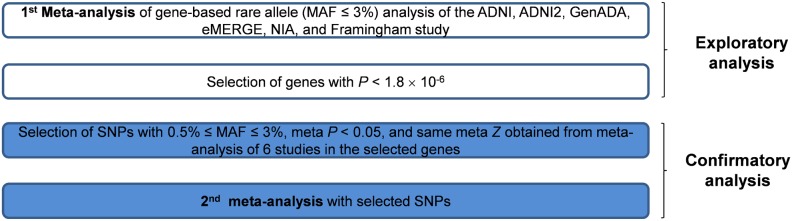
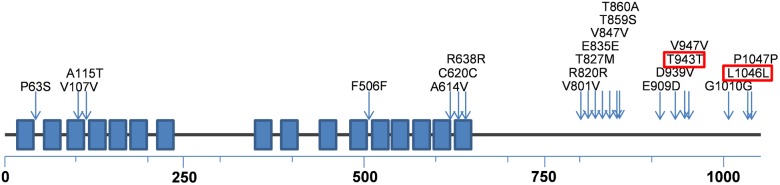
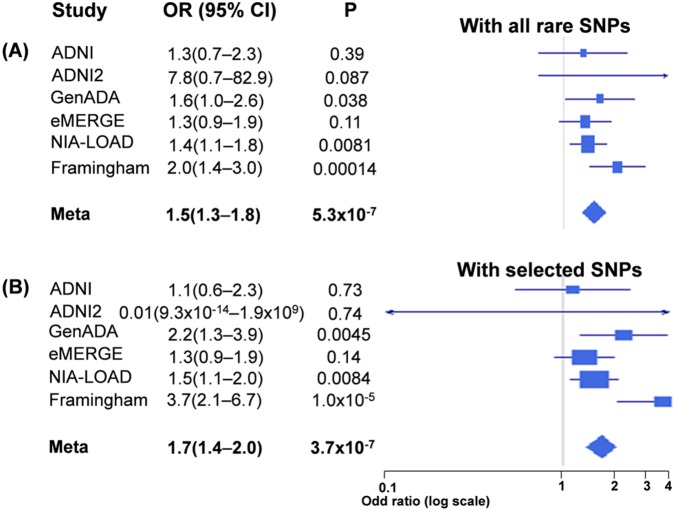
Alzheimer's disease (AD) has a strong propensity to run in families. However, the known risk genes excluding APOE are not clinically useful. In various complex diseases, gene studies have targeted rare alleles for unsolved heritability. Our study aims to elucidate previously unknown risk genes for AD by targeting rare alleles. We used data from five publicly available genetic studies from the Alzheimer's Disease Neuroimaging Initiative (ADNI) and the database of Genotypes and Phenotypes (dbGaP). A total of 4,171 cases and 9,358 controls were included. The genotype information of rare alleles was imputed using 1,000 genomes. We performed gene-based analysis of rare alleles (minor allele frequency≤3%). The genome-wide significance level was defined as meta P<1.8×10(-6) (0.05/number of genes in human genome = 0.05/28,517). ZNF628, which is located at chromosome 19q13.42, showed a genome-wide significant association with AD. The association of ZNF628 with AD was not dependent on APOE ε4. APOE and TREM2 were also significantly associated with AD, although not at genome-wide significance levels. Other genes identified by targeting common alleles could not be replicated in our gene-based rare allele analysis. We identified that rare variants in ZNF628 are associated with AD. The protein encoded by ZNF628 is known as a transcription factor. Furthermore, the associations of APOE and TREM2 with AD were highly significant, even in gene-based rare allele analysis, which implies that further deep sequencing of these genes is required in AD heritability studies.
阿尔茨海默病(AD)具有很强的家族聚集倾向。然而,除APOE外的已知风险基因在临床上并无实用价值。在各种复杂疾病中,基因研究针对未解决的遗传力靶向罕见等位基因。我们的研究旨在通过靶向罕见等位基因来阐明AD之前未知的风险基因。我们使用了来自阿尔茨海默病神经影像倡议(ADNI)和基因型与表型数据库(dbGaP)的五项公开可用基因研究的数据。共纳入4171例病例和9358例对照。使用千人基因组对罕见等位基因的基因型信息进行了推算。我们对罕见等位基因(次要等位基因频率≤3%)进行了基于基因的分析。全基因组显著性水平定义为meta P<1.8×10⁻⁶(0.05/人类基因组中的基因数量 = 0.05/28517)。位于19号染色体q13.42的ZNF628与AD呈现全基因组显著关联。ZNF628与AD的关联不依赖于APOE ε4。APOE和TREM2也与AD显著相关,尽管未达到全基因组显著性水平。通过靶向常见等位基因鉴定出的其他基因在我们基于基因的罕见等位基因分析中无法重复。我们确定ZNF628中的罕见变异与AD相关。ZNF628编码的蛋白质是一种转录因子。此外,即使在基于基因的罕见等位基因分析中,APOE和TREM2与AD的关联也非常显著,这意味着在AD遗传力研究中需要对这些基因进行进一步的深度测序。