Tresukosol Damrus, Suktitipat Bhoom, Hunnangkul Saowalak, Kamkaew Ruttakarn, Poldee Saiphon, Tassaneetrithep Boonrat, Likidlilid Atip
Division of Cardiology, Department of Internal Medicine, Faculty of Medicine, Siriraj Hospital, Mahidol University, Siriraj, Bangkoknoi, Bangkok, Thailand.
Department of Biochemistry, Faculty of Medicine, Siriraj Hospital, Mahidol University, Siriraj, Bangkoknoi, Bangkok, Thailand; Integrative Computation BioScience Center (ICBS), Mahidol University, Salaya, Nakhon Prathom, Thailand.
PLoS One. 2014 Oct 16;9(10):e110188. doi: 10.1371/journal.pone.0110188. eCollection 2014.
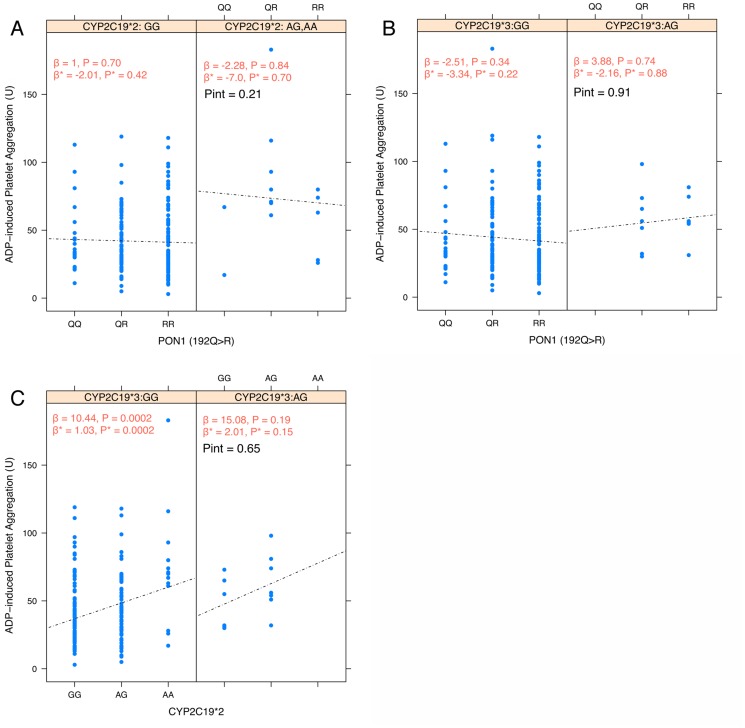
Clopidogrel is an antiplatelet prodrug that is recommended to reduce the risk of recurrent thrombosis in coronary artery disease (CAD) patients. Paraoxonase 1 (PON1) is suggested to be a rate-limiting enzyme in the conversion of 2-oxo-clopidogrel to active thiol metabolite with inconsistent results. Here, we sought to determine the associations of CYP2C19 and PON1 gene polymorphisms with clopidogrel response and their role in ADP-induced platelet aggregation. Clopidogrel response and platelet aggregation were determined using Multiplate aggregometer in 211 patients with established CAD who received 75 mg clopidogrel and 75-325 mg aspirin daily for at least 14 days. Polymorphisms in CYP2C19 and PON1 were genotyped and tested for association with clopidogrel resistance. Linkage disequilibrium (LD) and their epistatic interaction effects on ADP-induced platelet aggregation were analysed. The prevalence of clopidogrel resistance in this population was approximately 33.2% (n = 70). The frequencies of CYP2C19*2 and 3 were significantly higher in non-responder than those in responders. After adjusting for established risk factors, CYP2C192 and *3 alleles independently increased the risk of clopidogrel resistance with adjusted ORs 2.94 (95%CI, 1.65-5.26; p<0.001) and 11.26 (95%CI, 2.47-51.41; p = 0.002, respectively). Patients with *2 or 3 allele and combined with smoking, diabetes and increased platelet count had markedly increased risk of clopidogrel resistance. No association was observed between PON1 Q192R and clopidogrel resistance (adjusted OR = 1.13, 95%CI, 0.70-1.82; p = 0.622). Significantly higher platelet aggregation values were found in CYP2C192 and *3 patients when compared with *1/1 allele carriers (p = 1.98 × 10(-6)). For PON1 Q192R genotypes, aggregation values were similar across all genotype groups (p = 0.359). There was no evidence of gene-gene interaction or LD between CYP2C19 and PON1 polymorphisms on ADP-induced platelet aggregation. Our findings indicated that only CYP2C192 and *3 alleles had an influence on clopidogrel resistance. The risk of clopidogrel resistance increased further with smoking, diabetes, and increased platelet count.
氯吡格雷是一种抗血小板前体药物,推荐用于降低冠状动脉疾病(CAD)患者复发性血栓形成的风险。对氧磷酶1(PON1)被认为是2-氧代氯吡格雷转化为活性硫醇代谢物过程中的限速酶,但相关研究结果并不一致。在此,我们旨在确定CYP2C19和PON1基因多态性与氯吡格雷反应的关联及其在ADP诱导的血小板聚集过程中的作用。我们使用多电极血小板聚集仪,对211例确诊为CAD且每天服用75mg氯吡格雷和75 - 325mg阿司匹林至少14天的患者进行了氯吡格雷反应和血小板聚集的测定。对CYP2C19和PON1的多态性进行基因分型,并检测其与氯吡格雷抵抗的相关性。分析了连锁不平衡(LD)及其上位性相互作用对ADP诱导的血小板聚集的影响。该人群中氯吡格雷抵抗的发生率约为33.2%(n = 70)。CYP2C192和3在无反应者中的频率显著高于反应者。在调整既定风险因素后,CYP2C192和3等位基因独立增加氯吡格雷抵抗的风险,调整后的OR值分别为2.94(95%CI,1.65 - 5.26;p<0.001)和11.26(95%CI,2.47 - 51.41;p = 0.002)。携带2或3等位基因且合并吸烟、糖尿病和血小板计数增加的患者,氯吡格雷抵抗的风险显著增加。未观察到PON1 Q192R与氯吡格雷抵抗之间的关联(调整后的OR = 1.13,95%CI,0.70 - 1.82;p = 0.622)。与1/1等位基因携带者相比,CYP2C192和3患者的血小板聚集值显著更高(p = 1.98×10⁻⁶)。对于PON1 Q192R基因型,所有基因型组的聚集值相似(p = 0.359)。没有证据表明CYP2C19和PON1多态性在ADP诱导的血小板聚集上存在基因 - 基因相互作用或LD。我们的研究结果表明,只有CYP2C192和3等位基因对氯吡格雷抵抗有影响。吸烟、糖尿病和血小板计数增加会进一步增加氯吡格雷抵抗的风险。