Mohammed Riazuddin, Hayward Keith, Mulay Sanjay, Bindi Frank, Wallace Murray
Wrightington Hospital, Appley Bridge, Wigan, WN6 9EP, UK,
J Orthop Traumatol. 2015 Mar;16(1):9-13. doi: 10.1007/s10195-014-0324-9. Epub 2014 Oct 21.
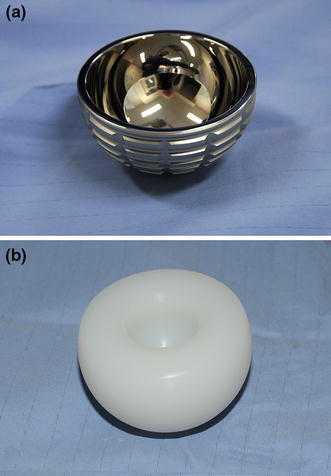
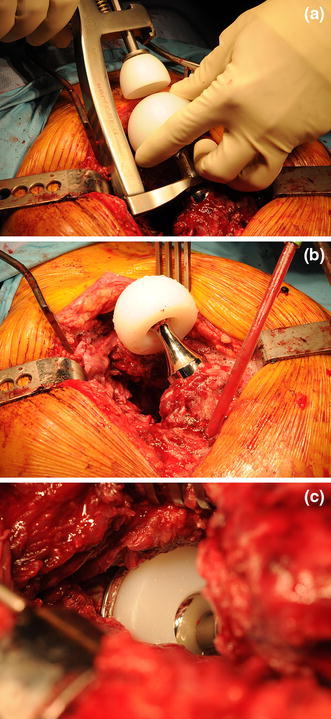
The concept of a dual-mobility hip socket involves the standard femoral head component encased in a larger polyethylene liner, which in turn articulates inside a metal shell implanted in the native acetabulum. The aim of this study was to assess outcomes from using a Serf Novae(®) Dual Mobility Acetabular cup (Orthodynamics Ltd, Gloucestershire, UK) to address the problem of instability in primary and revision total hip arthroplasty (THA).
A retrospective review was carried out of all hip arthroplasties performed in a District General Hospital utilising the dual-mobility socket from January 2007 to December 2012. Clinical and radiological outcomes were analysed for 44 hips in 41 patients, comprising 20 primary and 24 revision THA. The average age of the study group was 70.8 years (range 56-84 years) for primary and 76.4 years (range 56-89 years) for revision arthroplasty. Among the primary THA, always performed for hip osteoarthritis or in presence of osteoarthritic changes, the reasons to choose a dual mobility cup were central nervous system problems such as Parkinson's disease, stroke, dementia (10), hip fracture (5), failed hip fracture fixation (2), severe fixed hip deformity (2) and diffuse peripheral neuropathy (1). The indications for revisions were recurrent dislocation (17), aseptic loosening with abductor deficiency (4), failed hemiarthroplasty with abductor deficiency (2) and neglected dislocation (1).
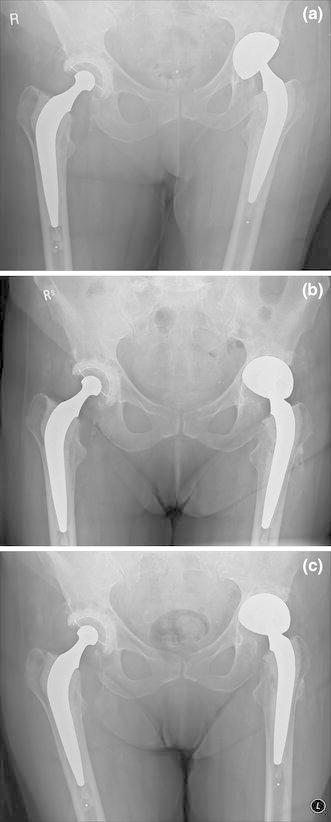
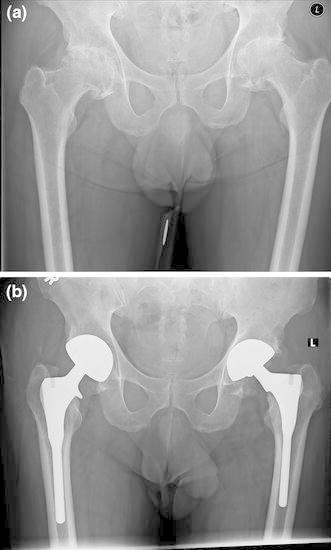
At a mean follow-up of 22 months (range 6-63 months), none of the hips had any dislocation, instability or infection and no further surgical intervention was required. Radiological assessment showed that one uncemented socket in a revision arthroplasty performed for recurrent dislocation had changed position, but was stable in the new position. The patient did not have complications from this and did not need any surgical intervention.
Even though postoperative hip stability depends on several factors other than design-related ones, our study shows promising early results for reducing the risk of instability in this challenging group of patients undergoing primary and revision hip arthroplasty.
IV.
双动髋关节臼的概念是指标准股骨头组件被包裹在一个更大的聚乙烯内衬中,该内衬又在植入天然髋臼的金属壳内进行关节活动。本研究的目的是评估使用Serf Novae(®)双动髋臼杯(英国格洛斯特郡Orthodynamics有限公司)解决初次和翻修全髋关节置换术(THA)中不稳定问题的效果。
对2007年1月至2012年12月在一家地区综合医院使用双动髋臼杯进行的所有髋关节置换术进行回顾性研究。分析了41例患者44髋的临床和影像学结果,包括20例初次THA和24例翻修THA。研究组初次置换患者的平均年龄为70.8岁(范围56 - 84岁),翻修置换患者的平均年龄为76.4岁(范围56 - 89岁)。在因髋关节骨关节炎或存在骨关节炎改变而进行的初次THA中,选择双动髋臼杯的原因包括中枢神经系统问题,如帕金森病、中风、痴呆(10例)、髋部骨折(5例)、髋部骨折内固定失败(2例)、严重固定性髋部畸形(2例)和弥漫性周围神经病变(1例)。翻修的指征包括复发性脱位(17例)、伴有外展肌缺损的无菌性松动(4例)、伴有外展肌缺损的半髋关节置换失败(2例)和陈旧性脱位(1例)。
平均随访22个月(范围6 - 63个月),所有髋关节均无脱位、不稳定或感染,无需进一步手术干预。影像学评估显示,1例因复发性脱位进行翻修置换的非骨水泥髋臼杯位置发生改变,但在新位置稳定。患者未因此出现并发症,也无需任何手术干预。
尽管术后髋关节稳定性取决于设计相关因素以外的其他多种因素,但我们的研究显示,在这一具有挑战性的初次和翻修髋关节置换患者群体中,降低不稳定风险的早期结果令人鼓舞。
IV级。