Mathur Gagan, Haugen Thomas H, Davis Scott L, Krasowski Matthew D
Department of Pathology, University of Iowa Hospitals and Clinics, Iowa City, IA, USA.
Department of Pathology, University of Iowa Hospitals and Clinics, Iowa City, IA, USA ; Department of Pathology, Veteran Affairs Medical Centre, Iowa City, IA, USA.
J Pathol Inform. 2014 Sep 30;5(1):36. doi: 10.4103/2153-3539.141990. eCollection 2014.
Interfacing of clinical laboratory instruments with the laboratory information system (LIS) via "middleware" software is increasingly common. Our clinical laboratory implemented capillary electrophoresis using a Sebia(®) Capillarys-2™ (Norcross, GA, USA) instrument for serum and urine protein electrophoresis. Using Data Innovations Instrument Manager, an interface was established with the LIS (Cerner) that allowed for bi-directional transmission of numeric data. However, the text of the interpretive pathology report was not properly transferred. To reduce manual effort and possibility for error in text data transfer, we developed scripts in AutoHotkey, a free, open-source macro-creation and automation software utility.
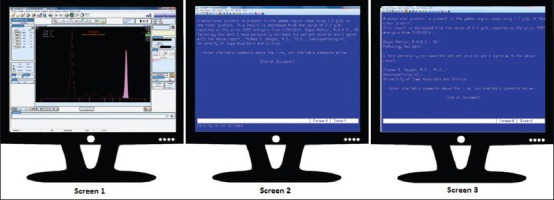
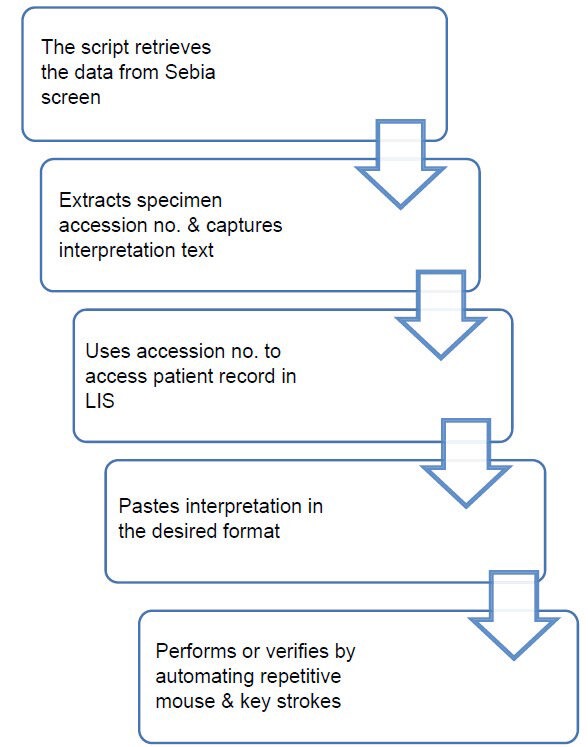
Scripts were written to create macros that automated mouse and key strokes. The scripts retrieve the specimen accession number, capture user input text, and insert the text interpretation in the correct patient record in the desired format.
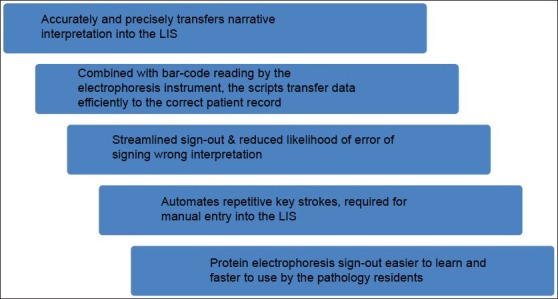
The scripts accurately and precisely transfer narrative interpretation into the LIS. Combined with bar-code reading by the electrophoresis instrument, the scripts transfer data efficiently to the correct patient record. In addition, the AutoHotKey script automated repetitive key strokes required for manual entry into the LIS, making protein electrophoresis sign-out easier to learn and faster to use by the pathology residents. Scripts allow for either preliminary verification by residents or final sign-out by the attending pathologist.
Using the open-source AutoHotKey software, we successfully improved the transfer of text data between capillary electrophoresis software and the LIS. The use of open-source software tools should not be overlooked as tools to improve interfacing of laboratory instruments.
临床检验仪器通过“中间件”软件与实验室信息系统(LIS)连接日益普遍。我们的临床实验室采用赛比(Sebia®)Capillarys-2™(美国佐治亚州诺克罗斯)仪器进行血清和尿蛋白电泳的毛细管电泳分析。利用数据创新仪器管理器,与LIS(erner)建立了接口,实现了数值数据的双向传输。然而,解释性病理报告的文本未能正确传输。为减少文本数据传输中的人工操作和错误可能性,我们用免费开源的宏创建与自动化软件工具AutoHotkey编写了脚本。
编写脚本创建宏,实现鼠标和按键操作自动化。这些脚本可检索标本编号,获取用户输入文本,并将文本解释以所需格式插入正确的患者记录中。
脚本准确无误地将叙述性解释传输到LIS中。结合电泳仪的条形码读取功能,脚本可高效地将数据传输到正确的患者记录中。此外,AutoHotKey脚本实现了手动录入LIS所需的重复按键操作自动化,使病理住院医师更易掌握蛋白电泳结果签出流程,且使用起来更快。脚本既允许住院医师进行初步验证,也允许主治病理学家进行最终签出。
利用开源的AutoHotKey软件,我们成功改善了毛细管电泳软件与LIS之间文本数据的传输。作为改善实验室仪器连接的工具,开源软件工具的作用不应被忽视。