Zhang Haiying, Jiao Ling, Cui Songye, Wang Liang, Tan Jian, Zhang Guizhi, He Yajing, Ruan Shuzhou, Fan Saijun, Zhang Wenyi
Tianjin Key Laboratory of Molecular Nuclear Medicine, Institute Of Radiation Medicine, Chinese Academy Of Medical Sciences & Peking Union Medical College, Tianjin 300192, China.
Department of Nuclear Medicine, Tianjin Medical University General Hospital, Tianjin 300052, China.
Int J Environ Res Public Health. 2014 Oct 21;11(10):10991-1003. doi: 10.3390/ijerph111010991.
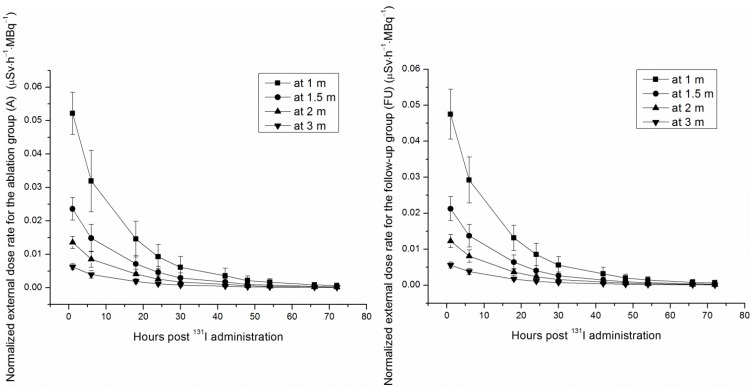
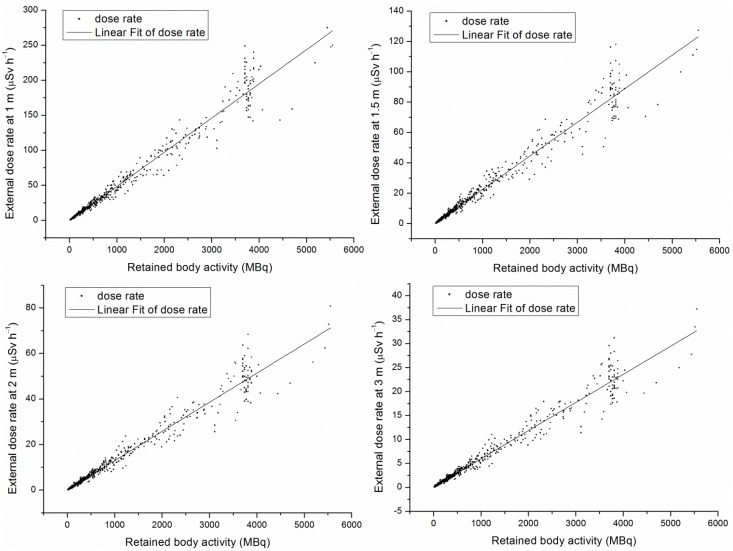
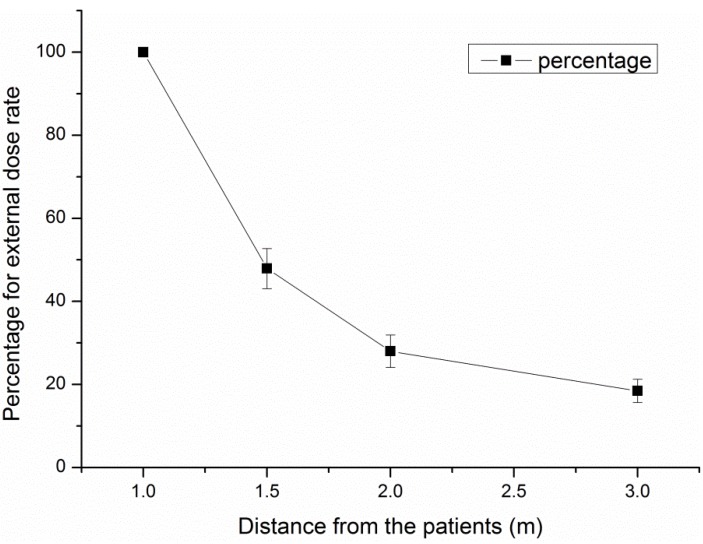
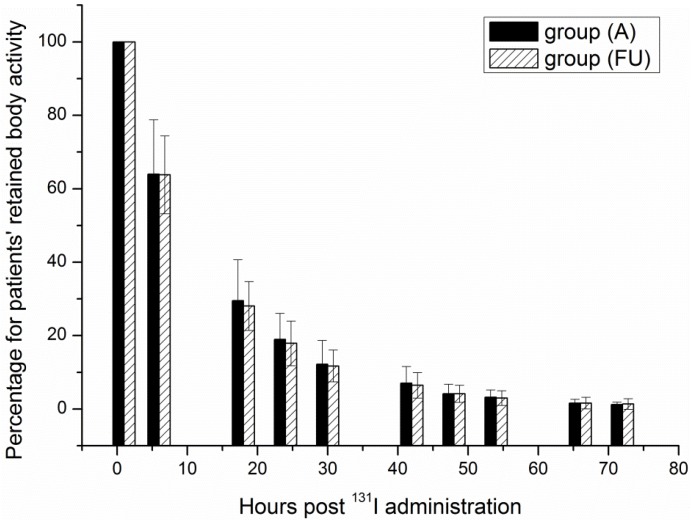
Radiation safety is an integral part of targeted radionuclide therapy. The aim of this work was to study the external dose rate and retained body activity as functions of time in differentiated thyroid carcinoma patients receiving 131I therapy. Seventy patients were stratified into two groups: the ablation group (A) and the follow-up group (FU). The patients' external dose rate was measured, and simultaneously, their retained body radiation activity was monitored at various time points. The equations of the external dose rate and the retained body activity, described as a function of hours post administration, were fitted. Additionally, the release time for patients was calculated. The reduction in activity in the group receiving a second or subsequent treatment was more rapid than the group receiving only the initial treatment. Most important, an expeditious method was established to indirectly evaluate the retained body activity of patients by measuring the external dose rate with a portable radiation survey meter. By this method, the calculated external dose rate limits are 19.2, 8.85, 5.08 and 2.32 μSv·h-1 at 1, 1.5, 2 and 3 m, respectively, according to a patient's released threshold level of retained body activity <400 MBq. This study is beneficial for radiation safety decision-making.
辐射安全是靶向放射性核素治疗不可或缺的一部分。本研究的目的是研究接受¹³¹I治疗的分化型甲状腺癌患者的外照射剂量率和体内滞留活度随时间的变化情况。70例患者被分为两组:消融组(A)和随访组(FU)。测量患者的外照射剂量率,同时在不同时间点监测其体内滞留的辐射活度。拟合了外照射剂量率和体内滞留活度随给药后小时数变化的方程。此外,还计算了患者的出院时间。接受第二次或后续治疗的组中活度的降低比仅接受初始治疗的组更快。最重要的是,建立了一种快速方法,通过使用便携式辐射检测仪测量外照射剂量率来间接评估患者体内的滞留活度。根据患者体内滞留活度<400MBq的出院阈值水平,通过该方法计算出在距离患者1、1.5、2和3米处的外照射剂量率限值分别为19.2、8.85、5.08和2.32μSv·h⁻¹。本研究有助于辐射安全决策。