Zhao Xingshan, Yin Xuejun, Li Xian, Yan Lijing L, Lam Christopher T, Li Shenshen, He Feng, Xie Wuxiang, Sang Ba, Luobu Gesang, Ke Liang, Wu Yangfeng
Department of Cardiology, Beijing Jishuitan Hospital, 4th medical college of Peking University, Beijing, China.
The George Institute for Global Health at Peking University Health Science Center, Beijing, China.
PLoS One. 2014 Oct 22;9(10):e110131. doi: 10.1371/journal.pone.0110131. eCollection 2014.
To evaluate the effects of a low-sodium and high-potassium salt-substitute on lowering blood pressure (BP) among Tibetans living at high altitude (4300 meters).
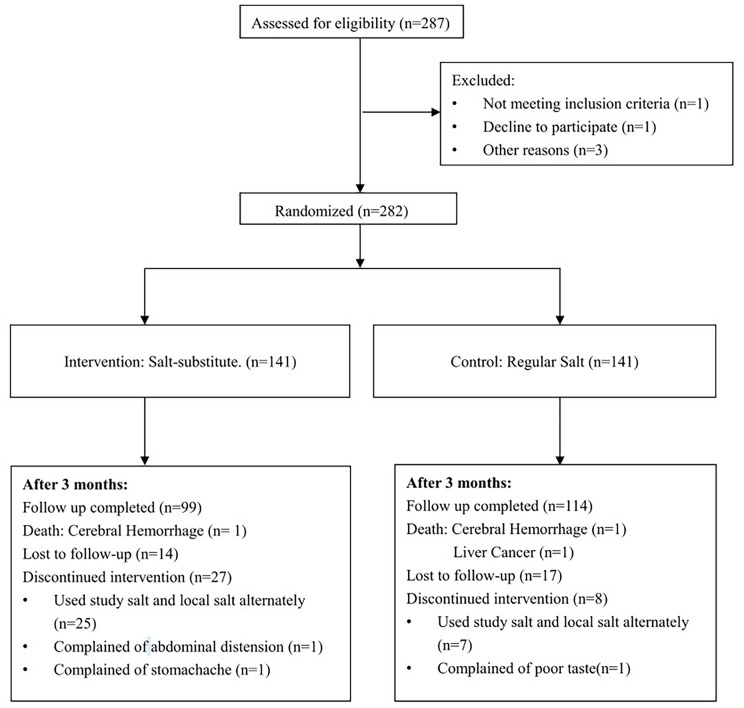
The study was a patient-blinded randomized controlled trial conducted between February and May 2009 in Dangxiong County, Tibetan Autonomous Region, China. A total of 282 Tibetans aged 40 or older with known hypertension (systolic BP≥140 mmHg) were recruited and randomized to intervention (salt-substitute, 65% sodium chloride, 25% potassium chloride and 10% magnesium sulfate) or control (100% sodium chloride) in a 1: 1 allocation ratio with three months' supply. Primary outcome was defined as the change in BP levels measured from baseline to followed-up with an automated sphygmomanometer. Per protocol (PP) and intention to treat (ITT) analyses were conducted.
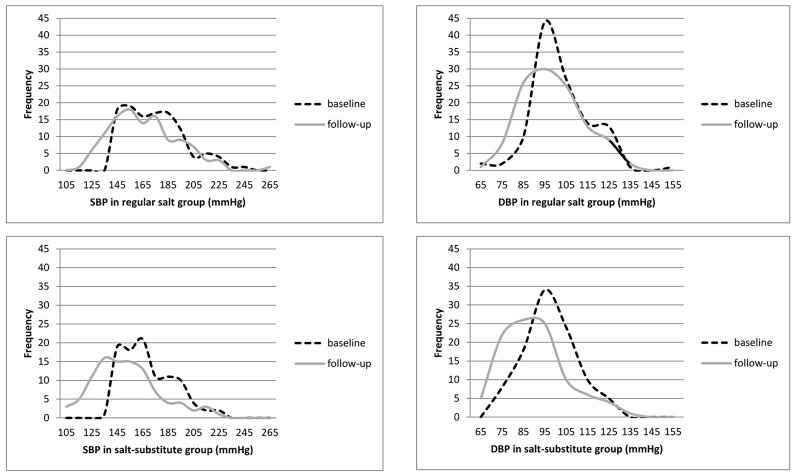
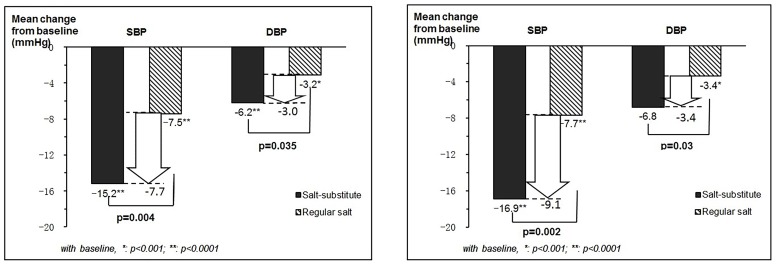
After the three months' intervention period, the net reduction in SBP/DBP in the intervention group in comparison to the control group was -8.2/-3.4 mmHg (all p<0.05) in PP analysis, after adjusting for baseline BP and other variables. ITT analysis showed the net reduction in SBP/DBP at -7.6/-3.5 mmHg with multiple imputations (all p<0.05). Furthermore, the whole distribution of blood pressure showed an overall decline in SBP/DBP and the proportion of patients with BP under control (SBP/DBP<140 mmHg) was significantly higher in salt-substitute group in comparison to the regular salt group (19.2% vs. 8.8%, p = 0.027).
Low sodium high potassium salt-substitute is effective in lowering both systolic and diastolic blood pressure and offers a simple, low-cost approach for hypertension control among Tibetans in China.
ClinicalTrials.gov NCT01429246.
评估低钠高钾盐替代品对生活在高海拔地区(4300米)的藏族人降低血压的效果。
该研究为患者盲法随机对照试验,于2009年2月至5月在中国西藏自治区当雄县进行。共招募了282名40岁及以上的已知高血压(收缩压≥140 mmHg)藏族人,并按1:1的分配比例随机分为干预组(盐替代品,65%氯化钠、25%氯化钾和10%硫酸镁)或对照组(100%氯化钠),每组供应三个月的用量。主要结局定义为使用自动血压计从基线到随访测量的血压水平变化。进行了符合方案(PP)分析和意向性分析(ITT)。
在三个月的干预期后,在PP分析中,调整基线血压和其他变量后,干预组与对照组相比,收缩压/舒张压的净降低值为-8.2/-3.4 mmHg(所有p<0.05)。ITT分析显示,多次插补后收缩压/舒张压的净降低值为-7.6/-3.5 mmHg(所有p<0.05)。此外,血压的整体分布显示收缩压/舒张压总体下降,与常规盐组相比,盐替代品组血压得到控制(收缩压/舒张压<140 mmHg)的患者比例显著更高(19.2%对8.8%,p = 0.027)。
低钠高钾盐替代品在降低收缩压和舒张压方面有效,为中国藏族人群控制高血压提供了一种简单、低成本的方法。
ClinicalTrials.gov NCT01429246。