Business Unit Bioscience, Plant Research International, Wageningen University and Research Centre Wageningen, Netherlands ; Laboratory of Plant Physiology, Wageningen University and Research Centre Wageningen, Netherlands.
Laboratory of Pharmacognosy, Federal University of Mato Grosso do Sul, Campo Grande Brazil.
Front Plant Sci. 2014 Oct 8;5:519. doi: 10.3389/fpls.2014.00519. eCollection 2014.
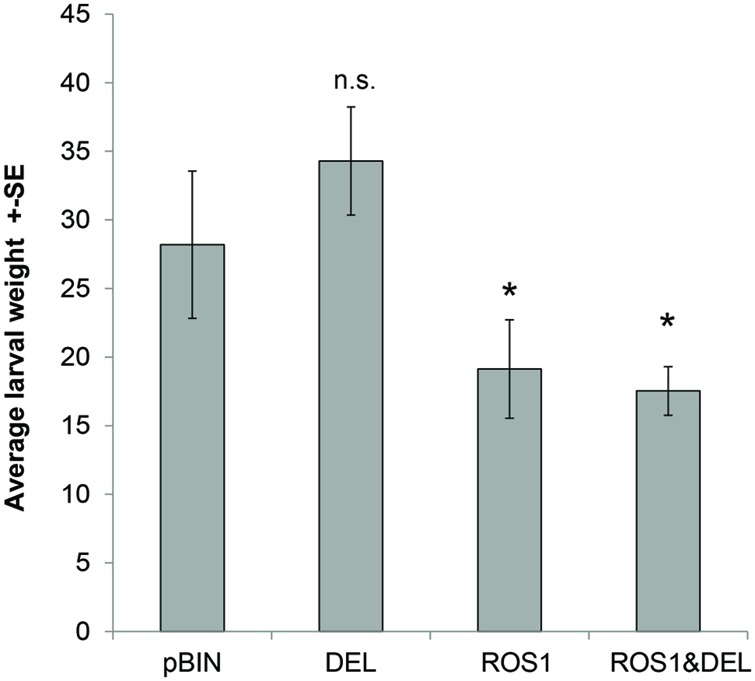
Coloration of plant organs such as fruit, leaves and flowers through anthocyanin production is governed by a combination of MYB and bHLH type transcription factors (TFs). In this study we introduced Rosea1 (ROS1, a MYB type) and Delila (DEL, a bHLH type), into Nicotiana benthamiana leaves by agroinfiltration. ROS1 and DEL form a pair of well-characterized TFs from Snapdragon (Antirrhinum majus), which specifically induce anthocyanin accumulation when expressed in tomato fruit. In N. benthamiana, robust induction of a single anthocyanin, delphinidin-3-rutinoside (D3R) was observed after expression of both ROS1 and DEL. Surprisingly in addition to D3R, a range of additional metabolites were also strongly and specifically up-regulated upon expression of ROS1 and DEL. Except for the D3R, these induced compounds were not derived from the flavonoid pathway. Most notable among these are nornicotine conjugates with butanoyl, hexanoyl, and octanoyl hydrophobic moieties, and phenylpropanoid-polyamine conjugates such as caffeoyl putrescine. The defensive properties of the induced molecules were addressed in bioassays using the tobacco specialist lepidopteran insect Manduca sexta. Our study showed that the effect of ROS1 and DEL expression in N. benthamiana leaves extends beyond the flavonoid pathway. Apparently the same transcription factor may regulate different secondary metabolite pathways in different plant species.
植物器官的颜色形成,如水果、叶子和花朵,是通过花色素苷生物合成的 MYB 和 bHLH 转录因子 (TFs) 的组合来调控的。在这项研究中,我们通过农杆菌浸润将 Rosetta1 (ROS1,一种 MYB 类型) 和 Delila (DEL,一种 bHLH 类型) 引入到烟草叶片中。ROS1 和 DEL 是来自金鱼草 (Antirrhinum majus) 的一对特征良好的 TF,当在番茄果实中表达时,它们特异性地诱导花色素苷积累。在烟草叶片中,表达 ROS1 和 DEL 后,会观察到单个花色素苷——飞燕草素-3-芸香糖苷 (D3R) 的强烈诱导。令人惊讶的是,除了 D3R,ROS1 和 DEL 的表达还强烈且特异性地上调了一系列其他代谢物。除了 D3R,这些诱导的化合物不是来自类黄酮途径。在这些化合物中,最值得注意的是具有丁酰基、己酰基和辛酰基疏水性部分的烟碱缀合物,以及咖啡酰腐胺等苯丙烷-多胺缀合物。利用烟草专食性鳞翅目昆虫烟夜蛾进行生物测定,研究了诱导分子的防御特性。我们的研究表明,ROS1 和 DEL 在烟草叶片中的表达作用超出了类黄酮途径。显然,同一转录因子可能在不同植物物种中调节不同的次生代谢途径。