Matsuo Reo, Morihara Hirofumi, Mohri Tomomi, Murasawa Shiho, Takewaki Kana, Nakayama Hiroyuki, Maeda Makiko, Fujio Yasushi
Graduate School of Pharmaceutical Sciences, Osaka University, Suita City, Osaka, Japan.
PLoS One. 2014 Oct 23;9(10):e111097. doi: 10.1371/journal.pone.0111097. eCollection 2014.
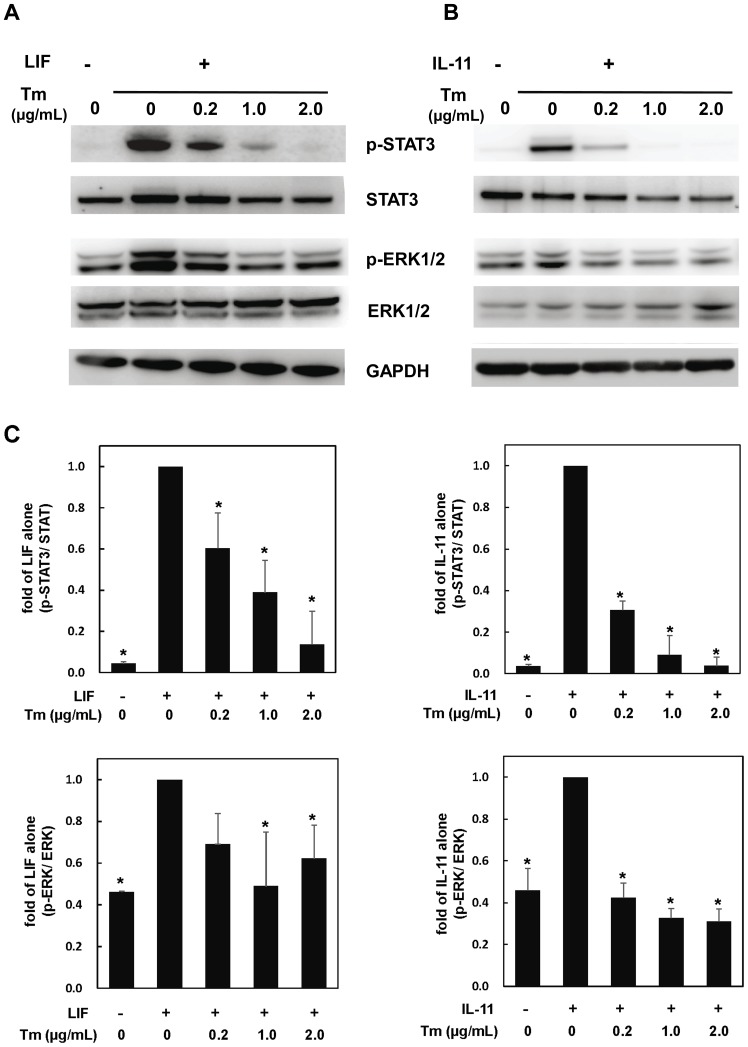
Interleukin-6 (IL-6) family cytokines play important roles in cardioprotection against pathological stresses. IL-6 cytokines bind to their specific receptors and activate glycoprotein 130 (gp130), a common receptor, followed by further activation of STAT3 and extracellular signal-regulated kinase (ERK)1/2 through janus kinases (JAKs); however the importance of glycosylation of gp130 remains to be elucidated in cardiac myocytes. In this study, we examined the biological significance of gp130 glycosylation using tunicamycin (Tm), an inhibitor of enzyme involved in N-linked glycosylation. In cardiomyocytes, the treatment with Tm completely replaced the glycosylated form of gp130 with its unglycosylated one. Tm treatment inhibited leukemia inhibitory factor (LIF)-mediated activation of STAT3 and ERK1/2. Similarly, IL-11 failed to activate STAT3 and ERK1/2 in the presence of Tm. Interestingly, Tm inhibited the activation of JAKs 1 and 2, without influencing the expression of suppressor of cytokine signalings (SOCSs) and protein-tyrosine phosphatase 1B (PTP1B), which are endogenous inhibitors of JAKs. To exclude the possibility that Tm blocks LIF and IL-11 signals by inhibiting the glycosylation of their specific receptors, we investigated whether the stimulation with IL-6 plus soluble IL-6 receptor (sIL-6R) could transduce their signals in Tm-treated cardiomyocytes and found that this stimulation was unable to activate the downstream signals. Collectively, these findings indicate that glycosylation of gp130 is essential for signal transduction of IL-6 family cytokines in cardiomyocytes.
白细胞介素-6(IL-6)家族细胞因子在抵抗病理应激的心脏保护中发挥重要作用。IL-6细胞因子与其特异性受体结合并激活共同受体糖蛋白130(gp130),随后通过Janus激酶(JAKs)进一步激活信号转导和转录激活因子3(STAT3)以及细胞外信号调节激酶(ERK)1/2;然而,gp130糖基化在心肌细胞中的重要性仍有待阐明。在本研究中,我们使用衣霉素(Tm)(一种参与N-连接糖基化的酶的抑制剂)研究了gp130糖基化的生物学意义。在心肌细胞中,用Tm处理可使其完全替换gp130的糖基化形式为非糖基化形式。Tm处理抑制了白血病抑制因子(LIF)介导的STAT3和ERK1/2的激活。同样,在存在Tm的情况下,IL-11也无法激活STAT3和ERK1/2。有趣的是,Tm抑制了JAKs 1和2的激活,而不影响细胞因子信号抑制因子(SOCSs)和蛋白酪氨酸磷酸酶1B(PTP1B)(JAKs的内源性抑制剂)的表达。为了排除Tm通过抑制其特异性受体的糖基化来阻断LIF和IL-11信号的可能性,我们研究了在Tm处理的心肌细胞中,用IL-6加可溶性IL-6受体(sIL-6R)刺激是否能转导其信号,结果发现这种刺激无法激活下游信号。总的来说,这些发现表明gp130的糖基化对于心肌细胞中IL-6家族细胞因子的信号转导至关重要。