
蛋白磷酸酶4促进染色体配对和联会,并随着年龄增长有助于维持交叉能力。
Protein phosphatase 4 promotes chromosome pairing and synapsis, and contributes to maintaining crossover competence with increasing age.
作者信息
Sato-Carlton Aya, Li Xuan, Crawley Oliver, Testori Sarah, Martinez-Perez Enrique, Sugimoto Asako, Carlton Peter M
机构信息
Institute for Integrated Cell-Material Sciences (iCeMS), Kyoto University, Kyoto, Japan.
MRC Clinical Sciences Centre, Imperial College Faculty of Medicine, London, United Kingdom.
出版信息
PLoS Genet. 2014 Oct 23;10(10):e1004638. doi: 10.1371/journal.pgen.1004638. eCollection 2014 Oct.
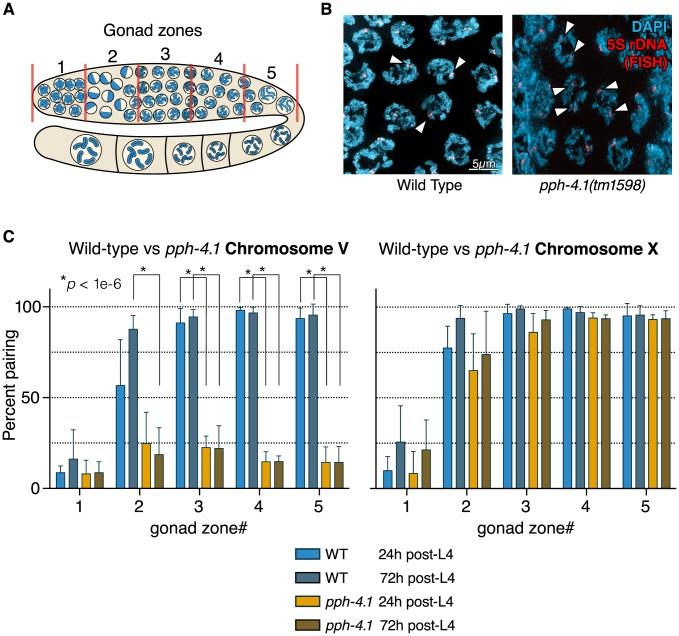
Prior to the meiotic divisions, dynamic chromosome reorganizations including pairing, synapsis, and recombination of maternal and paternal chromosome pairs must occur in a highly regulated fashion during meiotic prophase. How chromosomes identify each other's homology and exclusively pair and synapse with their homologous partners, while rejecting illegitimate synapsis with non-homologous chromosomes, remains obscure. In addition, how the levels of recombination initiation and crossover formation are regulated so that sufficient, but not deleterious, levels of DNA breaks are made and processed into crossovers is not understood well. We show that in Caenorhabditis elegans, the highly conserved Serine/Threonine protein phosphatase PP4 homolog, PPH-4.1, is required independently to carry out four separate functions involving meiotic chromosome dynamics: (1) synapsis-independent chromosome pairing, (2) restriction of synapsis to homologous chromosomes, (3) programmed DNA double-strand break initiation, and (4) crossover formation. Using quantitative imaging of mutant strains, including super-resolution (3D-SIM) microscopy of chromosomes and the synaptonemal complex, we show that independently-arising defects in each of these processes in the absence of PPH-4.1 activity ultimately lead to meiotic nondisjunction and embryonic lethality. Interestingly, we find that defects in double-strand break initiation and crossover formation, but not pairing or synapsis, become even more severe in the germlines of older mutant animals, indicating an increased dependence on PPH-4.1 with increasing maternal age. Our results demonstrate that PPH-4.1 plays multiple, independent roles in meiotic prophase chromosome dynamics and maintaining meiotic competence in aging germlines. PP4's high degree of conservation suggests it may be a universal regulator of meiotic prophase chromosome dynamics.
在减数分裂之前,包括同源染色体配对、联会和重组在内的动态染色体重排必须在减数分裂前期以高度调控的方式发生。染色体如何识别彼此的同源性,并仅与同源伙伴配对和联会,同时排斥与非同源染色体的异常联会,目前仍不清楚。此外,重组起始水平和交叉形成水平是如何调控的,以便产生足够但无害水平的DNA断裂并将其加工成交叉,这一点也尚未完全理解。我们发现,在秀丽隐杆线虫中,高度保守的丝氨酸/苏氨酸蛋白磷酸酶PP4同源物PPH-4.1独立地执行四项涉及减数分裂染色体动态的不同功能:(1)不依赖联会的染色体配对;(2)将联会限制在同源染色体上;(3)程序性DNA双链断裂起始;(4)交叉形成。通过对突变体菌株进行定量成像,包括对染色体和联会复合体的超分辨率(3D-SIM)显微镜观察,我们发现,在缺乏PPH-4.1活性的情况下,这些过程中每个过程独立出现的缺陷最终都会导致减数分裂不分离和胚胎致死。有趣的是,我们发现,在老年突变动物的生殖系中,双链断裂起始和交叉形成的缺陷,而不是配对或联会的缺陷,变得更加严重,这表明随着母体年龄的增加,对PPH-4.1的依赖性增强。我们的结果表明,PPH-4.1在减数分裂前期染色体动态和维持衰老生殖系的减数分裂能力中发挥多种独立作用。PP4的高度保守性表明它可能是减数分裂前期染色体动态的普遍调节因子。




 Zotero 插件