Raboisson Didier, Waret-Szkuta Agnès, Rushton Jonathan, Häsler Barbara, Alarcon Pablo
BMC Vet Res. 2014 Oct 26;10:254. doi: 10.1186/s12917-014-0254-z.
Schmallenberg virus (SBV) was first detected in November 2011 in Germany and then rapidly spread throughout Europe. In beef suckler farms, clinical signs are mainly associated with reproductive disorders, particularly in late gestation, and intransient and non-specific symptoms, namely diarrhea, inappetence and fever. The objectives of this study were to develop models that simulate the production of different beef suckler systems in the United Kingdom (UK) and France and to use these models to estimate, through partial budget analyses, the farm-level economic cost of SBV under two disease impact scenarios, namely high and low impact. The probability for a farm to be in the high or low scenario depends, among other, on the high, low or nil vectorial activity for a given period and location and on the period(s) of sensitivity of the animals to the disease.
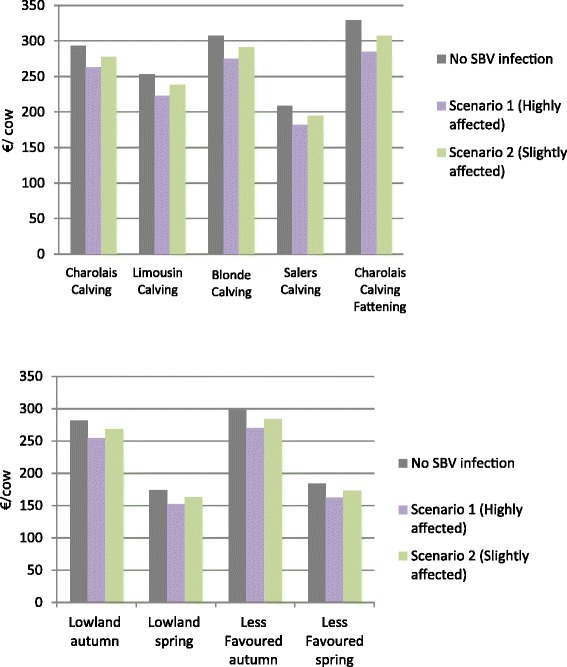
Under the high impact scenario, the estimated SBV impact ranged from 26€ to 43€ per cow per year in France and from 29€ to 36€ per cow per year in the UK. It was approximately half of this amount in the low impact scenario. These financial impacts represent 5 to 16% of the gross margin, depending on the country, impact scenario and livestock system considered. Most of the SBV impact originates from the costs of the steers and heifers not produced. Differences identified between the systems studied mainly stem from differences among the value of the steers or heifers sold: SBV impact is higher for British autumn calving systems compared to spring calving, and for French farms with calving and fattening activities compared to farms with only a single, annual calving activity.
This study shows the usefulness of integrated production and economic models to accurately evaluate the costs of diseases and understand which factors have major impacts in the different systems. The models stand as a useful basis for animal health professionals when considering alternative disease control measures. They are also a farm accounting tool for estimating disease impact on differing production practices, which creates the necessary basis for cost-effectiveness analysis of intervention strategies, such as vaccination.
施马伦贝格病毒(SBV)于2011年11月在德国首次被发现,随后迅速蔓延至整个欧洲。在肉牛养殖场,临床症状主要与繁殖障碍有关,尤其是在妊娠后期,以及短暂且非特异性的症状,即腹泻、食欲不振和发热。本研究的目的是开发模拟英国(UK)和法国不同肉牛养殖系统生产情况的模型,并通过部分预算分析,利用这些模型估计在两种疾病影响情景下,即高影响和低影响情景下,农场层面SBV的经济成本。一个农场处于高或低情景的概率,除其他因素外,取决于给定时期和地点的高、低或无媒介活动,以及动物对该疾病的敏感时期。
在高影响情景下,法国估计的SBV影响为每头母牛每年26欧元至43欧元,英国为每头母牛每年29欧元至36欧元。在低影响情景下,这一金额约为高影响情景下的一半。这些财务影响占毛利润的5%至16%,具体取决于所考虑的国家、影响情景和畜牧系统。SBV的大部分影响源自未生产的公牛和小母牛的成本。所研究系统之间的差异主要源于所售公牛或小母牛价值的差异:与春季产犊相比,英国秋季产犊系统的SBV影响更高,与仅进行单次年度产犊活动的农场相比,法国有产犊和育肥活动的农场的SBV影响更高。
本研究表明综合生产和经济模型在准确评估疾病成本以及了解哪些因素在不同系统中具有重大影响方面的有用性。这些模型是动物健康专业人员在考虑替代疾病控制措施时的有用基础。它们也是一种农场核算工具,用于估计疾病对不同生产实践的影响,这为诸如疫苗接种等干预策略的成本效益分析创造了必要基础。