School of Environment and Resources, Zhejiang Agricultural and Forestry University Lin'an, China.
School of Environment and Resources, Zhejiang Agricultural and Forestry University Lin'an, China ; State Key Laboratory of Environmental Geochemistry, Institute of Geochemistry, Chinese Academy of Sciences Guiyang, China.
Front Plant Sci. 2014 Oct 10;5:529. doi: 10.3389/fpls.2014.00529. eCollection 2014.
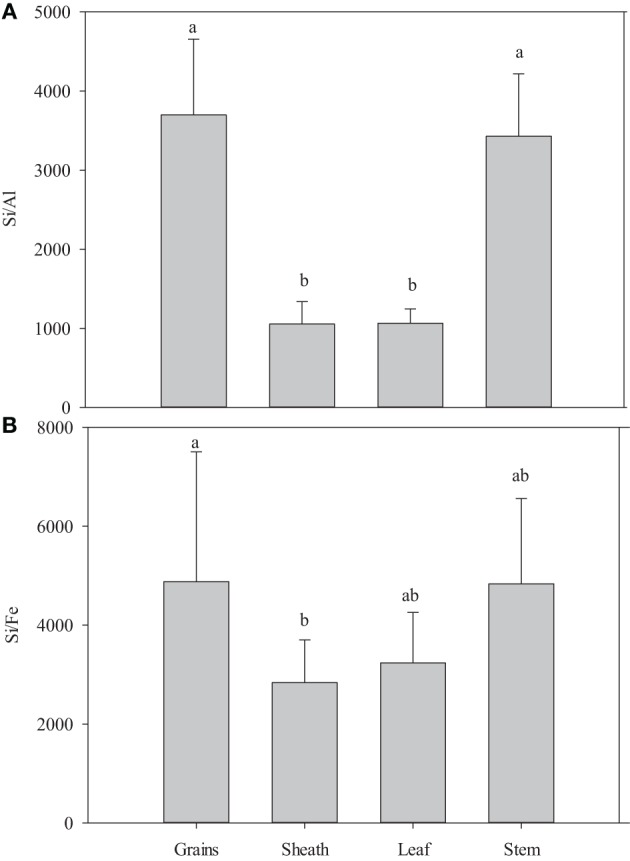
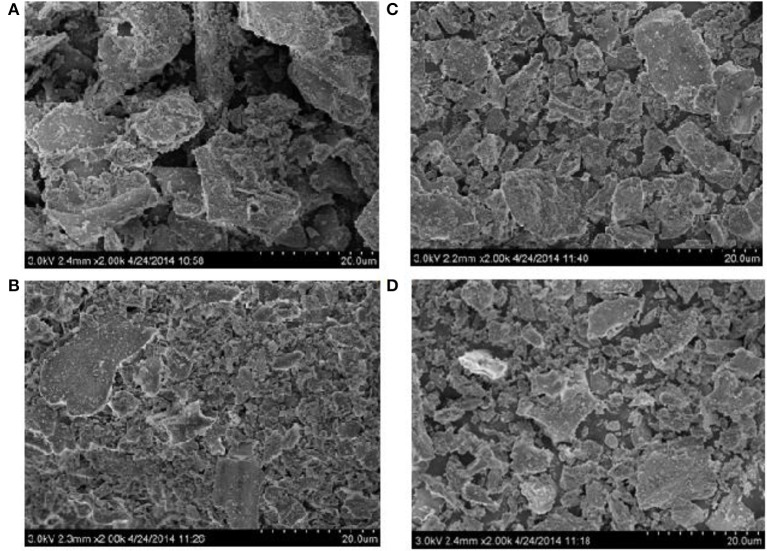
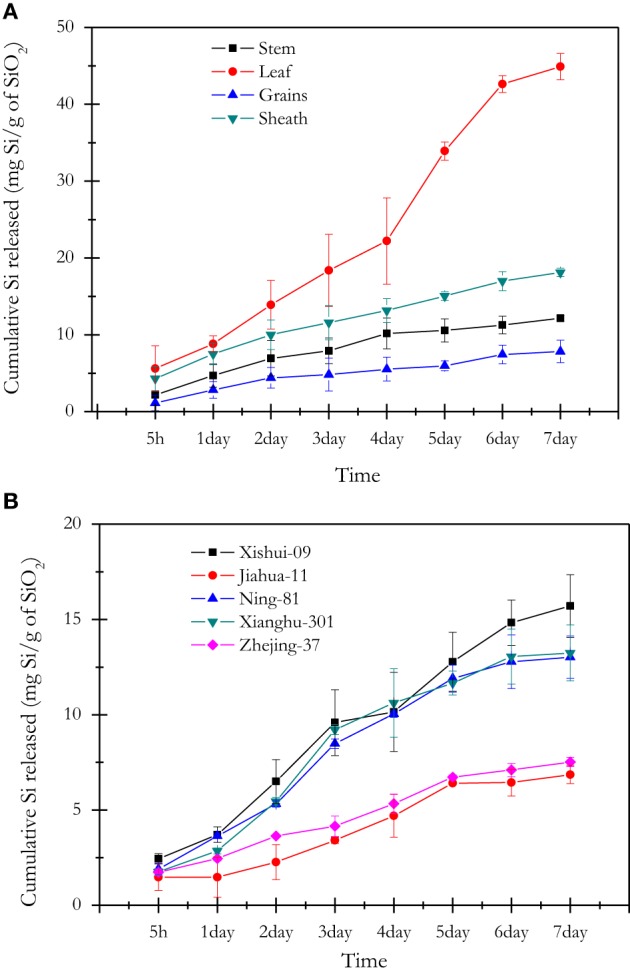
The continental bio-cycling of silicon (Si) plays a key role in global Si cycle and as such partly controls global carbon (C) budget through nutrition of marine and terrestrial biota, accumulation of phytolith-occluded organic carbon (PhytOC) and weathering of silicate minerals. Despite the key role of elemental composition of phytoliths on their solubility in soils, the impact of plant cultivar and organ on the elemental composition of phytoliths in Si high-accumulator plants, such as rice (Oryza sativa) is not yet fully understood. Here we show that rice cultivar significantly impacts the elemental composition of phytoliths (Si, Al, Fe, and C) in different organs of the shoot system (grains, sheath, leaf and stem). The amount of occluded OC within phytoliths is affected by contents of Si, Al, and Fe in plants, while independent of the element composition of phytoliths. Our data document, for different cultivars, higher bio-available Si release from phytoliths of leaves and sheaths, which are characterized by higher enrichment with Al and Fe (i.e., lower Si/Al and Si/Fe ratios), compared to grains and stems. We indicate that phytolith solubility in soils may be controlled by rice cultivar and type of organs. Our results highlight that the role of the morphology, the hydration rate and the chemical composition in the solubility of phytoliths and the kinetic release of Si in soil solution needs to be studied further. This is central to a better understanding of the impact of soil amendment with different plant organs and cultivars on soil OC stock and on the delivery of dissolved Si as we show that sheath and leaf rice organs are both characterized by higher content of OC occluded in phytolith and higher phytolith solubility compared to grains and stems. Our study shows the importance of studying the impact of the agro-management on the evolution of sinks and sources of Si and C in soils used for Si-high accumulator plants.
硅(Si)的大陆生物循环在全球 Si 循环中起着关键作用,因此通过海洋和陆地生物群的营养、 PhytOC 的积累以及硅酸盐矿物的风化,部分控制着全球碳(C)预算。尽管植硅体的元素组成对其在土壤中的溶解度起着关键作用,但植物品种和器官对 Si 高积累植物(如水稻(Oryza sativa))中植硅体元素组成的影响尚未完全了解。在这里,我们表明,水稻品种显著影响了不同地上器官(谷物、叶鞘、叶片和茎)中植硅体的元素组成(Si、Al、Fe 和 C)。植硅体中固存 OC 的量受植物中 Si、Al 和 Fe 的含量影响,而与植硅体的元素组成无关。我们的数据记录了不同品种的叶片和叶鞘中的植硅体具有更高的生物可利用 Si 释放,其特征是 Al 和 Fe 的富集程度更高(即 Si/Al 和 Si/Fe 比值较低),而谷物和茎中的含量较低。我们表明,植硅体在土壤中的溶解度可能受水稻品种和器官类型的控制。我们的研究结果强调,形态、水合速率和化学成分在植硅体的溶解度和 Si 在土壤溶液中的动力学释放中的作用需要进一步研究。这对于更好地理解不同植物器官和品种的土壤改良对土壤 OC 储量和溶解 Si 释放的影响至关重要,因为我们表明,与谷物和茎相比,叶鞘和叶片水稻器官的特征是含有更高含量的 OC 被植硅体固存,并且植硅体的溶解度更高。我们的研究表明,研究农业管理对 Si 高积累植物所用土壤中 Si 和 C 的汇源演化的重要性。