Marsden Karen E, Ma Wei Ji, Deci Edward L, Ryan Richard M, Chiu Pearl H
Baylor College of Medicine, Houston, TX, USA.
Cogn Affect Behav Neurosci. 2015 Jun;15(2):276-86. doi: 10.3758/s13415-014-0324-5.
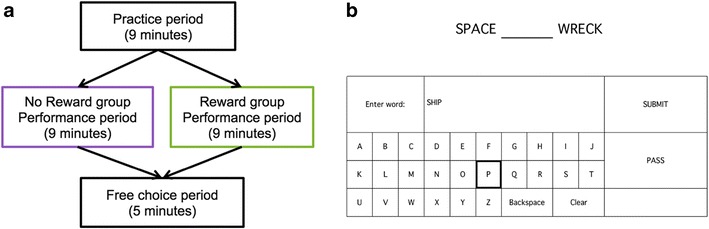
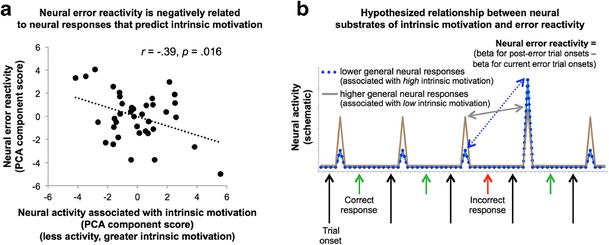
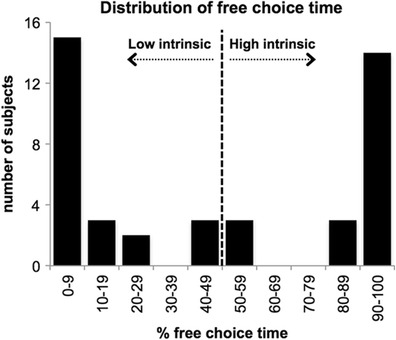
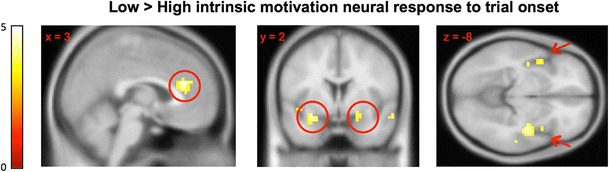
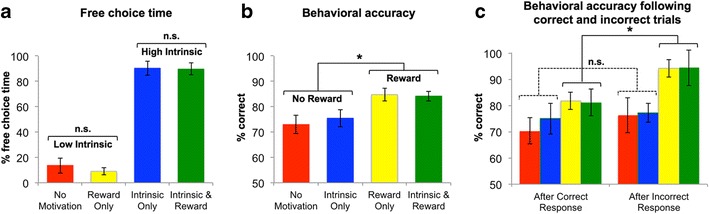
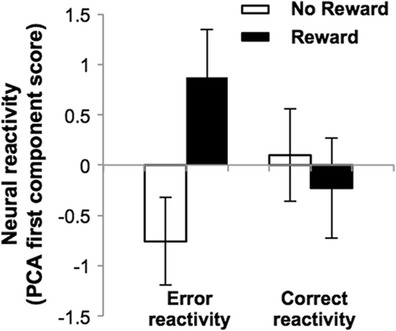
The duration and quality of human performance depend on both intrinsic motivation and external incentives. However, little is known about the neuroscientific basis of this interplay between internal and external motivators. Here, we used functional magnetic resonance imaging to examine the neural substrates of intrinsic motivation, operationalized as the free-choice time spent on a task when this was not required, and tested the neural and behavioral effects of external reward on intrinsic motivation. We found that increased duration of free-choice time was predicted by generally diminished neural responses in regions associated with cognitive and affective regulation. By comparison, the possibility of additional reward improved task accuracy, and specifically increased neural and behavioral responses following errors. Those individuals with the smallest neural responses associated with intrinsic motivation exhibited the greatest error-related neural enhancement under the external contingency of possible reward. Together, these data suggest that human performance is guided by a "tonic" and "phasic" relationship between the neural substrates of intrinsic motivation (tonic) and the impact of external incentives (phasic).
人类表现的持续时间和质量取决于内在动机和外部激励。然而,对于这种内部和外部激励因素之间相互作用的神经科学基础,我们知之甚少。在此,我们使用功能磁共振成像来研究内在动机的神经基础,内在动机通过在无需完成任务时自由选择花费在任务上的时间来衡量,并测试外部奖励对内在动机的神经和行为影响。我们发现,与认知和情感调节相关区域的神经反应普遍减弱预示着自由选择时间的延长。相比之下,额外奖励的可能性提高了任务准确性,并且在出现错误后,神经和行为反应尤其增强。在可能获得奖励的外部条件下,那些与内在动机相关的神经反应最小的个体,其与错误相关的神经增强最为显著。总之,这些数据表明,人类表现受内在动机(持续性)的神经基础与外部激励(阶段性)的影响之间的“持续性”和“阶段性”关系所引导。