Murphy Andrew James, Dragoljevic Dragana, Tall Alan Richard
Haematopoiesis and Leukocyte Biology, Baker IDI , Melbourne, VIC , Australia ; Department of Immunology, Monash University , Melbourne, VIC , Australia ; University of New South Wales , Sydney, NSW , Australia.
Haematopoiesis and Leukocyte Biology, Baker IDI , Melbourne, VIC , Australia.
Front Immunol. 2014 Oct 13;5:490. doi: 10.3389/fimmu.2014.00490. eCollection 2014.
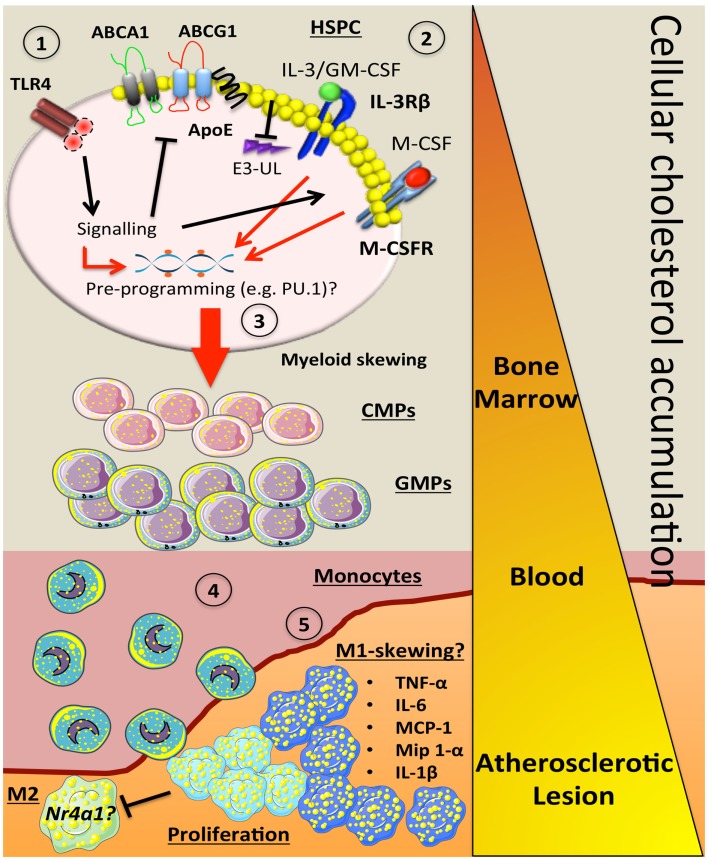
Atherosclerotic cardiovascular disease is a chronic inflammatory disease of the blood vessels that can lead to myocardial infarction or stroke. The major cell in the atherosclerotic lesion, the macrophage, is thought to be an important contributor to the production of inflammatory mediators that exacerbate this disease. Macrophages are generally derived from circulating monocytes, which are in turn produced by hematopoietic stem and multipotential progenitor cells (HSPCs) in the bone marrow and other medullary organs. Recent studies suggest that disruption in cholesterol homeostasis or prolonged exposure to a hypercholesterolemic environment can influence HSPCs to over-produce monocytes, resulting in monocytosis. These monocytes may carry a pre-programed ability to become M1-like macrophages once they enter the atherosclerotic lesion. Future studies may help to differentiate the role of such pre-programing versus responses to local environmental cues in determining M1, M2, or other macrophage phenotypes in atherosclerotic lesions.
动脉粥样硬化性心血管疾病是一种血管慢性炎症性疾病,可导致心肌梗死或中风。动脉粥样硬化病变中的主要细胞——巨噬细胞,被认为是加剧该疾病的炎症介质产生的重要促成因素。巨噬细胞通常源自循环单核细胞,而循环单核细胞又是由骨髓和其他髓性器官中的造血干细胞和多能祖细胞(HSPCs)产生的。最近的研究表明,胆固醇稳态的破坏或长期暴露于高胆固醇环境会影响HSPCs过度产生单核细胞,导致单核细胞增多症。这些单核细胞一旦进入动脉粥样硬化病变,可能具有预先编程的能力,成为类似M1的巨噬细胞。未来的研究可能有助于区分这种预先编程与对局部环境线索的反应在确定动脉粥样硬化病变中M1、M2或其他巨噬细胞表型方面的作用。