Department of Biological & Environmental Sciences, University of Tennessee at Chattanooga 215 Holt Hall, Dept 2653 615 McCallie Aven, Chattanooga, 37403, Tennessee.
Mathematical Ecology Research Group, Department of Zoology, University of Oxford Oxford, OX1 3PS, U.K ; St Peter's College Oxford, OX1 2DL, U.K.
Ecol Evol. 2014 Jun;4(12):2330-51. doi: 10.1002/ece3.1083. Epub 2014 May 12.
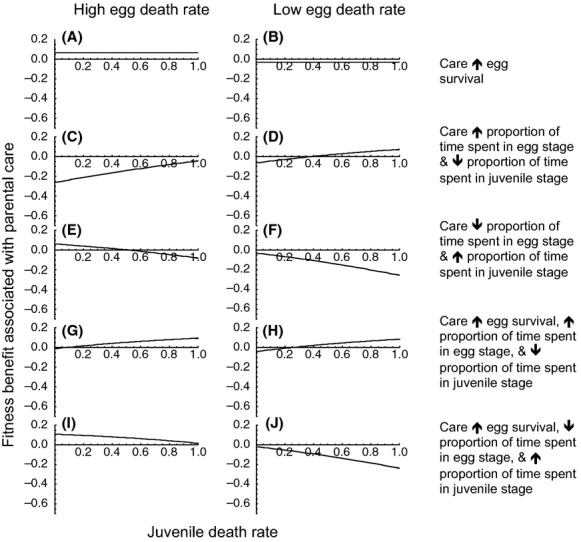
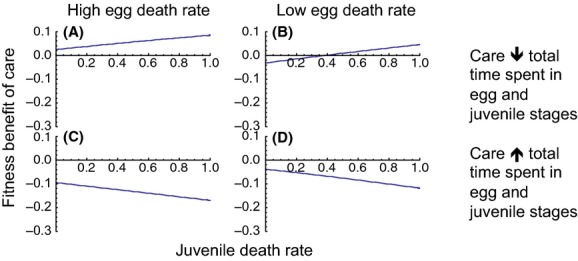
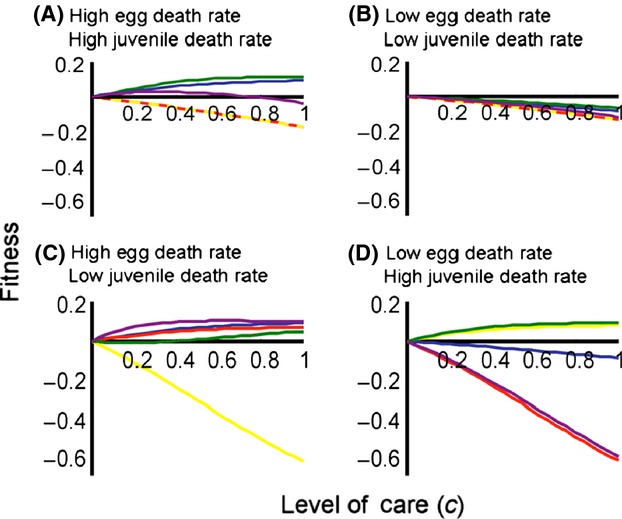
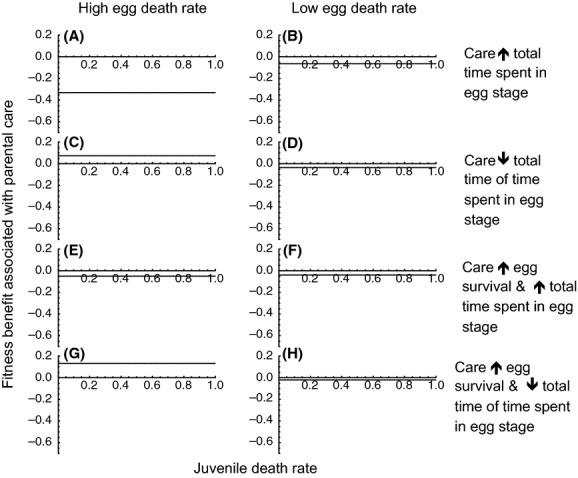
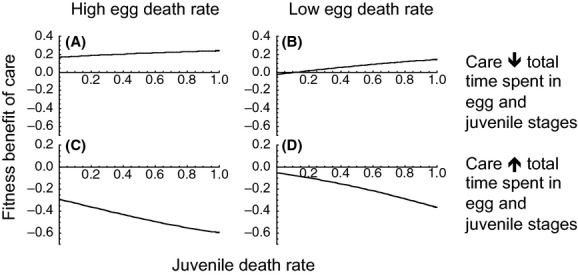
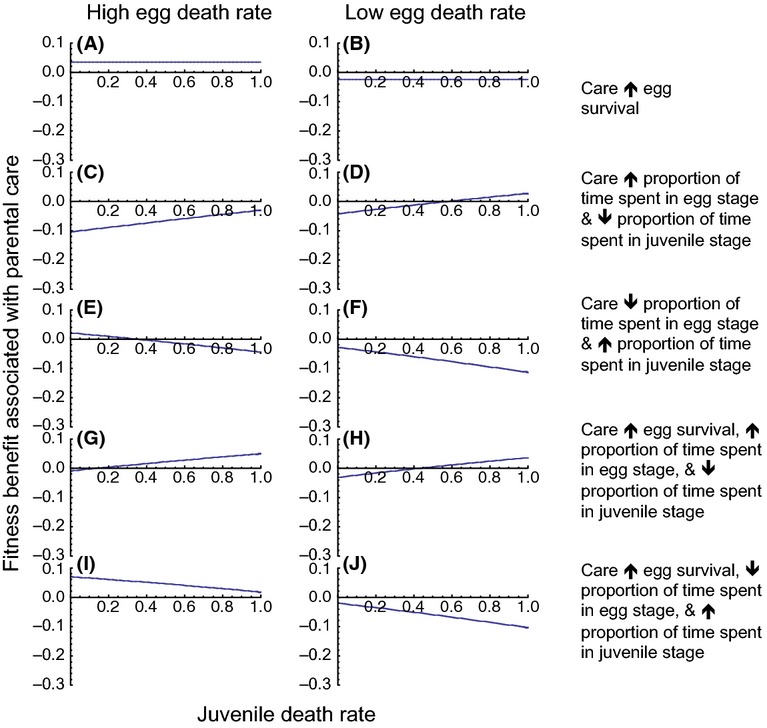
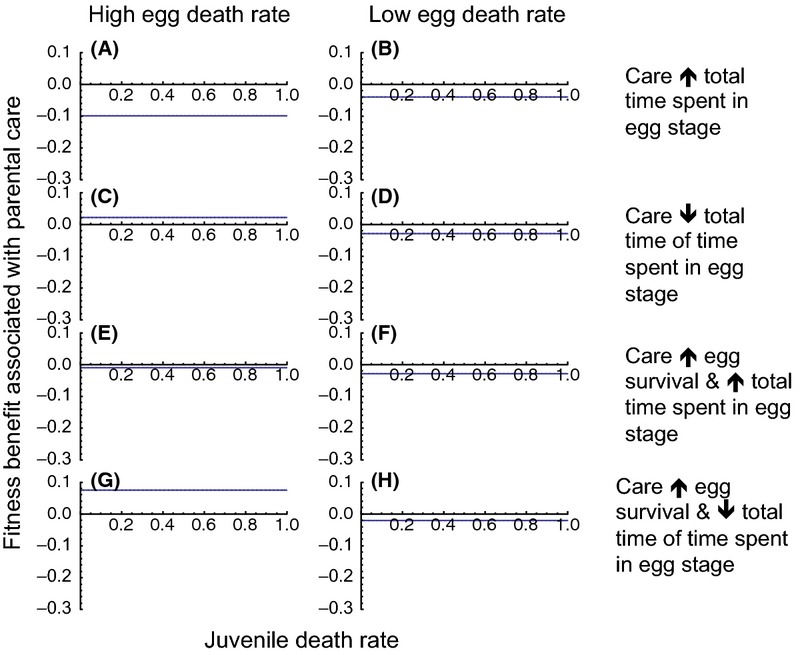
The evolution of parental care is beneficial if it facilitates offspring performance traits that are ultimately tied to offspring fitness. While this may seem self-evident, the benefits of parental care have received relatively little theoretical exploration. Here, we develop a theoretical model that elucidates how parental care can affect offspring performance and which aspects of offspring performance (e.g., survival, development) are likely to be influenced by care. We begin by summarizing four general types of parental care benefits. Care can be beneficial if parents (1) increase offspring survival during the stage in which parents and offspring are associated, (2) improve offspring quality in a way that leads to increased offspring survival and/or reproduction in the future when parents are no longer associated with offspring, and/or (3) directly increase offspring reproductive success when parents and offspring remain associated into adulthood. We additionally suggest that parental control over offspring developmental rate might represent a substantial, yet underappreciated, benefit of care. We hypothesize that parents adjust the amount of time offspring spend in life-history stages in response to expected offspring mortality, which in turn might increase overall offspring survival, and ultimately, fitness of parents and offspring. Using a theoretical evolutionary framework, we show that parental control over offspring developmental rate can represent a significant, or even the sole, benefit of care. Considering this benefit influences our general understanding of the evolution of care, as parental control over offspring developmental rate can increase the range of life-history conditions (e.g., egg and juvenile mortalities) under which care can evolve.
如果亲代照顾能促进与后代适应性相关的后代表现特征,那么这种进化是有益的。虽然这似乎是不言而喻的,但亲代照顾的好处在理论上还没有得到太多的探讨。在这里,我们建立了一个理论模型,阐明了亲代照顾如何影响后代的表现,并指出了哪些方面的后代表现(例如,生存、发育)可能受到照顾的影响。我们首先总结了亲代照顾的四种一般益处。亲代照顾可能有益,如果父母(1)在父母和后代相关的阶段增加后代的存活率,(2)以提高后代未来的存活率和/或繁殖率的方式改善后代的质量,而当父母不再与后代相关时,(3)当父母和后代成年后仍然相关时,直接增加后代的生殖成功。我们还认为,父母对后代发育速度的控制可能代表了照顾的一个重要但被低估的好处。我们假设,父母会根据预期的后代死亡率来调整后代在生命史阶段的时间分配,这反过来可能会增加后代的整体存活率,最终增加父母和后代的适应性。利用理论进化框架,我们表明,父母对后代发育速度的控制可以代表亲代照顾的一个重要的,甚至是唯一的好处。考虑到这一好处会影响我们对亲代照顾进化的一般理解,因为父母对后代发育速度的控制可以增加亲代照顾能够进化的生命史条件范围(例如,卵和幼体死亡率)。