Claes Nele, Dhaeze Tessa, Fraussen Judith, Broux Bieke, Van Wijmeersch Bart, Stinissen Piet, Hupperts Raymond, Hellings Niels, Somers Veerle
Hasselt University, Biomedical Research Institute and Transnationale Universiteit Limburg, School of Life Sciences, Diepenbeek, Belgium.
Hasselt University, Biomedical Research Institute and Transnationale Universiteit Limburg, School of Life Sciences, Diepenbeek, Belgium; Rehabilitation & MS-Center, Overpelt, Belgium.
PLoS One. 2014 Oct 31;9(10):e111115. doi: 10.1371/journal.pone.0111115. eCollection 2014.
The long term effects of fingolimod, an oral treatment for relapsing-remitting (RR) multiple sclerosis (MS), on blood circulating B and T cell subtypes in MS patients are not completely understood. This study describes for the first time the longitudinal effects of fingolimod treatment on B and T cell subtypes. Furthermore, expression of surface molecules involved in antigen presentation and costimulation during fingolimod treatment are assessed in MS patients in a 12 month follow-up study.
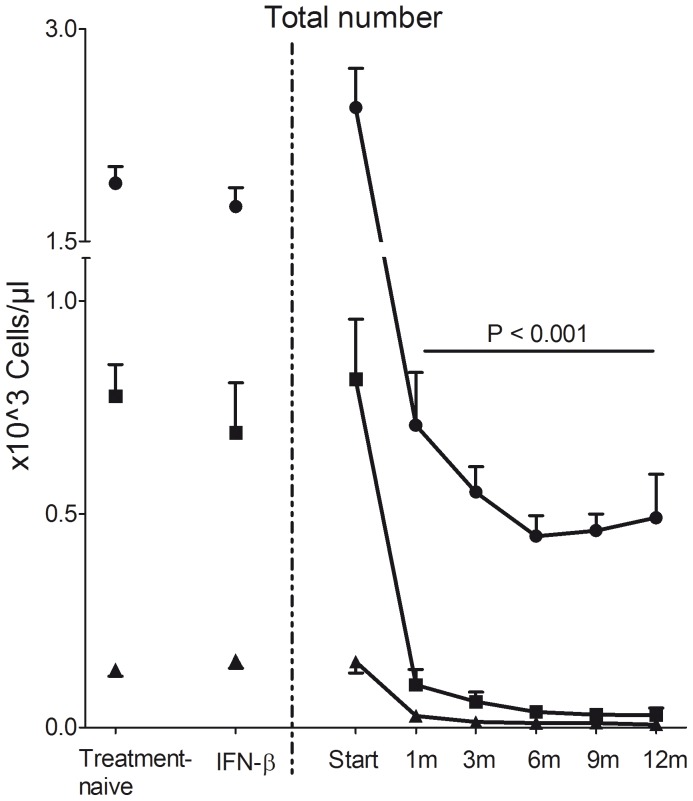
Using flow cytometry, B and T cell subtypes, and their expression of antigen presentation, costimulation and migration markers were measured during a 12 month follow-up in the peripheral blood of MS patients. Data of fingolimod-treated MS patients (n = 49) were compared to those from treatment-naive (n = 47) and interferon-treated (n = 27) MS patients.
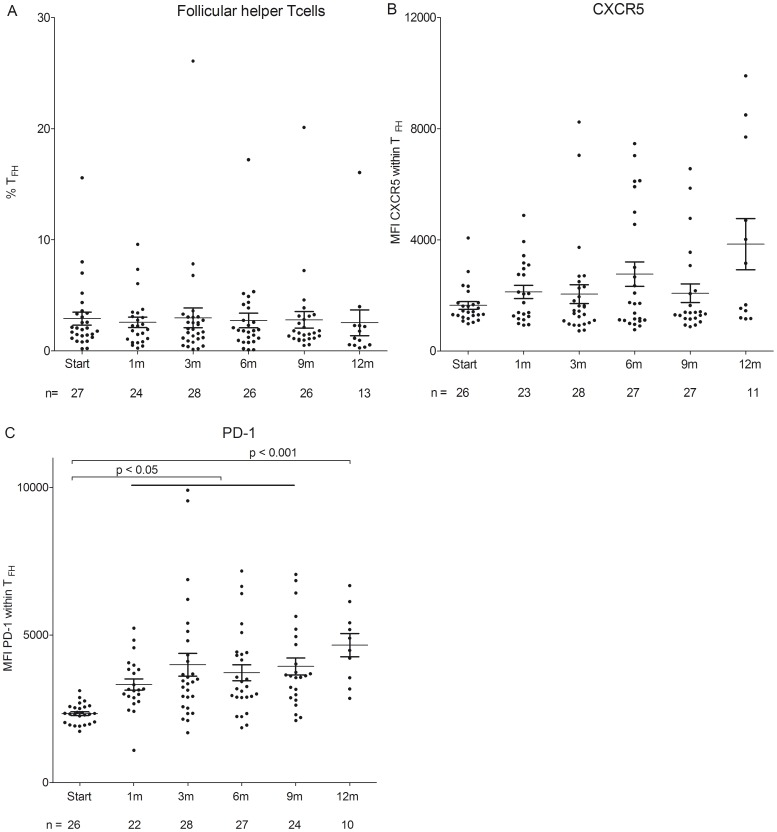
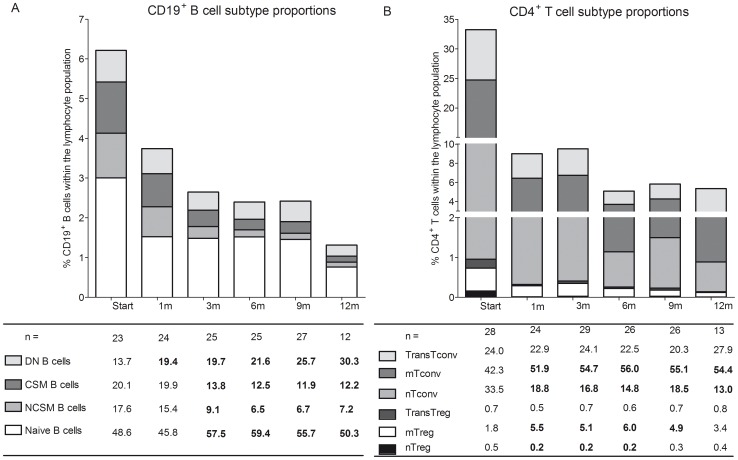
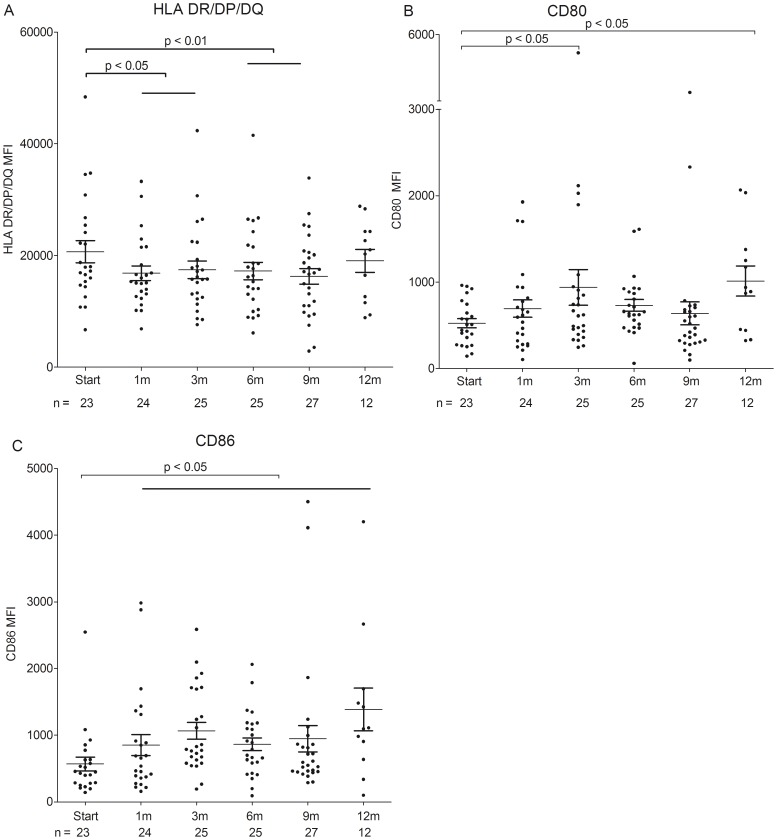
In the B cell population, we observed a decrease in the proportion of non class-switched and class-switched memory B cells (p<0.001), both implicated in MS pathogenesis, while the proportion of naive B cells was increased during fingolimod treatment in the peripheral blood (PB) of MS patients (p<0.05). The remaining T cell population, in contrast, showed elevated proportions of memory conventional and regulatory T cells (p<0.01) and declined proportions of naive conventional and regulatory cells (p<0.05). These naive T cell subtypes are main drivers of MS pathogenesis. B cell expression of CD80 and CD86 and programmed death (PD) -1 expression on circulating follicular helper T cells was increased during fingolimod follow-up (p<0.05) pointing to a potentially compensatory mechanism of the remaining circulating lymphocyte subtypes that could provide additional help during normal immune responses.
MS patients treated with fingolimod showed a change in PB lymphocyte subtype proportions and expression of functional molecules on T and B cells, suggesting an association with the therapeutic efficacy of fingolimod.
作为复发缓解型(RR)多发性硬化症(MS)的口服治疗药物,芬戈莫德对MS患者血液中循环B和T细胞亚群的长期影响尚未完全明确。本研究首次描述了芬戈莫德治疗对B和T细胞亚群的纵向影响。此外,在一项为期12个月的随访研究中,对MS患者在芬戈莫德治疗期间参与抗原呈递和共刺激的表面分子表达进行了评估。
运用流式细胞术,在MS患者外周血12个月的随访期间,检测B和T细胞亚群及其抗原呈递、共刺激和迁移标志物的表达。将接受芬戈莫德治疗的MS患者(n = 49)的数据与未接受过治疗(n = 47)和接受干扰素治疗(n = 27)的MS患者的数据进行比较。
在B细胞群体中,我们观察到未发生类别转换和已发生类别转换的记忆B细胞比例均下降(p<0.001),这两种细胞均与MS发病机制有关,而在MS患者外周血(PB)中进行芬戈莫德治疗期间,初始B细胞比例增加(p<0.05)。相比之下,其余T细胞群体中,记忆性常规T细胞和调节性T细胞比例升高(p<0.01),而初始常规T细胞和调节性T细胞比例下降(p<0.05)。这些初始T细胞亚群是MS发病机制的主要驱动因素。在芬戈莫德随访期间,循环滤泡辅助性T细胞上的B细胞CD80和CD86表达以及程序性死亡(PD)-1表达增加(p<0.05),这表明其余循环淋巴细胞亚群可能存在一种补偿机制,在正常免疫反应期间可提供额外帮助。
接受芬戈莫德治疗的MS患者外周血淋巴细胞亚群比例以及T和B细胞上功能分子的表达发生了变化,提示这与芬戈莫德的治疗效果相关。