Yoon Su-Jung, Kim Do-Hoon, Nam Ga-Eun, Yoon Yeo-Joon, Han Kyung-Do, Jung Dong-Wook, Park Sang-Woon, Kim Young-Eun, Lee Sung-Ho, Lee Sang-Su, Kim Yang-Hyun
Department of Family Medicine, Korea University College of Medicine, Seoul, South Korea.
Department of Medical Statistics, Catholic University College of Medicine, Seoul, South Korea.
PLoS One. 2014 Oct 31;9(10):e111179. doi: 10.1371/journal.pone.0111179. eCollection 2014.
Albuminuria is associated with cardiovascular disease, and the relationship between albuminuria and hypertension is well established in many studies. So the control of hypertension is critical for decreasing cardiovascular events and albuminuria. Obesity and abdominal obesity are also associated with hypertension and albuminuria. Therefore, we analyzed the relationship between albuminuria and the prevalence and control of hypertension in the general Korean population according to obesity status.
We analyzed data from the 2011-2012 Korea National Health and Nutrition Examination Survey, and 9,519 subjects were included. Subjects were divided into four groups: non-obese/normal waist circumference, non-obese/high waist circumference, obese/normal waist circumference, and obese/high waist circumference.
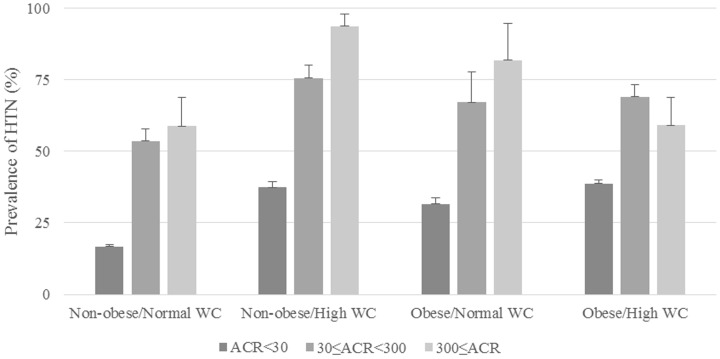
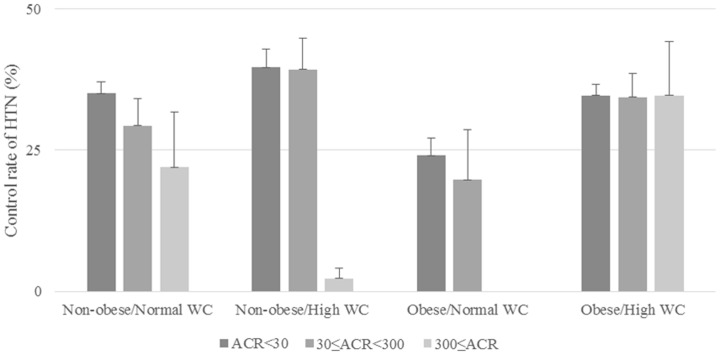
Systolic blood pressure and diastolic blood pressure were positively associated with albumin-creatinine ratio in all groups (all p values <0.005). Non-obese/normal waist circumference group were more likely to have hypertension (odds ratios [95% confidential intervals (CIs)] were 3.20 [2.21-4.63] in microalbuminuria level and 3.09 [1.05-9.14] in macroalbuminuria level), and less likely to have controlled hypertension (odds ratios <1 for both albuminuria levels) after adjusting for all covariates. Obese/normal waist circumference group were also more likely to have hypertension (odds ratio [95% CI] were 3.10 [1.56-6.15] in microalbuminuria level and 21.75 [3.66-129.04] in macroalbuminuria level), and less likely to have controlled hypertension in macroalbuminuria level (odds ratio [95% CI], 0.04 [0.01-0.15]).
Non-obese and normal waist circumference subjects have an increased prevalence and decreased control of hypertension in microalbuminuria and macroalbuminuria levels. Screening for albuminuria may provide helpful information about hypertension and blood pressure control, particularly in the non-obese and normal waist circumference subjects.
蛋白尿与心血管疾病相关,并且在许多研究中蛋白尿与高血压之间的关系已得到充分证实。因此,控制高血压对于降低心血管事件和蛋白尿至关重要。肥胖和腹型肥胖也与高血压和蛋白尿相关。因此,我们根据肥胖状况分析了韩国普通人群中蛋白尿与高血压患病率及控制情况之间的关系。
我们分析了2011 - 2012年韩国国家健康与营养检查调查的数据,纳入了9519名受试者。受试者被分为四组:非肥胖/正常腰围、非肥胖/高腰围、肥胖/正常腰围和肥胖/高腰围。
所有组的收缩压和舒张压均与白蛋白肌酐比值呈正相关(所有p值<0.005)。在调整所有协变量后,非肥胖/正常腰围组更易患高血压(微量白蛋白尿水平的比值比[95%置信区间(CI)]为3.20[2.21 - 4.63],大量白蛋白尿水平的比值比为3.09[1.05 - 9.14]),且高血压得到控制的可能性较小(两种白蛋白尿水平的比值比均<1)。肥胖/正常腰围组也更易患高血压(微量白蛋白尿水平的比值比[95%CI]为3.10[1.56 - 6.15],大量白蛋白尿水平的比值比为21.75[3.66 - 129.04]),且在大量白蛋白尿水平时高血压得到控制的可能性较小(比值比[95%CI],0.04[0.01 - 0.15])。
非肥胖且腰围正常的受试者在微量白蛋白尿和大量白蛋白尿水平时高血压患病率增加且控制率降低。蛋白尿筛查可能为高血压及血压控制提供有用信息,尤其是在非肥胖且腰围正常的受试者中。