Tanaka Satoru, Takase Hiroyuki, Dohi Yasuaki, Kimura Genjiro
Department of Cardio-Renal Medicine and Hypertension, Nagoya City University Graduate School of Medical Sciences, Nagoya, Japan.
BMC Res Notes. 2013 Jul 7;6:256. doi: 10.1186/1756-0500-6-256.
Microalbuminuria is a marker of cardiovascular events. This study investigated the prevalence of microalbuminuria in the general population and the factors that can affect urinary excretion of albumin.
Apparently healthy subjects who participated in a health checkup at our hospital were enrolled in this study (n = 7963, male 64.0%, 56.2 ± 11.8 years old) Urine samples were collected for the measurement of albumin concentrations, which were expressed as the ratio of urinary albumin to creatinine concentrations (UACR [mg/g Cr]). Individual salt intake was assessed by estimating the 24-hour urinary salt excretion of subjects.
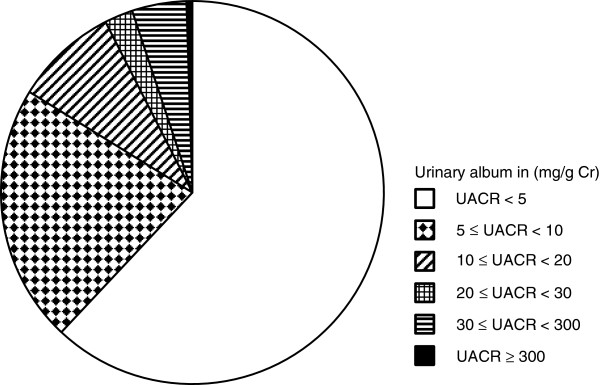
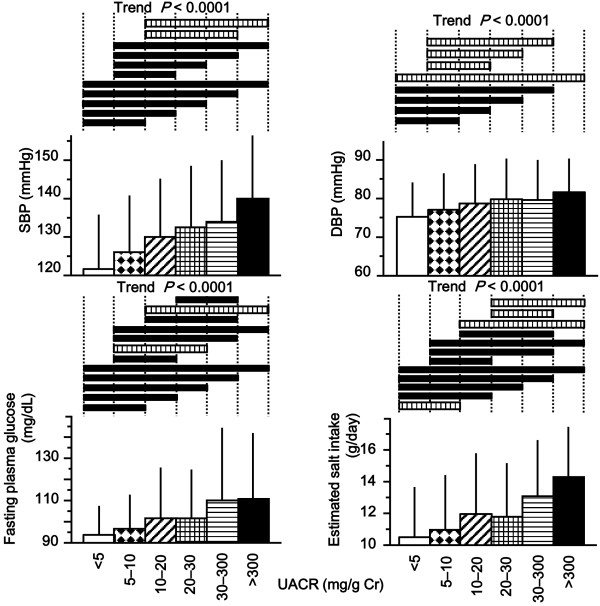
The mean blood pressure was 124 ± 15/76 ± 10 mmHg and 31.6%, 7.4%, and 44.1% of subjects had hypertension, diabetes mellitus, and dyslipidemia, respectively. Urinary albumin was detected in 7265 subjects (91.2%: UACR ≥ 300 mg/g Cr, 0.5%; 300 > UACR ≥ 30 mg/g Cr, 4.6%; 30 > UACR ≥ 20 mg/g Cr, 2.4%; 20 > UACR ≥ 10 mg/g Cr, 8.7%; 10 > UACR ≥ 5 mg/g Cr, 21.8%; UACR < 5 mg/g Cr, 53.2%). In subjects with detectable albuminuria, UACR was independently correlated with age, systolic blood pressure, serum creatinine, fasting plasma glucose, and salt intake after adjustment for possible factors (P < 0.0001).
The prevalence of microalbuminuria was found to be 4.6% in the general population. The urinary excretion of albumin was closely associated with blood pressure and salt intake. These data indicated the importance of salt restriction for the prevention of cardiovascular disease and end-stage renal disease.
微量白蛋白尿是心血管事件的一个标志物。本研究调查了普通人群中微量白蛋白尿的患病率以及影响尿白蛋白排泄的因素。
参与我院健康体检的表面健康受试者纳入本研究(n = 7963,男性占64.0%,年龄56.2±11.8岁)。收集尿液样本以测量白蛋白浓度,其以尿白蛋白与肌酐浓度之比(UACR[mg/g Cr])表示。通过估算受试者24小时尿盐排泄量来评估个体盐摄入量。
平均血压为124±15/76±10 mmHg,分别有31.6%、7.4%和44.1%的受试者患有高血压、糖尿病和血脂异常。7265名受试者检测到尿白蛋白(91.2%:UACR≥300 mg/g Cr,0.5%;300>UACR≥30 mg/g Cr,4.6%;30>UACR≥20 mg/g Cr,2.4%;20>UACR≥10 mg/g Cr,8.7%;10>UACR≥5 mg/g Cr,21.8%;UACR<5 mg/g Cr,53.2%)。在可检测到蛋白尿的受试者中,调整可能因素后,UACR与年龄、收缩压、血清肌酐、空腹血糖和盐摄入量独立相关(P<0.0001)。
发现普通人群中微量白蛋白尿的患病率为4.6%。尿白蛋白排泄与血压和盐摄入量密切相关。这些数据表明限制盐摄入对预防心血管疾病和终末期肾病的重要性。