Lemay Matthew A, Russello Michael A
University of British Columbia, Okanagan Campus, 3247 University Way, Kelowna, BC V1V 1V7, Canada.
BMC Res Notes. 2014 Nov 4;7:778. doi: 10.1186/1756-0500-7-778.
Understanding the distribution and abundance of pathogens can provide insight into the evolution and ecology of their host species. Previous research in kokanee, the freshwater form of sockeye salmon (Oncorhynchus nerka), found evidence that populations spawning in streams may experience a greater pathogen load compared with populations that spawn on beaches. In this study we tested for differences in the abundance and diversity of the gram-negative bacteria, Flavobacterium spp., infecting tissues of kokanee in both of these spawning habitats (streams and beaches). Molecular assays were carried out using primers designed to amplify a ~200 nucleotide region of the gene encoding the ATP synthase alpha subunit (AtpA) within the genus Flavobacterium. Using a combination of DNA sequencing and quantitative PCR (qPCR) we compared the diversity and relative abundance of Flavobacterium AtpA amplicons present in DNA extracted from tissue samples of kokanee collected from each spawning habitat.
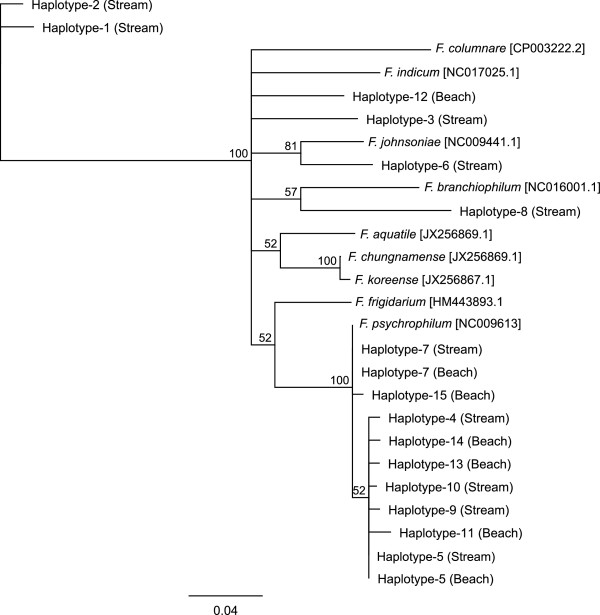
We identified 10 Flavobacterium AtpA haplotypes among the tissues of stream-spawning kokanee and seven haplotypes among the tissues of beach-spawning kokanee, with only two haplotypes shared between spawning habitats. Haplotypes occurring in the same clade as F. psychrophilum were the most prevalent (92% of all reads, 60% of all haplotypes), and occurred in kokanee from both spawning habitats (streams and beaches). Subsequent qPCR assays did not find any significant difference in the relative abundance of Flavobacterium AtpA amplicons between samples from the different spawning habitats.
We confirmed the presence of Flavobacterium spp. in both spawning habitats and found weak evidence for increased Flavobacterium diversity in kokanee sampled from stream-spawning sites. However, the quantity of Flavobacterium DNA did not differ between spawning habitats. We recommend further study aimed at quantifying pathogen diversity and abundance in population-level samples of kokanee combined with environmental sampling to better understand the ecology of pathogen infection in this species.
了解病原体的分布和丰度有助于洞察其宿主物种的进化和生态。此前对红大马哈鱼(Oncorhynchus nerka)的淡水形态——科卡尼鲑的研究发现,有证据表明在溪流中产卵的种群可能比在海滩上产卵的种群承受更大的病原体负荷。在本研究中,我们测试了感染这两种产卵栖息地(溪流和海滩)中科卡尼鲑组织的革兰氏阴性菌——黄杆菌属(Flavobacterium spp.)的丰度和多样性差异。使用设计用于扩增黄杆菌属内编码ATP合酶α亚基(AtpA)基因的约200个核苷酸区域的引物进行分子检测。我们结合DNA测序和定量PCR(qPCR),比较了从每个产卵栖息地收集的科卡尼鲑组织样本中提取的DNA中黄杆菌AtpA扩增子的多样性和相对丰度。
我们在溪流产卵的科卡尼鲑组织中鉴定出10种黄杆菌AtpA单倍型,在海滩产卵的科卡尼鲑组织中鉴定出7种单倍型,两个产卵栖息地之间仅共享两种单倍型。与嗜冷黄杆菌(F. psychrophilum)处于同一进化枝的单倍型最为普遍(占所有读数的92%,所有单倍型的60%),且在来自两个产卵栖息地(溪流和海滩)的科卡尼鲑中均有出现。随后的qPCR检测未发现来自不同产卵栖息地的样本之间黄杆菌AtpA扩增子的相对丰度有任何显著差异。
我们证实了两种产卵栖息地中均存在黄杆菌属,并发现了一些微弱证据,表明从溪流产卵地采集的科卡尼鲑中黄杆菌的多样性有所增加。然而,黄杆菌DNA的数量在不同产卵栖息地之间并无差异。我们建议进一步开展研究,旨在对科卡尼鲑种群水平样本中的病原体多样性和丰度进行量化,并结合环境采样,以更好地了解该物种中病原体感染的生态学。