Lou Xiaoli, Hou Yanqiang, Liang Dongyu, Peng Liang, Chen Hongwei, Ma Shanyuan, Zhang Lurong
Department of Central Laboratory, Songjiang Hospital Affiliated First People's Hospital, Shanghai Jiao Tong University, Shanghai 201600, P.R. China.
Department of Radiation Oncology, Shands Cancer Center, University of Florida, Gainesville, FL 32610, USA.
Int J Mol Med. 2015 Jan;35(1):72-80. doi: 10.3892/ijmm.2014.1991. Epub 2014 Nov 5.
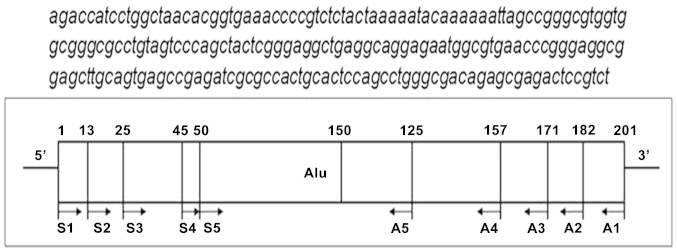
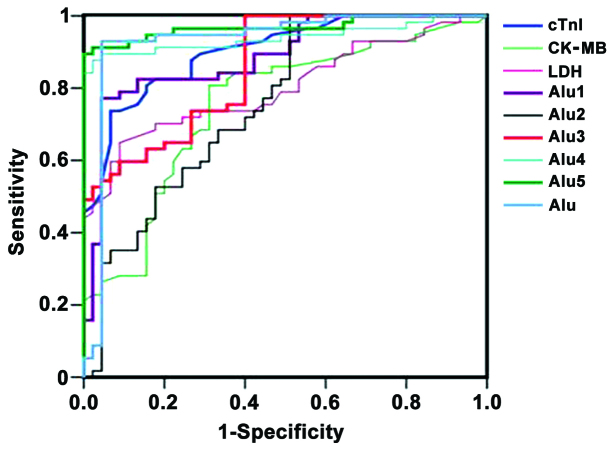
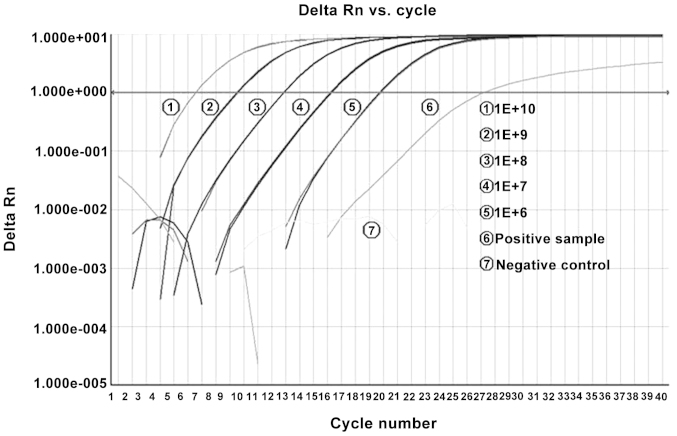
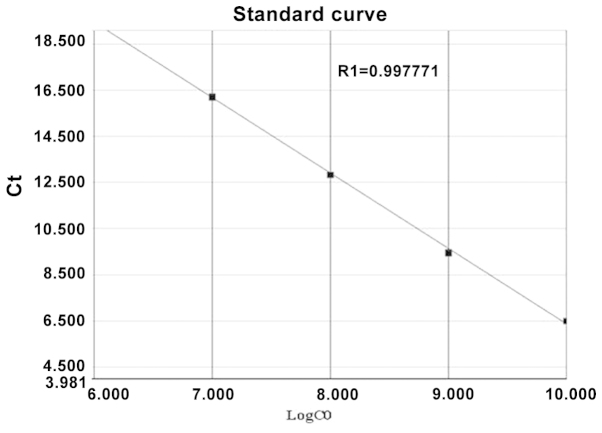
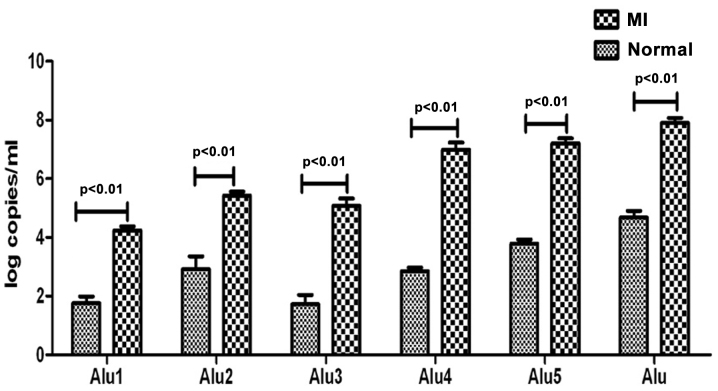
In the present study, we aimed to develop and validate a rapid and sensitive, Alu-based real-time PCR method for the detection of circulating cell-free DNA (cfDNA). This method targeted repetitive elements of the Alu reduplicative elements in the human genome, followed by signal amplification using fluorescence quantification. Standard Alu-puc57 vectors were constructed and 5 pairs of specific primers were designed. Valuation was conducted concerning linearity, variation and recovery. We found 5 linear responses (R1-5=0.998-0.999). The average intra- and inter-assay coefficients of variance were 12.98 and 10.75%, respectively. The recovery was 82.33-114.01%, with a mean recovery index of 101.26%. This Alu-based assay was reliable, accurate and sensitive for the quantitative detection of cfDNA. Plasma from normal controls and patients with myocardial infarction (MI) were analyzed, and the baseline levels of cfDNA were higher in the MI group. The area under the receiver operating characteristic (ROC) curve for Alu1, Alu2, Alu3, Alu4, Alu5 and Alu (Alu1 + Alu2 + Alu3 + Alu4 + Alu5) was 0.887, 0.758, 0.857, 0.940, 0.968 and 0.933, respectively. The optimal cut-off value for Alu1, Alu2, Alu3, Alu4, Alu5 and Alu to predict MI was 3.71, 1.93, 0.22, 3.73, 6.13 and 6.40 log copies/ml. We demonstrate that this new method is a reliable, accurate and sensitive method for the quantitative detection of cfDNA and that it is useful for studying the regulation of cfDNA in certain pathological conditions. Alu4, Alu5 and Alu showed better sensitivity and specificity for the diagnosis of MI compared with cardiac troponin I (cTnI), creatine kinase MB (CK-MB) isoenzyme and lactate dehydrogenase (LDH). Alu5 had the best prognostic ability.
在本研究中,我们旨在开发并验证一种快速、灵敏的基于Alu的实时荧光定量PCR方法,用于检测循环游离DNA(cfDNA)。该方法针对人类基因组中Alu重复元件的重复序列,随后通过荧光定量进行信号放大。构建了标准Alu-puc57载体并设计了5对特异性引物。对线性度、变异度和回收率进行了评估。我们发现有5个线性响应(R1-5 = 0.998 - 0.999)。平均批内和批间变异系数分别为12.98%和10.75%。回收率为82.33% - 114.01%,平均回收指数为101.26%。这种基于Alu的检测方法对于cfDNA的定量检测是可靠、准确且灵敏的。分析了正常对照者和心肌梗死(MI)患者的血浆,MI组中cfDNA的基线水平更高。Alu1、Alu2、Alu3、Alu4、Alu5和Alu(Alu1 + Alu2 + Alu3 + Alu4 + Alu5)的受试者工作特征(ROC)曲线下面积分别为0.887、0.758、0.857、0.940、0.968和0.933。预测MI的Alu1、Alu2、Alu3、Alu4、Alu5和Alu的最佳截断值分别为3.71、1.93、0.22、3.73、6.13和6.40 log拷贝/毫升。我们证明这种新方法是一种可靠、准确且灵敏的cfDNA定量检测方法,并且对于研究某些病理条件下cfDNA的调控是有用的。与心肌肌钙蛋白I(cTnI)、肌酸激酶MB(CK-MB)同工酶和乳酸脱氢酶(LDH)相比,Alu4、Alu5和Alu在MI诊断中表现出更好的敏感性和特异性。Alu5具有最佳的预后能力。