Hsueh Yuan-Shuo, Chang Hui Hua, Chiang Nai-Jung, Yen Chueh-Chuan, Li Chien-Feng, Chen Li-Tzong
National Institute of Cancer Research, National Health Research Institutes, Tainan, Taiwan.
Institute of Clinical Pharmacy and Pharmaceutical Sciences, College of Medicine, National Cheng Kung University, Tainan, Taiwan.
Oncotarget. 2014 Nov 30;5(22):11723-36. doi: 10.18632/oncotarget.2607.
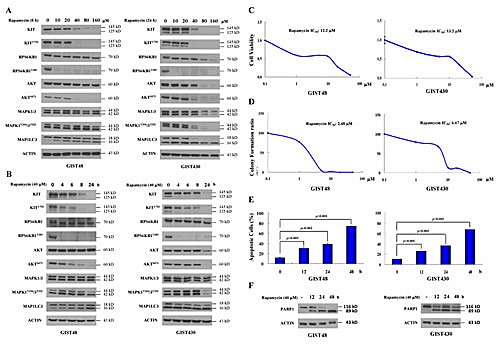
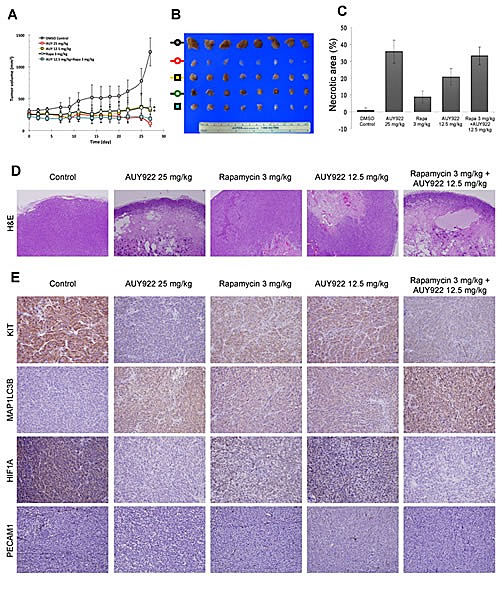
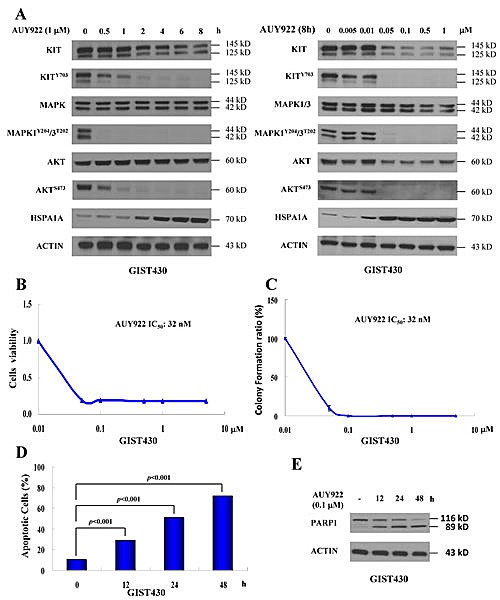
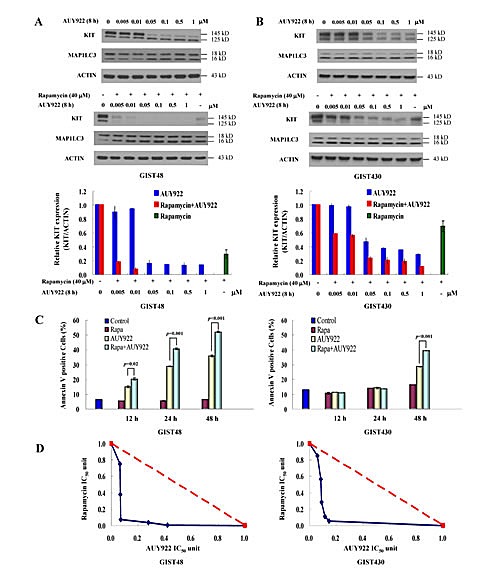
Our previous study demonstrated NVP-AUY922, a HSP90AA1 inhibitor, could enhance mutant KIT degradation in gastrointestinal stromal tumor (GIST) cells through both proteasome- and autophagy-mediated pathways. Herein, we showed rapamycin, a MTOR inhibitor and autophagy inducer, could reduce total and phospho-KIT expression levels and enhance apoptosis in imatinib-resistant GIST cells. The involvement of autophagy in rapamycin-induced KIT downregulation was further confirmed by co-localization of KIT and autophagosome, and partial recovery of KIT expression level by either siRNA-mediated BECN1 and ATG5 silencing or autophagy inhibitors after rapamycin. Rapamycin and NVP-AUY922 synergistically inhibited GIST cells growth in vitro. The combination of low-dose NVP-AUY922 with rapamycin had comparable effects on reducing KIT expression, increasing MAP1LC3B puncta and tumor necrosis, and inhibiting tumor growth as high-dose NVP-AUY922 did in GIST430 xenograft model. Our results suggest the addition of a MTOR inhibitor may reduce NVP-AUY922 dose requirement and potentially improve its therapeutic index in mutant KIT-expressing GISTs.
我们之前的研究表明,HSP90AA1抑制剂NVP-AUY922可通过蛋白酶体和自噬介导的途径增强胃肠道间质瘤(GIST)细胞中突变型KIT的降解。在此,我们发现雷帕霉素,一种mTOR抑制剂和自噬诱导剂,可降低伊马替尼耐药GIST细胞中总KIT和磷酸化KIT的表达水平并增强细胞凋亡。KIT与自噬体的共定位以及雷帕霉素处理后通过siRNA介导的BECN1和ATG5沉默或自噬抑制剂部分恢复KIT表达水平,进一步证实了自噬参与雷帕霉素诱导的KIT下调。雷帕霉素和NVP-AUY922在体外协同抑制GIST细胞生长。在GIST430异种移植模型中,低剂量NVP-AUY922与雷帕霉素联合使用在降低KIT表达、增加MAP1LC3B斑点和肿瘤坏死以及抑制肿瘤生长方面具有与高剂量NVP-AUY922相当的效果。我们的结果表明,添加mTOR抑制剂可能会降低NVP-AUY922的剂量需求,并有可能提高其在表达突变型KIT的GIST中的治疗指数。