Doscas Michelle E, Williamson Ashley J, Usha Lydia, Bogachkov Yedida, Rao Geetha S, Xiao Fei, Wang Yimin, Ruby Carl, Kaufman Howard, Zhou Jingsong, Williams James W, Li Yi, Xu Xiulong
Department of Anatomy and Cell Biology, Rush University Medical Center, Chicago, IL 60612.
Rush Medical College, Rush University Medical Center, Chicago, IL 60612.
Neoplasia. 2014 Oct 23;16(10):824-34. doi: 10.1016/j.neo.2014.08.006. eCollection 2014 Oct.
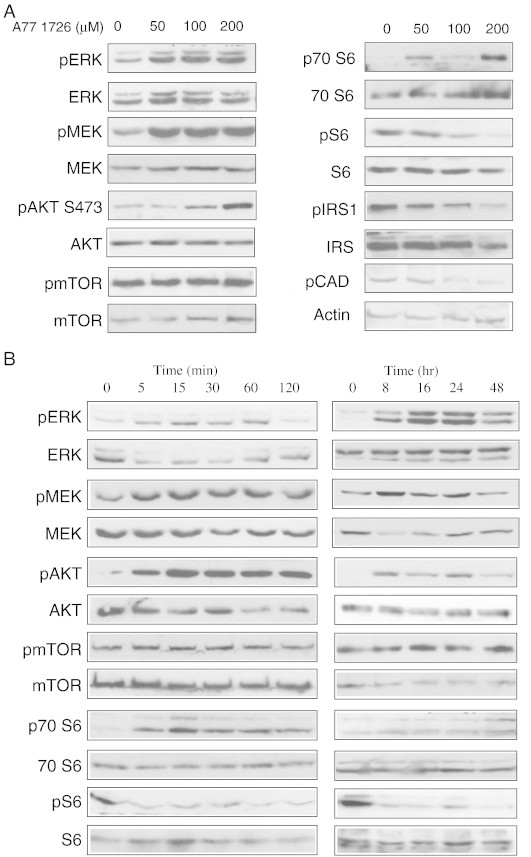
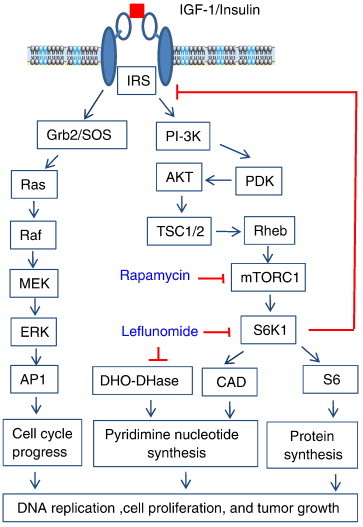
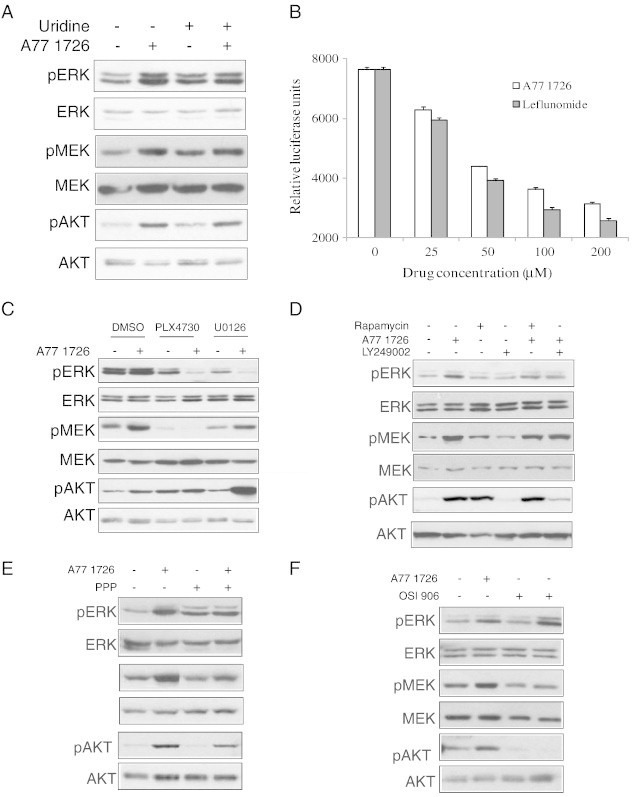
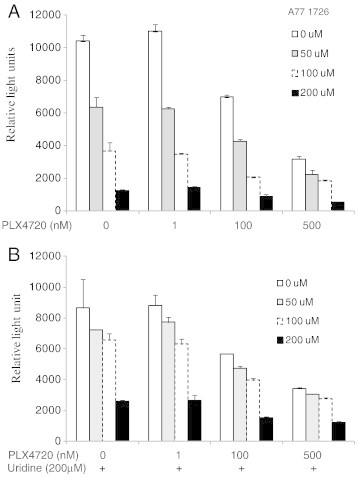
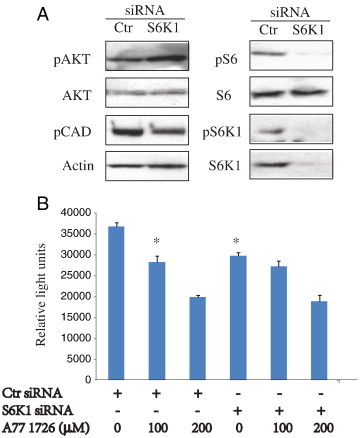
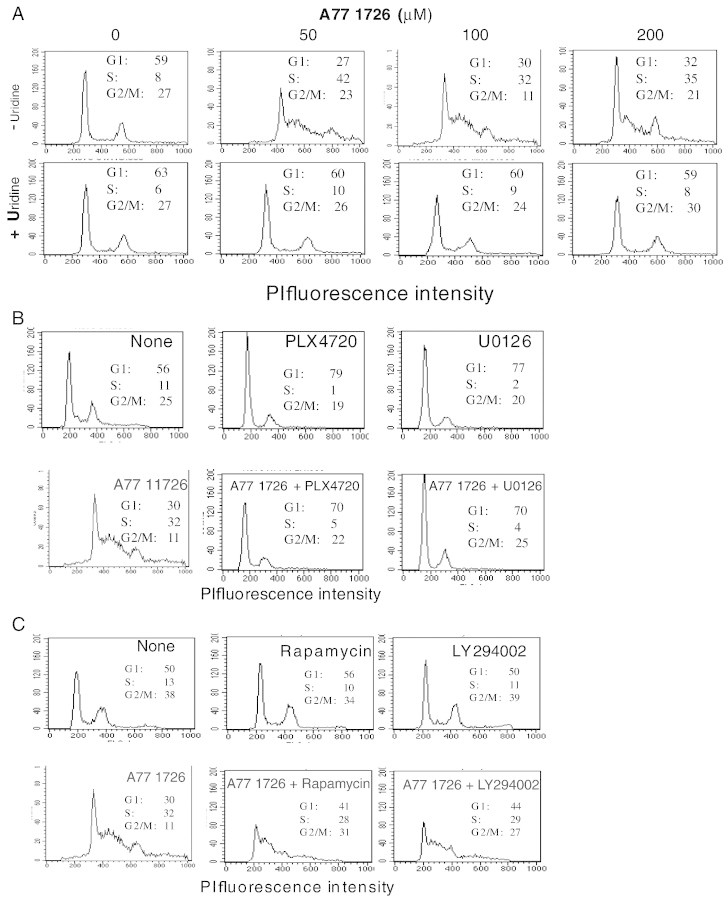
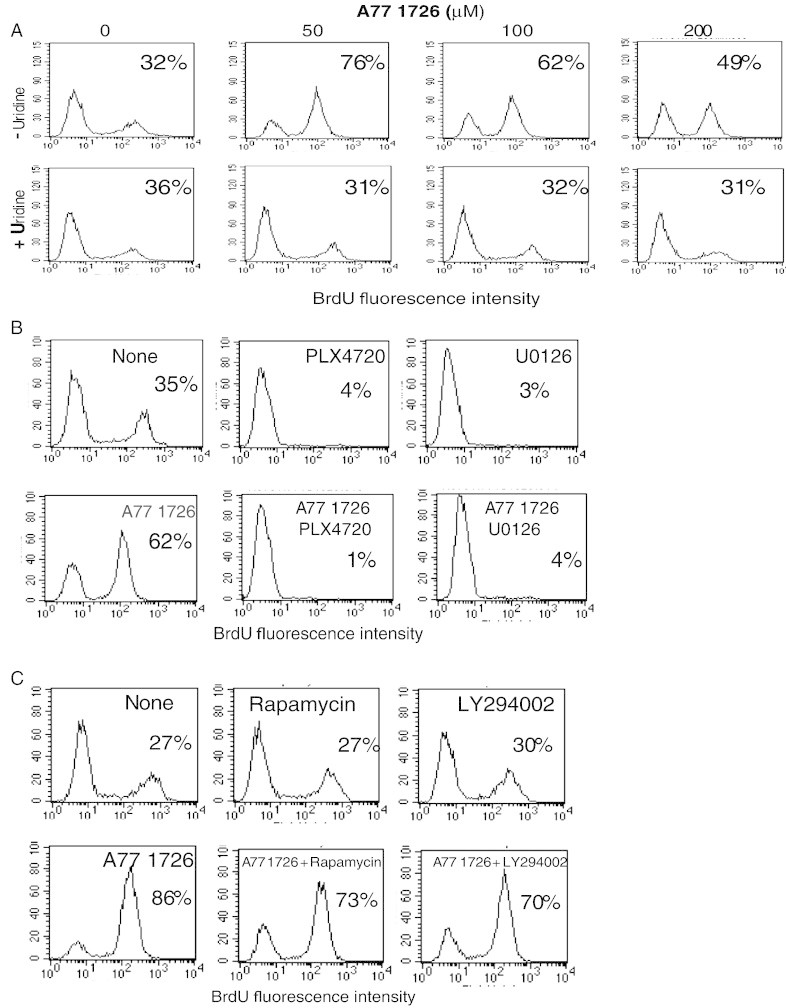
Leflunomide is a novel immunomodulatory drug prescribed for treating rheumatoid arthritis. It inhibits the activity of protein tyrosine kinases and dihydroorotate dehydrogenase, a rate-limiting enzyme in the pyrimidine nucleotide synthesis pathway. Here, we report that A77 1726, the active metabolite of leflunomide, inhibited the phosphorylation of ribosomal protein S6 and two other substrates of S6K1, insulin receptor substrate-1 and carbamoyl phosphate synthetase 2, in an A375 melanoma cell line. A77 1726 increased the phosphorylation of AKT, p70 S6 (S6K1), ERK1/2, and MEK through the feedback activation of the IGF-1 receptor-mediated signaling pathway. In vitro kinase assay revealed that leflunomide and A77 1726 inhibited S6K1 activity with IC50 values of approximately 55 and 80 μM, respectively. Exogenous uridine partially blocked A77 1726-induced inhibition of A375 cell proliferation. S6K1 knockdown led to the inhibition of A375 cell proliferation but did not potentiate the antiproliferative effect of A77 1726. A77 1726 stimulated bromodeoxyuridine incorporation in A375 cells but arrested the cell cycle in the S phase, which was reversed by addition of exogenous uridine or by MAP kinase pathway inhibitors but not by rapamycin and LY294002 (a phosphoinositide 3-kinase inhibitor). These observations suggest that A77 1726 accelerates cell cycle entry into the S phase through MAP kinase activation and that pyrimidine nucleotide depletion halts the completion of the cell cycle. Our study identified a novel molecular target of A77 1726 and showed that the inhibition of S6K1 activity was in part responsible for its antiproliferative activity. Our study also provides a novel mechanistic insight into A77 1726-induced cell cycle arrest in the S phase.
来氟米特是一种用于治疗类风湿性关节炎的新型免疫调节药物。它能抑制蛋白酪氨酸激酶和二氢乳清酸脱氢酶的活性,后者是嘧啶核苷酸合成途径中的一种限速酶。在此,我们报告来氟米特的活性代谢产物A77 1726在A375黑色素瘤细胞系中抑制核糖体蛋白S6以及S6K1的另外两个底物——胰岛素受体底物-1和氨甲酰磷酸合成酶2的磷酸化。A77 1726通过胰岛素样生长因子-1受体介导的信号通路的反馈激活增加AKT、p70 S6(S6K1)、ERK1/2和MEK的磷酸化。体外激酶试验表明,来氟米特和A77 分别以约55和80 μM的IC50值抑制S6K1活性。外源性尿苷部分阻断A77 1726诱导的A375细胞增殖抑制。S6K1基因敲低导致A375细胞增殖受到抑制,但并未增强A77 1726的抗增殖作用。A77 1726刺激A375细胞中溴脱氧尿苷的掺入,但使细胞周期停滞在S期,添加外源性尿苷或丝裂原活化蛋白激酶途径抑制剂可逆转这一现象,但雷帕霉素和LY29400(一种磷脂酰肌醇3激酶抑制剂)不能。这些观察结果表明,A77 1726通过丝裂原活化蛋白激酶激活加速细胞周期进入S期,且嘧啶核苷酸耗竭会阻止细胞周期的完成。我们的研究确定了A77 1726的一个新分子靶点,并表明S6K1活性的抑制部分是其抗增殖活性的原因。我们的研究还为A77 1726诱导的S期细胞周期停滞提供了新的机制见解。 1726 1726 1726 1726 1726 1726 1726 1726 1726 1726 1726 1726 1726 1726 1726 1726 1726 1726 1726 1726 1726 1726 1726 1726 1726 1726 1726 1726 1726 1726 1726 1726 1726 1726 1726 1726 1726 1726 17