Kobayashi Hisataka, Turkbey Baris, Watanabe Rira, Choyke Peter L
Molecular Imaging Program, Center for Cancer Research, National Cancer Institute, National Institutes of Health , Bethesda, Maryland 20892, United States.
Bioconjug Chem. 2014 Dec 17;25(12):2093-100. doi: 10.1021/bc500481x. Epub 2014 Nov 19.
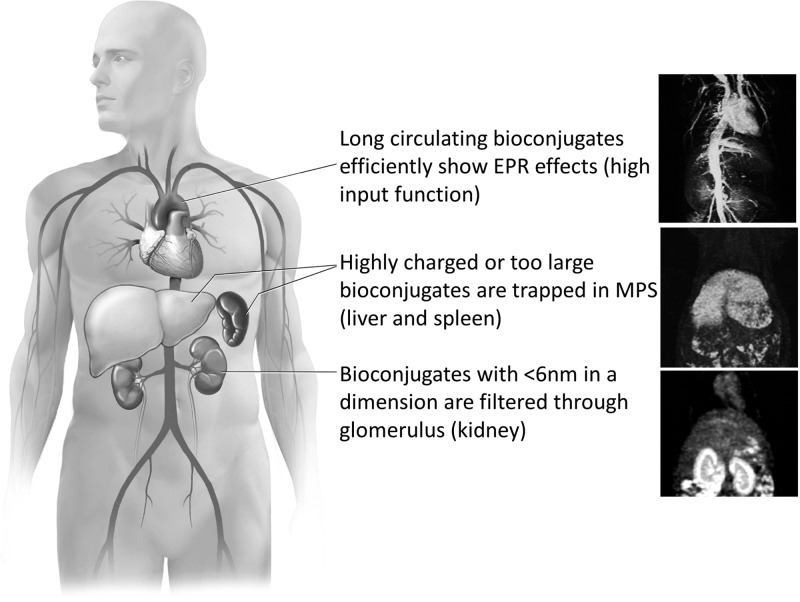
In order to efficiently deliver anticancer agents to tumors, biocompatible nanoparticles or bioconjugates, including antibody-drug conjugates (ADCs), have recently been designed, synthesized, and tested, some even in clinical trials. Controlled delivery can be enhanced by changing specific design characteristics of the bioconjugate such as its size, the nature of the payload, and the surface features. The delivery of macromolecular drugs to cancers largely relies on the leaky nature of the tumor vasculature compared with healthy vessels in normal organs. When administered intravenously, macromolecular bioconjugates and nanosized agents tend to circulate for prolonged times, unless they are small enough to be excreted by the kidney or stealthy enough to evade the macrophage phagocytic system (MPS), formerly the reticulo-endothelial system (RES). Therefore, macromolecular bioconjugates and nanosized agents with long circulation times leak preferentially into tumor tissue through permeable tumor vessels and are then retained in the tumor bed due to reduced lymphatic drainage. This process is known as the enhanced permeability and retention (EPR) effect. However, success of cancer drug delivery only relying on the EPR effect is still limited. To cure cancer patients, further improvement of drug delivery is required by both designing superior agents and enhancing EPR effects. In this Review, we describe the basis of macromolecular or nanosized bioconjugate delivery into cancer tissue and discuss current diagnostic methods for evaluating leakiness of the tumor vasculature. Then, we discuss methods to augment conventional "permeability and retention" effects for macromolecular or nanosized bioconjugates in cancer tissue.
为了将抗癌药物有效地递送至肿瘤部位,人们近来设计、合成并测试了生物相容性纳米颗粒或生物偶联物,包括抗体药物偶联物(ADC),其中一些甚至已进入临床试验阶段。通过改变生物偶联物的特定设计特征,如尺寸、载药性质和表面特性,可以增强可控递送。与正常器官中的健康血管相比,大分子药物向癌症部位的递送很大程度上依赖于肿瘤脉管系统的渗漏特性。静脉给药时,大分子生物偶联物和纳米制剂往往会在体内循环较长时间,除非它们足够小能够通过肾脏排出,或者具有足够的隐身性以逃避巨噬细胞吞噬系统(MPS,以前称为网状内皮系统(RES))。因此,具有较长循环时间的大分子生物偶联物和纳米制剂会优先通过可渗透的肿瘤血管渗漏到肿瘤组织中,然后由于淋巴引流减少而滞留在肿瘤床中。这个过程被称为增强渗透与滞留(EPR)效应。然而,仅依靠EPR效应进行癌症药物递送的成功率仍然有限。为了治愈癌症患者,需要通过设计更优异的制剂以及增强EPR效应来进一步改善药物递送。在本综述中,我们描述了大分子或纳米生物偶联物递送至癌症组织的基础,并讨论了评估肿瘤脉管系统渗漏性的当前诊断方法。然后,我们讨论了增强大分子或纳米生物偶联物在癌症组织中的传统“渗透与滞留”效应的方法。