Montoya-Alonso José Alberto, Carretón Elena, García-Guasch Laín, Expósito Jordi, Armario Belén, Morchón Rodrigo, Simón Fernando
Internal Medicine, Faculty of Veterinary Medicine, University of Las Palmas de Gran Canaria, 35413, Arucas, Las Palmas, Spain.
Cardiology Service, Hospital Veterinari Molins, 08620, Barcelona, Spain.
Parasit Vectors. 2014 Nov 12;7:506. doi: 10.1186/s13071-014-0506-6.
The metropolitan area of Barcelona is the most densely populated metropolitan area on the Mediterranean coast. Several studies have reported the presence of canine heartworm disease in this region; however, there are no published epidemiological data regarding feline heartworm in this region and the prevalence in this species remains unknown.
Serum samples from 758 cats living in the metropolitan area of Barcelona (Spain) were collected between 2012 and 2013. To establish the seroprevalence of heartworm infection in cats, serological techniques for anti-D.immitis and anti-Wolbachia antibody detection were used while a commercial ELISA test kit was used to detect circulating D.immitis antigens.
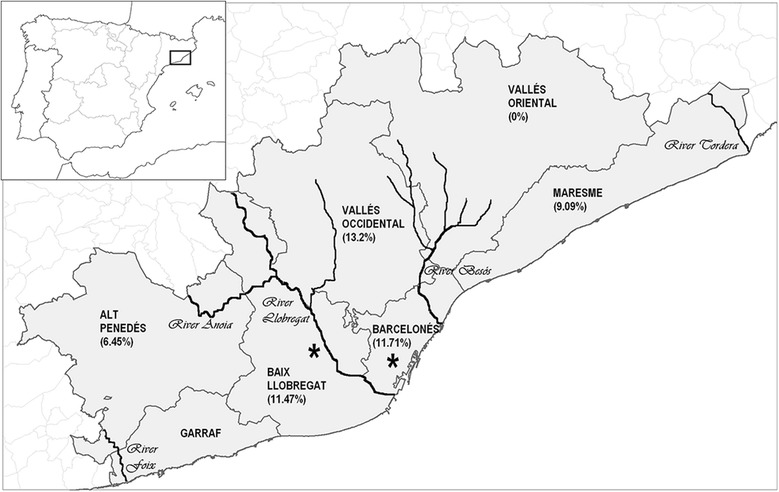
Of these samples, 11.47% were positive to D.immitis and Wolbachia surface protein antibodies and 0.26% were positive to D.immitis antigens. The higher antibody seroprevalences were found in the areas that follow the courses of the rivers Llobregat and Anoia (Baix Llobregat 11.5%, Vallés Occidental 13.2%; Barcelonés 11.7%) where humidity and vegetation favour the development of the mosquito vectors. High antibody seroprevalences were also found in the urban areas (Barcelona city 13.1%; Sabadell 15.5%), which demonstrates that city cats are also at risk from D.immitis infection.
Generally, in Spain cats do not receive prophylactic treatment and therefore the risk of infection is higher in this species than in dogs. Adequate prophylactic plans should be implemented in the feline population. This is the first epidemiologic study on feline heartworm infection to be carried out in continental Spain.
巴塞罗那大都市区是地中海沿岸人口最密集的大都市区。多项研究报告了该地区存在犬心丝虫病;然而,关于该地区猫心丝虫病尚无已发表的流行病学数据,该物种的患病率仍然未知。
2012年至2013年期间收集了来自西班牙巴塞罗那大都市区758只猫的血清样本。为确定猫心丝虫感染的血清阳性率,采用了抗伊氏锥虫和抗沃尔巴克氏体抗体检测的血清学技术,同时使用商业酶联免疫吸附测定试剂盒检测循环中的伊氏锥虫抗原。
在这些样本中,11.47%对伊氏锥虫和沃尔巴克氏体表面蛋白抗体呈阳性,0.26%对伊氏锥虫抗原呈阳性。在略夫雷加特河和阿诺伊亚河沿岸地区(下略夫雷加特11.5%、西瓦列斯13.2%;巴塞罗那内斯11.7%)发现较高的抗体血清阳性率,这些地区的湿度和植被有利于蚊媒的生长。在城市地区(巴塞罗那市13.1%;萨瓦德尔15.5%)也发现了较高的抗体血清阳性率,这表明城市猫也有感染伊氏锥虫的风险。
一般来说,在西班牙猫未接受预防性治疗,因此该物种的感染风险高于犬。应在猫群中实施适当的预防计划。这是在西班牙大陆进行的第一项关于猫心丝虫感染的流行病学研究。