Shon Yoo-Seok, Lee Ye-Na, Jeong Seong-Ho, Dhong Eun-Sang, Han Seung-Kyu
Department of Plastic Surgery, Korea University Guro Hospital, Korea University College of Medicine, Seoul, Korea.
Department of Nursing Service, Korea University Guro Hospital, Korea University College of Medicine, Seoul, Korea.
Arch Plast Surg. 2014 Nov;41(6):668-72. doi: 10.5999/aps.2014.41.6.668. Epub 2014 Nov 3.
Negative-pressure wound therapy (NPWT) is believed to accelerate wound healing by altering wound microvascular blood flow. Although many studies using laser Doppler have found that NPWT increases perfusion, recent work using other modalities has demonstrated that perfusion is reduced. The purpose of this study was to investigate the influence of NPWT on tissue oxygenation of the foot, which is the most sensitive region of the body to ischemia.
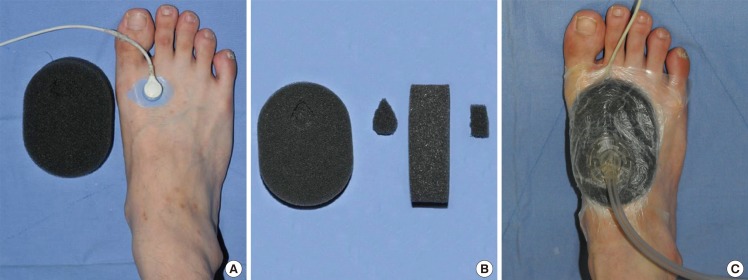
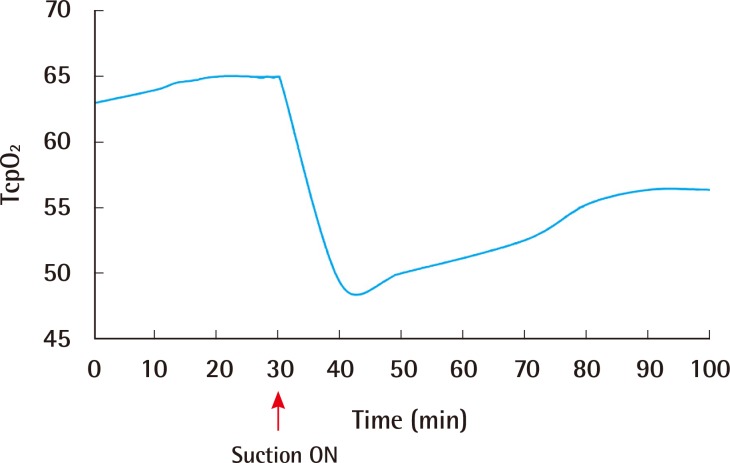
Transcutaneous partial pressure of oxygen (TcpO2) was used to determine perfusion beneath NPWT dressings of 10 healthy feet. The sensor was placed on the tarso-metatarsal area of the foot and the NPWT dressing was placed above the sensor. TcpO2 was measured until it reached a steady plateau state. The readings obtained at the suction-on period were compared with the initial baseline (pre-suction) readings.
TcpO2 decreased significantly immediately after applying NPWT, but gradually increased over time until reaching a steady plateau state. The decrease in TcpO2 from baseline to the steady state was 2.9 to 13.9 mm Hg (mean, 9.3±3.6 mm Hg; 13.5±5.8%; P<0.01). All feet reached a plateau within 20 to 65 minutes after suction was applied.
NPWT significantly decrease tissue oxygenation of the foot by 2.9 to 13.9 mm Hg. NPWT should be used with caution on feet that do not have adequate tissue oxygenation for wound healing.
负压伤口治疗(NPWT)被认为可通过改变伤口微血管血流来加速伤口愈合。尽管许多使用激光多普勒的研究发现NPWT可增加灌注,但最近使用其他方法的研究表明灌注会降低。本研究的目的是调查NPWT对足部组织氧合的影响,足部是身体对缺血最敏感的区域。
使用经皮氧分压(TcpO2)来测定10只健康足部NPWT敷料下的灌注情况。传感器放置在足部的跗跖区域,NPWT敷料放置在传感器上方。测量TcpO2直至其达到稳定的平台状态。将吸引开启期获得的读数与初始基线(吸引前)读数进行比较。
应用NPWT后,TcpO2立即显著下降,但随时间逐渐增加,直至达到稳定的平台状态。从基线到稳定状态,TcpO2下降了2.9至13.9 mmHg(平均,9.3±3.6 mmHg;13.5±5.8%;P<0.01)。所有足部在施加吸引后20至65分钟内达到平台期。
NPWT可使足部组织氧合显著降低2.9至13.9 mmHg。对于伤口愈合时组织氧合不足的足部,应谨慎使用NPWT。