Thongprayoon Charat, Cheungpasitporn Wisit, Akhoundi Abbasali, Ahmed Adil H, Kashani Kianoush B
Division of Nephrology and Hypertension, Department of Internal Medicine, Mayo Clinic, 200 First Street SW, Rochester, MN 55905, USA.
BMC Nephrol. 2014 Nov 15;15:176. doi: 10.1186/1471-2369-15-176.
In the current acute kidney injury (AKI) definition, the urine output (UO) criterion does not specify which body weights (BW), i.e. actual (ABW) versus ideal (IBW), should be used to diagnose and stage AKI, leading to heterogeneity across research studies.
This is a single center, retrospective, observational study conducted at a tertiary referral hospital. All adult patients who were admitted to intensive care units (ICUs) at our institution for a minimum of 6 continuous hours between January and March 2010 and had a urinary catheter for hourly urine output monitoring were eligible for this study. Patients' AKI stages, based on UO criterion, were assessed by calculating each milliliter of urine per kilogram per hour, using ABW versus IBW.
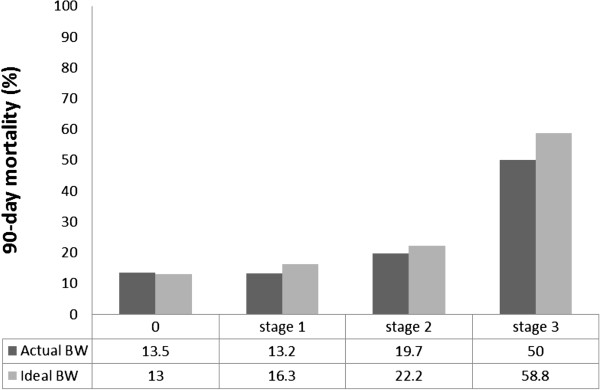
A total of 493 ICU patients were included in the analysis. The median ABW and IBW were 82 (IQR 68-96) and 70 (IQR 60-77) kg, respectively. Using the IBW criterion, 154 patients (31.2%) were diagnosed with AKI, while 204 (41.4%) were diagnosed using the ABW measurement (P-value<.01). Patients who had AKI regardless of BW type had an adjusted odds ratio of 1.76 (95% CI 1.05-2.95) for 90-day mortality, whereas patients who had AKI according to ABW but not IBW had no significant increase in the risk of 90-day mortality, adjusted OR 0.76; (95% CI 0.25-1.91), compared to patients who had no AKI.
Using ABW to diagnose and stage AKI by UO criterion is more sensitive and less specific than IBW. Based on the application of the definition, different BW types could be utilized.
在当前急性肾损伤(AKI)的定义中,尿量(UO)标准未明确规定应使用哪种体重(BW),即实际体重(ABW)还是理想体重(IBW)来诊断和分期AKI,这导致各研究之间存在异质性。
这是一项在三级转诊医院进行的单中心、回顾性观察研究。2010年1月至3月期间,所有在我院重症监护病房(ICU)连续住院至少6小时且留置导尿管以每小时监测尿量的成年患者均符合本研究条件。根据尿量标准,通过使用ABW与IBW计算每千克每小时的尿量来评估患者的AKI分期。
共有493例ICU患者纳入分析。ABW和IBW的中位数分别为82(四分位间距68 - 96)千克和70(四分位间距60 - 77)千克。使用IBW标准,154例患者(31.2%)被诊断为AKI,而使用ABW测量时为204例(41.4%)(P值<0.01)。无论体重类型如何,发生AKI的患者90天死亡率的调整比值比为1.76(95%可信区间1.05 - 2.95),而根据ABW而非IBW诊断为AKI的患者与未发生AKI的患者相比,90天死亡风险无显著增加,调整后的比值比为0.76;(95%可信区间0.25 - 1.91)。
根据尿量标准使用ABW诊断和分期AKI比使用IBW更敏感但特异性更低。基于该定义的应用,可以采用不同的体重类型。