Agarwal Shikhar, Garg Aatish, Parashar Akhil, Jaber Wael A, Menon Venu
Department of Cardiovascular Medicine, Cleveland Clinic, Cleveland, OH (S.A., W.A.J., V.M.).
Department of Internal Medicine, Cleveland Clinic, Cleveland, OH (A.G., A.P.).
J Am Heart Assoc. 2014 Nov 16;3(6):e001057. doi: 10.1161/JAHA.114.001057.
Socioeconomic status (SES) as reflected by residential zip code status may detrimentally influence a number of prehospital clinical, access-related, and transport variables that influence outcome for patients with ST-elevation myocardial infarction (STEMI) undergoing reperfusion. We sought to analyze the impact of SES on in-hospital mortality, timely reperfusion, and cost of hospitalization following STEMI.
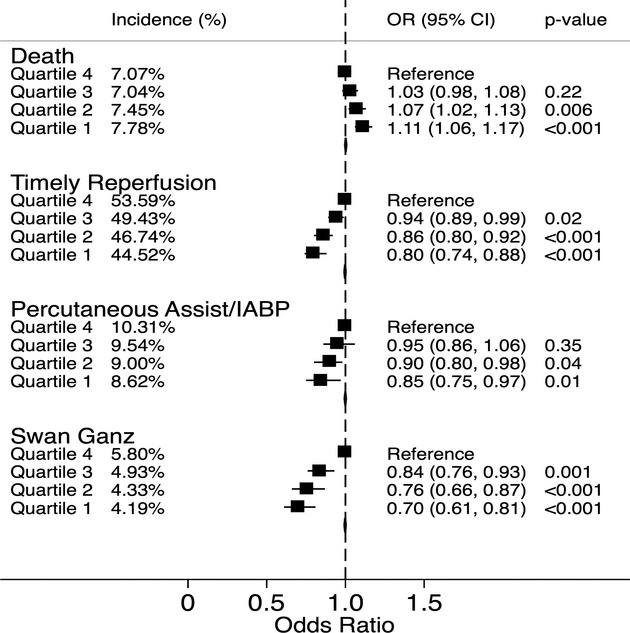
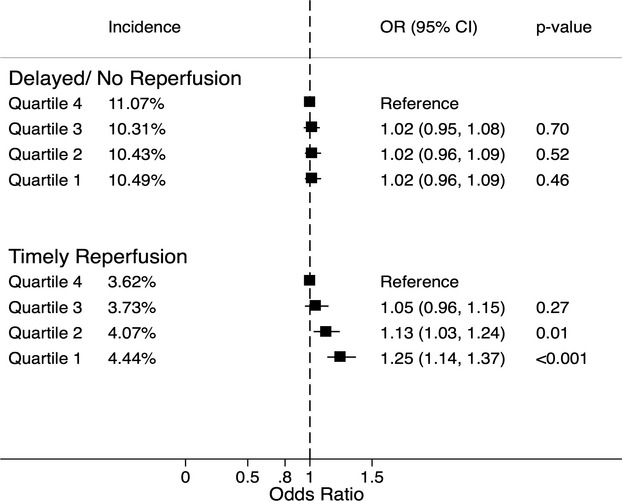
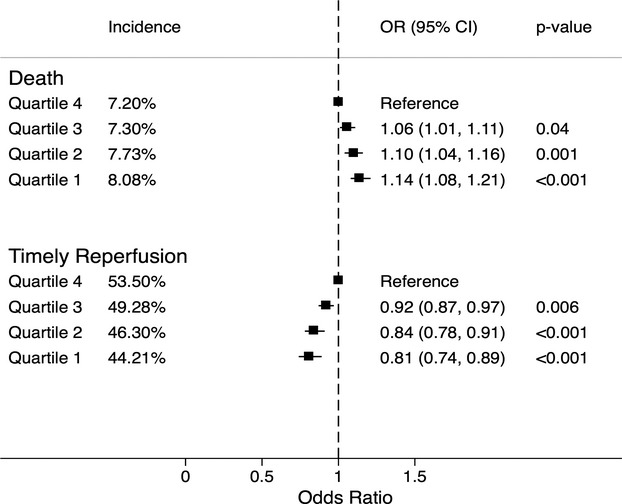
We used the 2003-2011 Nationwide Inpatient Sample database for this analysis. All hospital admissions with a principal diagnosis of STEMI were identified using ICD-9 codes. SES was assessed using median household income of the residential zip code for each patient. There was a significantly higher mortality among the lowest SES quartile as compared to the highest quartile (OR [95% CI]: 1.11 [1.06 to 1.17]). Similarly, there was a highly significant trend indicating a progressively reduced timely reperfusion among patients from lower quartiles (OR [95% CI]: 0.80 [0.74 to 0.88]). In addition, there was a lower utilization of circulatory support devices among patients from lower as compared to higher zip code quartiles (OR [95% CI]: 0.85 [0.75 to 0.97]). Furthermore, the mean adjusted cost of hospitalization among quartiles 2, 3, and 4, as compared to quartile 1 was significantly higher by $913, $2140, and $4070, respectively.
Patients residing in zip codes with lower SES had increased in-hospital mortality and decreased timely reperfusion following STEMI as compared to patients residing in higher SES zip codes. The cost of hospitalization of patients from higher SES quartiles was significantly higher than those from lower quartiles.
居住邮政编码所反映的社会经济地位(SES)可能会对一些院前临床、与就医机会相关以及转运变量产生不利影响,这些变量会影响接受再灌注治疗的ST段抬高型心肌梗死(STEMI)患者的预后。我们试图分析SES对STEMI后住院死亡率、及时再灌注以及住院费用的影响。
我们使用2003 - 2011年全国住院患者样本数据库进行此项分析。使用国际疾病分类第九版(ICD - 9)编码识别所有主要诊断为STEMI的住院病例。SES通过每位患者居住邮政编码区域的家庭收入中位数进行评估。与最高四分位数相比,最低SES四分位数组的死亡率显著更高(比值比[95%置信区间]:1.11[1.06至1.17])。同样,存在一个高度显著的趋势,表明较低四分位数组的患者及时再灌注率逐渐降低(比值比[95%置信区间]:0.80[0.74至0.88])。此外,与较高邮政编码四分位数组的患者相比,较低四分位数组的患者循环支持设备使用率更低(比值比[95%置信区间]:0.85[0.75至0.97])。此外,与第一四分位数相比,第二、第三和第四四分位数组的平均调整后住院费用分别显著高出913美元、2140美元和4070美元。
与居住在较高SES邮政编码区域的患者相比,居住在较低SES邮政编码区域的患者在STEMI后住院死亡率增加,及时再灌注率降低。较高SES四分位数组患者的住院费用显著高于较低四分位数组患者。