Kitano Ken
Graduate School of Biological Sciences, Nara Institute of Science and Technology Ikoma, Japan.
Front Genet. 2014 Oct 29;5:366. doi: 10.3389/fgene.2014.00366. eCollection 2014.
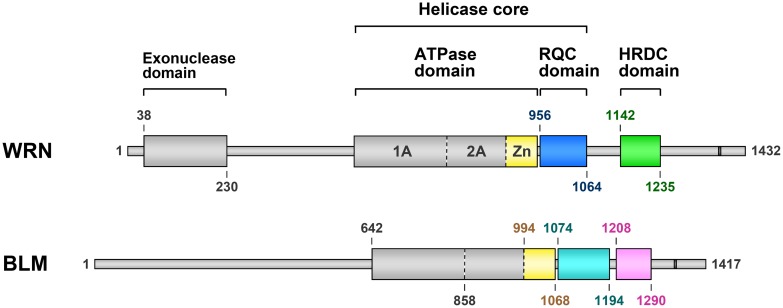
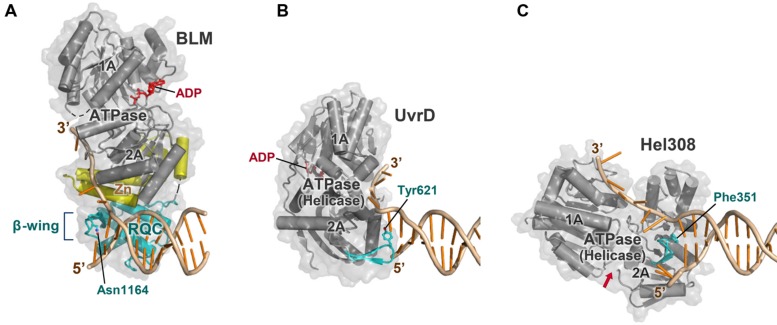
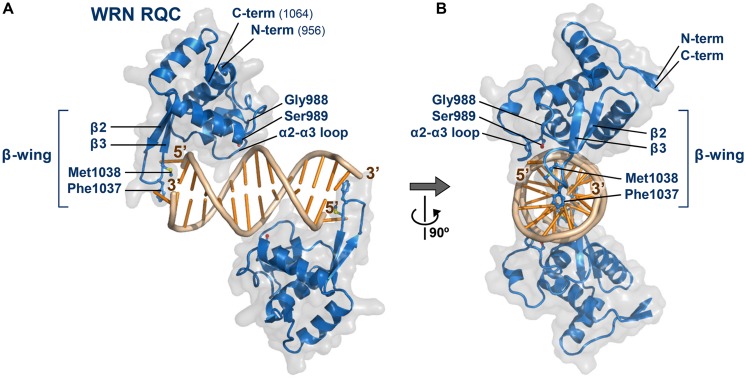
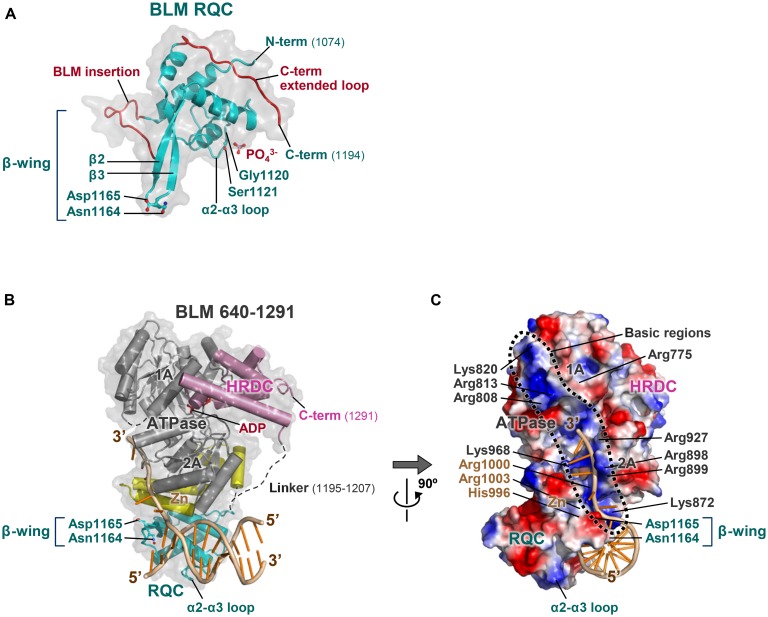
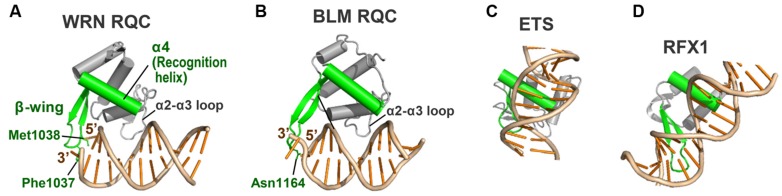
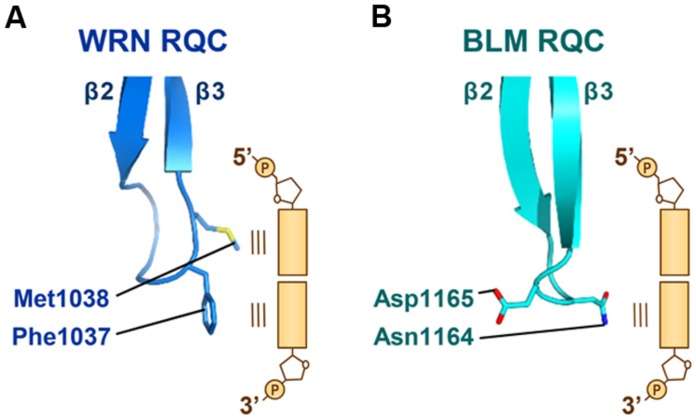
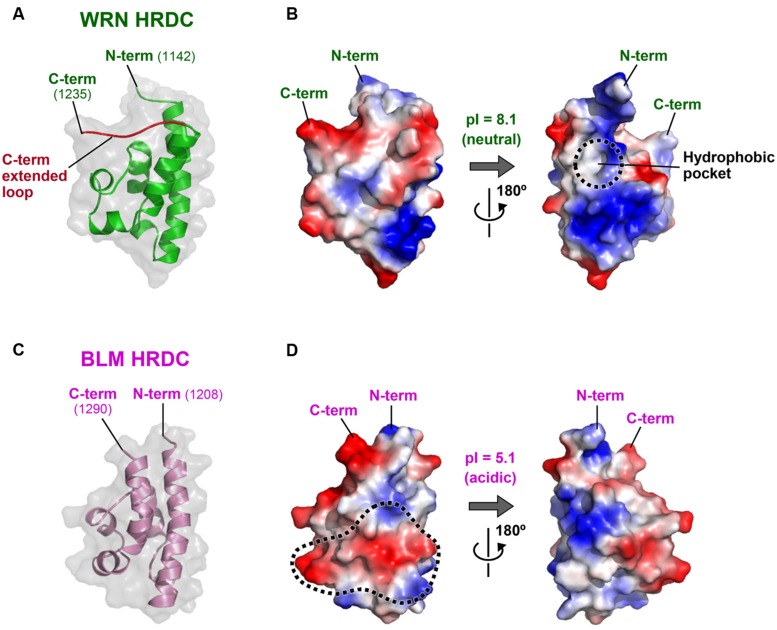
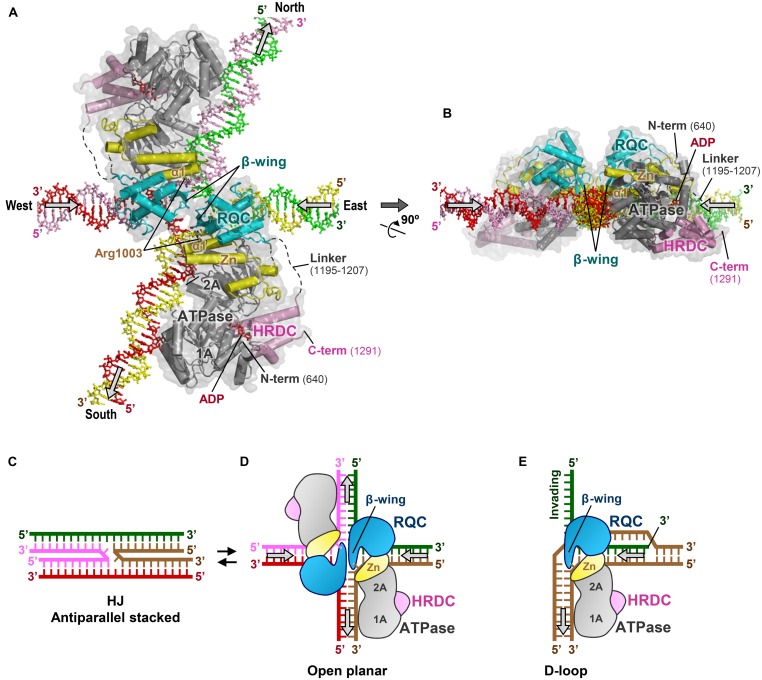
The RecQ family DNA helicases Werner syndrome protein (WRN) and Bloom syndrome protein (BLM) play a key role in protecting the genome against deleterious changes. In humans, mutations in these proteins lead to rare genetic diseases associated with cancer predisposition and accelerated aging. WRN and BLM are distinguished from other helicases by possessing signature tandem domains toward the C terminus, referred to as the RecQ C-terminal (RQC) and helicase-and-ribonuclease D-C-terminal (HRDC) domains. Although the precise function of the HRDC domain remains unclear, the previous crystal structure of a WRN RQC-DNA complex visualized a central role for the RQC domain in recognizing, binding and unwinding DNA at branch points. In particular, a prominent hairpin structure (the β-wing) within the RQC winged-helix motif acts as a scalpel to induce the unpairing of a Watson-Crick base pair at the DNA duplex terminus. A similar RQC-DNA interaction was also observed in the recent crystal structure of a BLM-DNA complex. I review the latest structures of WRN and BLM, and then provide a docking simulation of BLM with a Holliday junction. The model offers an explanation for the efficient branch migration activity of the RecQ family toward recombination and repair intermediates.
RecQ家族DNA解旋酶沃纳综合征蛋白(WRN)和布卢姆综合征蛋白(BLM)在保护基因组免受有害变化方面发挥着关键作用。在人类中,这些蛋白的突变会导致与癌症易感性和加速衰老相关的罕见遗传病。WRN和BLM与其他解旋酶的区别在于其C末端具有标志性的串联结构域,即RecQ C末端(RQC)结构域和螺旋酶及核糖核酸酶D C末端(HRDC)结构域。尽管HRDC结构域的确切功能仍不清楚,但之前WRN RQC-DNA复合物的晶体结构显示,RQC结构域在识别、结合和解开分支点处的DNA方面发挥着核心作用。特别是,RQC翼状螺旋基序内一个突出的发夹结构(β-翼)起到手术刀的作用,诱导DNA双链末端的沃森-克里克碱基对解链。在最近的BLM-DNA复合物晶体结构中也观察到了类似的RQC-DNA相互作用。我将综述WRN和BLM的最新结构,然后提供BLM与霍利迪连接体的对接模拟。该模型为RecQ家族对重组和修复中间体的高效分支迁移活性提供了解释。