Wheeler David C, London Gerard M, Parfrey Patrick S, Block Geoffrey A, Correa-Rotter Ricardo, Dehmel Bastian, Drüeke Tilman B, Floege Jürgen, Kubo Yumi, Mahaffey Kenneth W, Goodman William G, Moe Sharon M, Trotman Marie-Louise, Abdalla Safa, Chertow Glenn M, Herzog Charles A
University College London, London, UK (D.C.W.).
Hôpital Manhès, Paris, France (G.M.L.).
J Am Heart Assoc. 2014 Nov 17;3(6):e001363. doi: 10.1161/JAHA.114.001363.
Premature cardiovascular disease limits the duration and quality of life on long-term hemodialysis. The objective of this study was to define the frequency of fatal and nonfatal cardiovascular events attributable to atherosclerotic and nonatherosclerotic mechanisms, risk factors for these events, and the effects of cinacalcet, using adjudicated data collected during the EValuation of Cinacalcet HCl Therapy to Lower CardioVascular Events (EVOLVE) Trial.
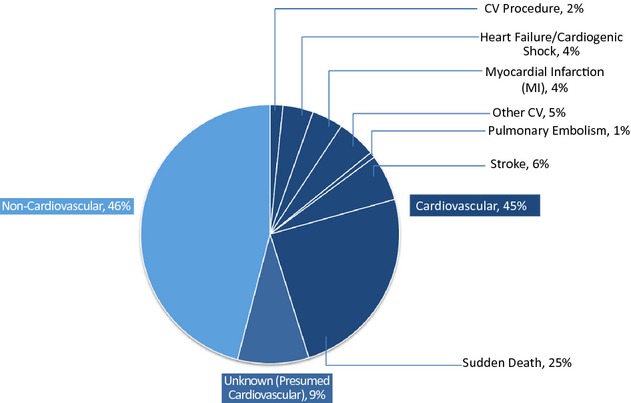
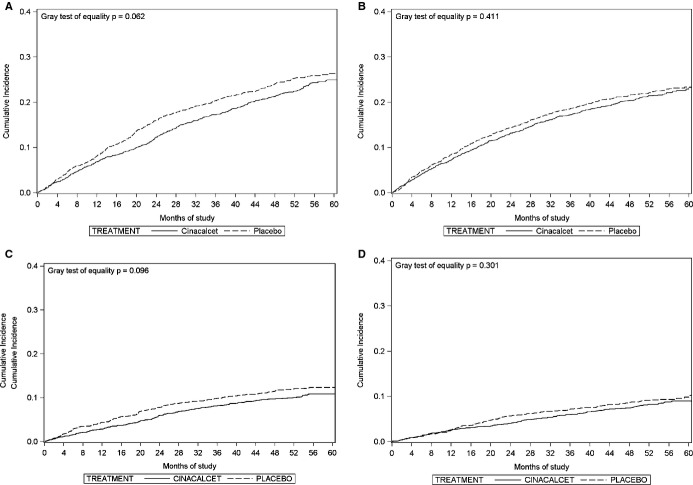
EVOLVE was a randomized, double-blind, placebo-controlled clinical trial that randomized 3883 hemodialysis patients with moderate to severe secondary hyperparathyroidism to cinacalcet or matched placebo for up to 64 months. For this post hoc analysis, the outcome measure was fatal and nonfatal cardiovascular events reflecting atherosclerotic and nonatherosclerotic cardiovascular diseases. During the trial, 1518 patients experienced an adjudicated cardiovascular event, including 958 attributable to nonatherosclerotic disease. Of 1421 deaths during the trial, 768 (54%) were due to cardiovascular disease. Sudden death was the most frequent fatal cardiovascular event, accounting for 24.5% of overall mortality. Combining fatal and nonfatal cardiovascular events, randomization to cinacalcet reduced the rates of sudden death and heart failure. Patients randomized to cinacalcet experienced fewer nonatherosclerotic cardiovascular events (adjusted relative hazard 0.84, 95% CI 0.74 to 0.96), while the effect of cinacalcet on atherosclerotic events did not reach statistical significance.
Accepting the limitations of post hoc analysis, any benefits of cinacalcet on cardiovascular disease in the context of hemodialysis may result from attenuation of nonatherosclerotic processes.
Unique identifier: NCT00345839. URL: ClinicalTrials.gov.
心血管疾病过早发作限制了长期血液透析患者的生存时长及生活质量。本研究的目的是利用盐酸西那卡塞治疗降低心血管事件(EVOLVE)试验期间收集的判定数据,确定归因于动脉粥样硬化和非动脉粥样硬化机制的致命和非致命心血管事件的发生率、这些事件的危险因素以及西那卡塞的疗效。
EVOLVE是一项随机、双盲、安慰剂对照的临床试验,将3883例患有中度至重度继发性甲状旁腺功能亢进的血液透析患者随机分为西那卡塞组或匹配的安慰剂组,治疗长达64个月。对于这项事后分析,结局指标是反映动脉粥样硬化和非动脉粥样硬化性心血管疾病的致命和非致命心血管事件。在试验期间,1518例患者发生了经判定的心血管事件,其中958例归因于非动脉粥样硬化性疾病。在试验期间的1421例死亡病例中,768例(54%)死于心血管疾病。心源性猝死是最常见的致命心血管事件,占总死亡率的24.5%。综合致命和非致命心血管事件来看,随机分组至西那卡塞组可降低心源性猝死和心力衰竭的发生率。随机分组至西那卡塞组的患者发生非动脉粥样硬化性心血管事件较少(校正相对风险0.84,95%可信区间0.74至0.96),而西那卡塞对动脉粥样硬化性事件的影响未达到统计学显著性。
考虑到事后分析的局限性,西那卡塞在血液透析背景下对心血管疾病的任何益处可能源于非动脉粥样硬化过程的减轻。
唯一标识符:NCT00345839。网址:ClinicalTrials.gov。