Lebreton Sébastien, Grabe Veit, Omondi Aman B, Ignell Rickard, Becher Paul G, Hansson Bill S, Sachse Silke, Witzgall Peter
1] Swedish University of Agricultural Sciences, Department of Plant Protection Biology, Chemical Ecology Unit, 230 53 Alnarp, Sweden [2] Department of Evolutionary Neuroethology, Max Planck Institute for Chemical Ecology, 07745 Jena, Germany.
Department of Evolutionary Neuroethology, Max Planck Institute for Chemical Ecology, 07745 Jena, Germany.
Sci Rep. 2014 Nov 19;4:7119. doi: 10.1038/srep07119.
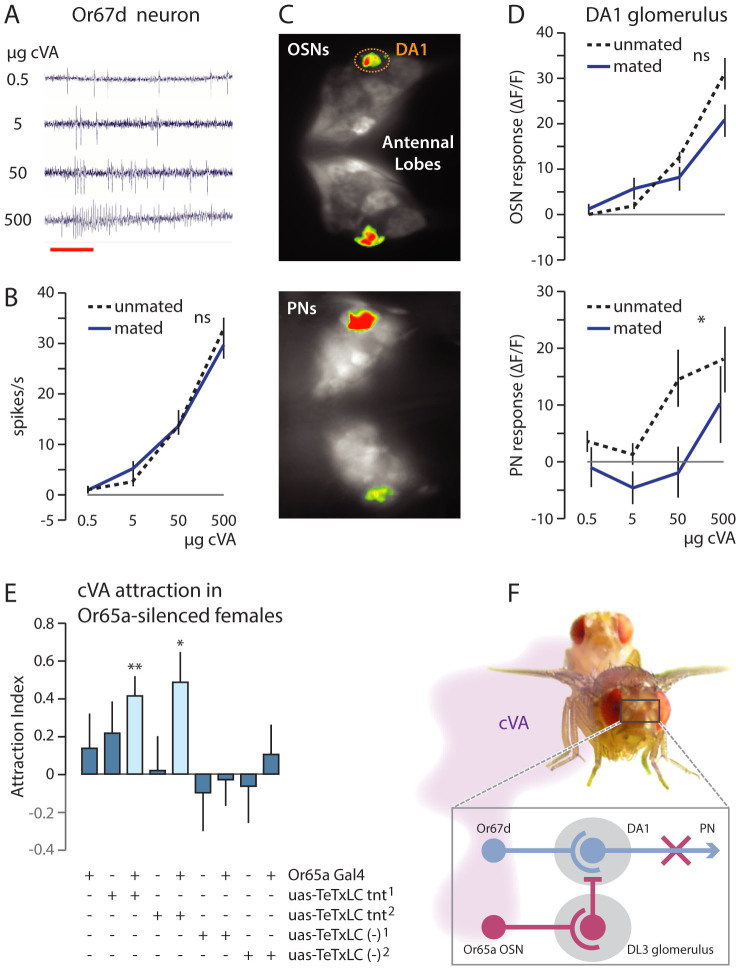
In Drosophila, the male sex pheromone cis-vaccenyl acetate (cVA) elicits aggregation and courtship, through the odorant receptor Or67d. Long-lasting exposure to cVA suppresses male courtship, via a second channel, Or65a. In females, the role of Or65a has not been studied. We show that, shortly after mating, Drosophila females are no longer attracted to cVA and that activation of olfactory sensory neurons (OSNs) expressing Or65a generates this behavioral switch: when silencing Or65a, mated females remain responsive to cVA. Neurons expressing Or67d converge into the DA1 glomerulus in the antennal lobe, where they synapse onto projection neurons (PNs), that connect to higher neural circuits generating the attraction response to cVA. Functional imaging of these PNs shows that the DA1 glomerulus is inhibited by simultaneous activation of Or65a OSNs, which leads to a suppression of the attraction response to cVA. The behavioral role of postmating cVA exposure is substantiated by the observation that matings with starved males, which produce less cVA, do not alter the female response. Moreover, exposure to synthetic cVA abolishes attraction and decreases sexual receptivity in unmated females. Taken together, Or65a mediates an aversive effect of cVA and may accordingly regulate remating, through concurrent behavioral modulation in males and females.
在果蝇中,雄性性信息素顺式乙酸vaccenyl酯(cVA)通过气味受体Or67d引发聚集和求偶行为。长期暴露于cVA会通过另一个通道Or65a抑制雄性求偶行为。在雌性果蝇中,Or65a的作用尚未得到研究。我们发现,交配后不久,果蝇雌性不再被cVA吸引,并且表达Or65a的嗅觉感觉神经元(OSN)的激活会产生这种行为转变:当沉默Or65a时,已交配的雌性对cVA仍保持反应。表达Or67d的神经元汇聚到触角叶中的DA1神经小球,在那里它们与投射神经元(PN)形成突触,这些投射神经元连接到产生对cVA吸引反应的更高神经回路。对这些PN的功能成像显示,DA1神经小球会被Or65a OSN的同时激活所抑制,这导致对cVA的吸引反应受到抑制。与饥饿雄性果蝇交配(产生较少的cVA)不会改变雌性反应这一观察结果,证实了交配后暴露于cVA的行为作用。此外,暴露于合成cVA会消除未交配雌性的吸引力并降低其性接受能力。综上所述,Or65a介导了cVA的厌恶效应,并可能因此通过对雄性和雌性的并发行为调节来调控再次交配。