Stancu Ilie-Cosmin, Vasconcelos Bruno, Terwel Dick, Dewachter Ilse
Catholic University of Louvain, Institute of Neuroscience, Alzheimer Dementia, Av, E, Mounier 53, Av, Hippocrate 54, B-1200 Brussels, Belgium.
Mol Neurodegener. 2014 Nov 18;9:51. doi: 10.1186/1750-1326-9-51.
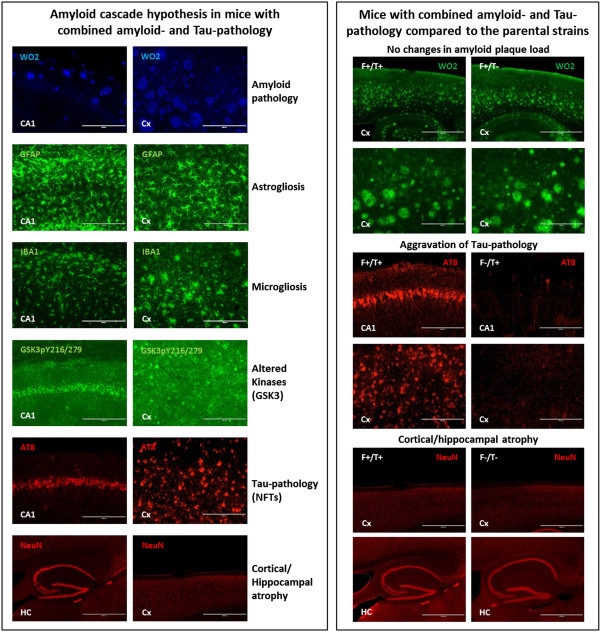
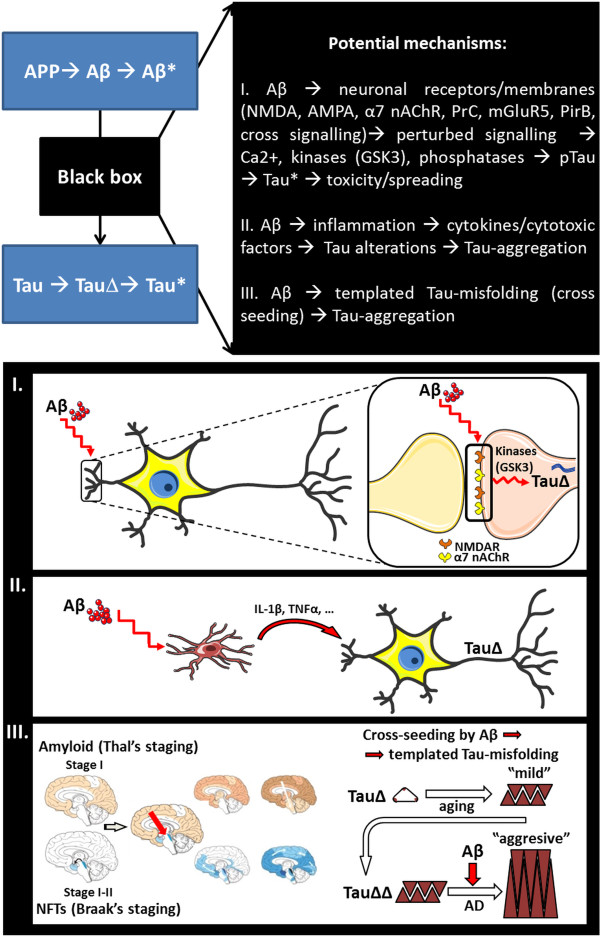
The amyloid cascade hypothesis has been the prevailing hypothesis in Alzheimer's Disease research, although the final and most wanted proof i.e. fully successful anti-amyloid clinical trials in patients, is still lacking. This may require a better in depth understanding of the cascade. Particularly, the exact toxic forms of Aβ and Tau, the molecular link between them and their respective contributions to the disease process need to be identified in detail. Although the lack of final proof has raised substantial criticism on the hypothesis per se, accumulating experimental evidence in in vitro models, in vivo models and from biomarkers analysis in patients supports the amyloid cascade and particularly Aβ-induced Tau-pathology, which is the focus of this review. We here discuss available models that recapitulate Aβ-induced Tau-pathology and review some potential underlying mechanisms. The availability and diversity of these models that mimic the amyloid cascade partially or more complete, provide tools to study remaining questions, which are crucial for development of therapeutic strategies for Alzheimer's Disease.
淀粉样蛋白级联假说一直是阿尔茨海默病研究中的主流假说,尽管仍缺乏最终也是最令人期待的证据,即在患者中进行的完全成功的抗淀粉样蛋白临床试验。这可能需要对该级联有更深入的了解。特别是,需要详细确定Aβ和Tau的确切毒性形式、它们之间的分子联系以及它们对疾病进程的各自贡献。尽管缺乏最终证据引发了对该假说本身的大量批评,但体外模型、体内模型以及患者生物标志物分析中积累的实验证据支持淀粉样蛋白级联假说,尤其是Aβ诱导的Tau病理学,这是本综述的重点。我们在此讨论重现Aβ诱导的Tau病理学的现有模型,并回顾一些潜在的潜在机制。这些部分或更完整地模拟淀粉样蛋白级联的模型的可用性和多样性,为研究剩余问题提供了工具,这些问题对于阿尔茨海默病治疗策略的开发至关重要。