Rondi-Reig Laure, Paradis Anne-Lise, Lefort Julie M, Babayan Benedicte M, Tobin Christine
Sorbonne Universités, UPMC Univ Paris 06, UMR-S 8246/UM 119, Neuroscience Paris Seine, Cerebellum, Navigation and Memory Team Paris, France ; Institut National de la Santé et de la Recherche Médicale 1130, Neuroscience Paris Seine, Cerebellum, Navigation and Memory Team Paris, France ; Centre National de la Recherche Scientifique, UMR 8246, Neuroscience Paris Seine, Cerebellum, Navigation and Memory Team Paris, France.
Front Syst Neurosci. 2014 Nov 4;8:205. doi: 10.3389/fnsys.2014.00205. eCollection 2014.
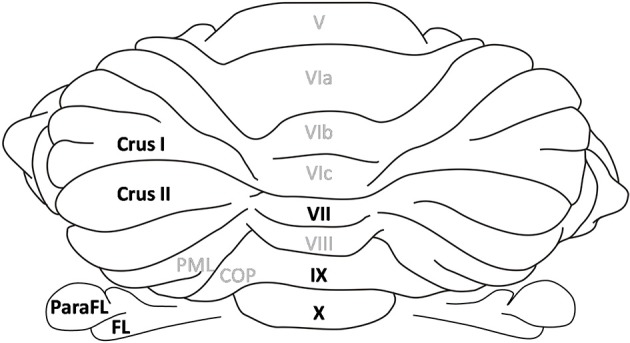
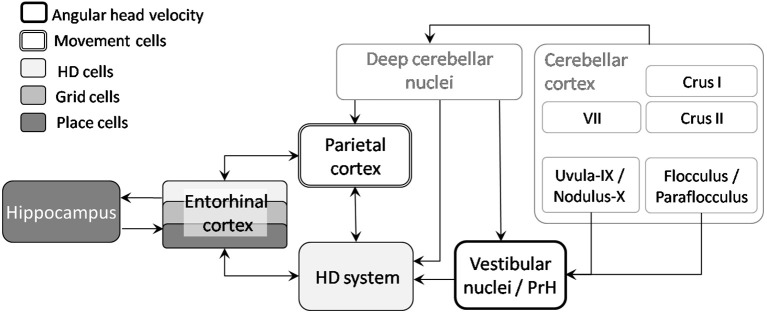
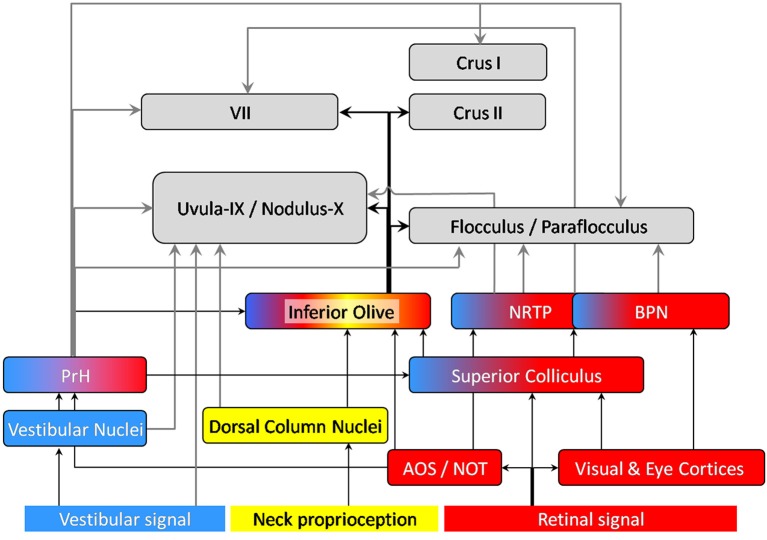
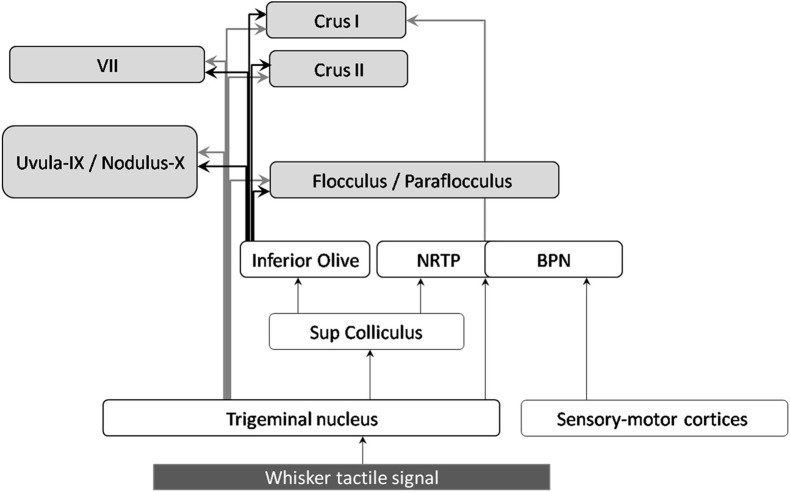
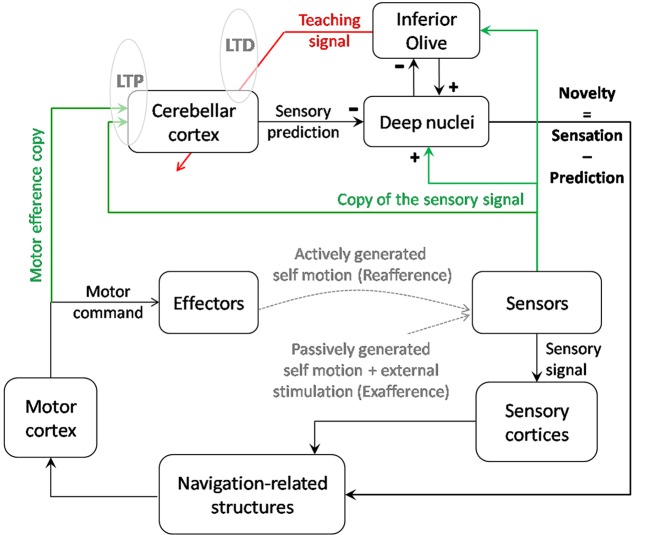
The cerebellum has already been shown to participate in the navigation function. We propose here that this structure is involved in maintaining a sense of direction and location during self-motion by monitoring sensory information and interacting with navigation circuits to update the mental representation of space. To better understand the processing performed by the cerebellum in the navigation function, we have reviewed: the anatomical pathways that convey self-motion information to the cerebellum; the computational algorithm(s) thought to be performed by the cerebellum from these multi-source inputs; the cerebellar outputs directed toward navigation circuits and the influence of self-motion information on space-modulated cells receiving cerebellar outputs. This review highlights that the cerebellum is adequately wired to combine the diversity of sensory signals to be monitored during self-motion and fuel the navigation circuits. The direct anatomical projections of the cerebellum toward the head-direction cell system and the parietal cortex make those structures possible relays of the cerebellum influence on the hippocampal spatial map. We describe computational models of the cerebellar function showing that the cerebellum can filter out the components of the sensory signals that are predictable, and provides a novelty output. We finally speculate that this novelty output is taken into account by the navigation structures, which implement an update over time of position and stabilize perception during navigation.
小脑已被证明参与导航功能。我们在此提出,该结构通过监测感觉信息并与导航回路相互作用以更新空间心理表征,从而在自我运动过程中参与维持方向感和位置感。为了更好地理解小脑在导航功能中所执行的处理过程,我们回顾了:将自我运动信息传递至小脑的解剖学通路;据认为小脑从这些多源输入中执行的计算算法;指向导航回路的小脑输出以及自我运动信息对接收小脑输出的空间调制细胞的影响。本综述强调,小脑具有适当的布线,可整合自我运动过程中要监测的各种感觉信号,并为导航回路提供支持。小脑向头部方向细胞系统和顶叶皮质的直接解剖投射使这些结构成为小脑对海马空间图谱产生影响的可能中继站。我们描述了小脑功能的计算模型,表明小脑可以滤除感觉信号中可预测的成分,并提供新颖性输出。我们最后推测,这种新颖性输出被导航结构所考虑,导航结构在导航过程中实现位置随时间的更新并稳定感知。