Melka Melkaye G, Castellani Christina A, Laufer Benjamin I, Rajakumar Raj N, O'Reilly Richard, Singh Shiva M
Department of Biology, Molecular Genetics Unit, Western Science Centre, The University of Western Ontario, London, Ontario N6A 5B7 Canada.
Department of Psychiatry, The University of Western Ontario, London, Ontario N6A 5B7 Canada.
J Mol Psychiatry. 2013 Nov 4;1(1):19. doi: 10.1186/2049-9256-1-19. eCollection 2013.
The dopamine (DA) hypothesis of schizophrenia proposes the mental illness is caused by excessive transmission of dopamine in selected brain regions. Multiple lines of evidence, including blockage of dopamine receptors by antipsychotic drugs that are used to treat schizophrenia, support the hypothesis. However, the dopamine D2 receptor (DRD2) blockade cannot explain some important aspects of the therapeutic effect of antipsychotic drugs. In this study, we hypothesized that antipsychotic drugs could affect the transcription of genes in the DA pathway by altering their epigenetic profile.
To test this hypothesis, we examined the effect of olanzapine, a commonly used atypical antipsychotic drug, on the DNA methylation status of genes from DA neurotransmission in the brain and liver of rats. Genomic DNA isolated from hippocampus, cerebellum, and liver of olanzapine treated (n = 2) and control (n = 2) rats were analyzed using rat specific methylation arrays.
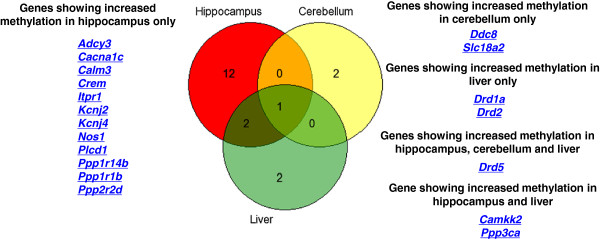
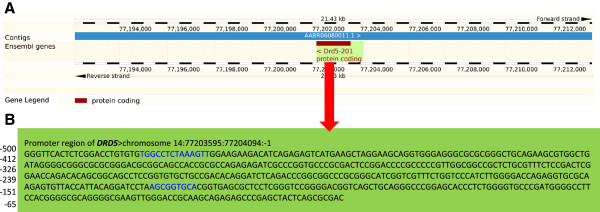
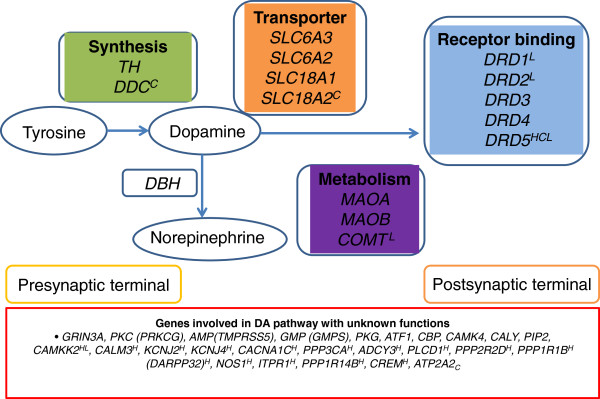
Our results show that olanzapine causes methylation changes in genes encoding for DA receptors (dopamine D1 receptor, dopamine D2 receptor and dopamine D5 receptor), a DA transporter (solute carrier family 18 member 2), a DA synthesis (differential display clone 8), and a DA metabolism (catechol-O-methyltransferase). We assessed a total of 40 genes in the DA pathway and found 19 to be differentially methylated between olanzapine treated and control rats. Most (17/19) genes showed an increase in methylation, in their promoter regions with in silico analysis strongly indicating a functional potential to suppress transcription in the brain.
Our results suggest that chronic olanzapine may reduce DA activity by altering gene methylation. It may also explain the delayed therapeutic effect of antipsychotics, which occurs despite rapid dopamine blockade. Furthermore, given the common nature of epigenetic variation, this lends insight into the differential therapeutic response of psychotic patients who display adequate blockage of dopamine receptors.
精神分裂症的多巴胺(DA)假说提出,这种精神疾病是由特定脑区多巴胺传递过多所致。包括用于治疗精神分裂症的抗精神病药物阻断多巴胺受体在内的多条证据支持这一假说。然而,多巴胺D2受体(DRD2)阻断无法解释抗精神病药物治疗效果的一些重要方面。在本研究中,我们假设抗精神病药物可通过改变其表观遗传特征来影响DA通路中基因的转录。
为验证这一假设,我们研究了常用的非典型抗精神病药物奥氮平对大鼠脑和肝中DA神经传递相关基因DNA甲基化状态的影响。使用大鼠特异性甲基化芯片分析从奥氮平处理组(n = 2)和对照组(n = 2)大鼠的海马、小脑和肝脏中分离的基因组DNA。
我们的结果表明,奥氮平会导致DA受体(多巴胺D1受体、多巴胺D2受体和多巴胺D5受体)、DA转运体(溶质载体家族18成员2)、DA合成(差异显示克隆8)和DA代谢(儿茶酚-O-甲基转移酶)编码基因的甲基化变化。我们总共评估了DA通路中的40个基因,发现奥氮平处理组和对照组大鼠之间有19个基因存在差异甲基化。大多数(17/19)基因在其启动子区域甲基化增加,计算机分析强烈表明其具有抑制脑中基因转录的功能潜力。
我们的结果表明,长期使用奥氮平可能通过改变基因甲基化来降低DA活性。这也可能解释了抗精神病药物的延迟治疗效果,尽管多巴胺能快速被阻断,但这种效果仍会出现。此外,鉴于表观遗传变异的普遍性,这有助于深入了解多巴胺受体被充分阻断的精神病患者的不同治疗反应。